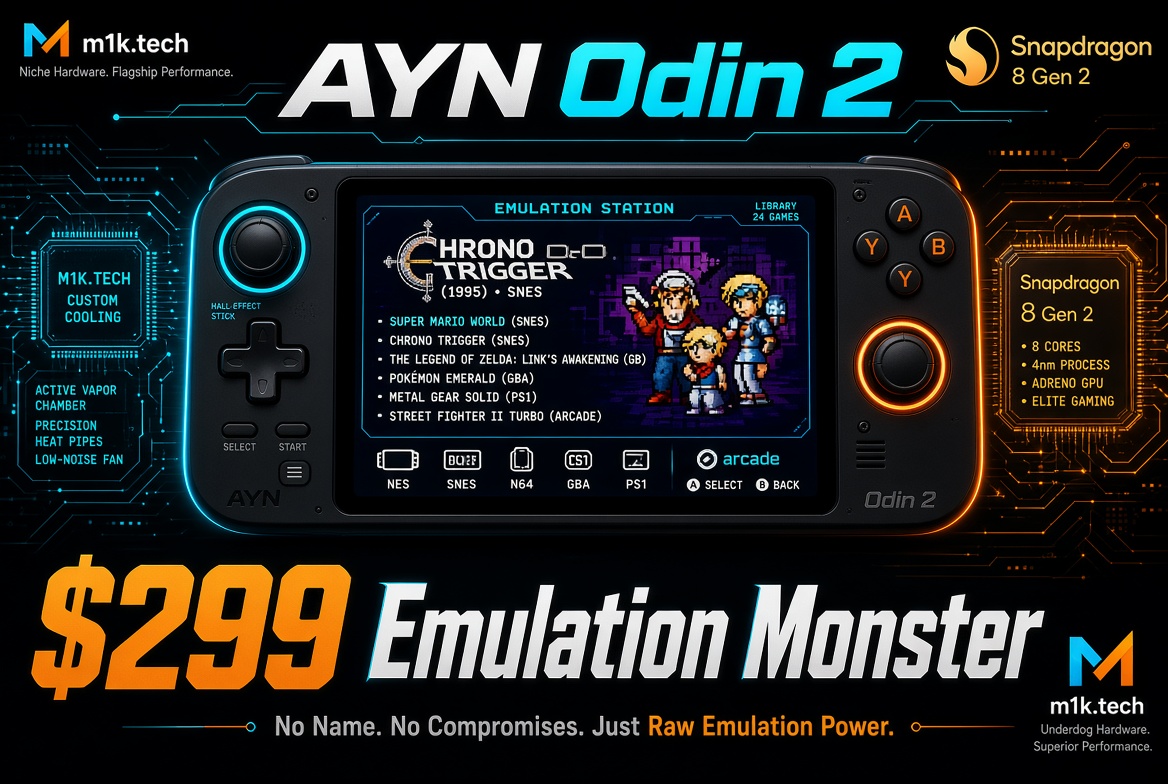
Two hundred ninety-nine dollars gets you a Snapdragon 8 Gen 2, the same flagship silicon inside a Galaxy S23 Ultra, bolted into a handheld with an 8000mAh battery and hall-effect sticks, sold direct by a company called AYN that most people reading this have never heard of. That is the entire story, and it is a little embarrassing for everyone else. Razer put Qualcomm’s dedicated gaming chip in the Edge and charged $400. AYN put a more powerful phone chip in the Odin 2 and started it a hundred dollars cheaper.
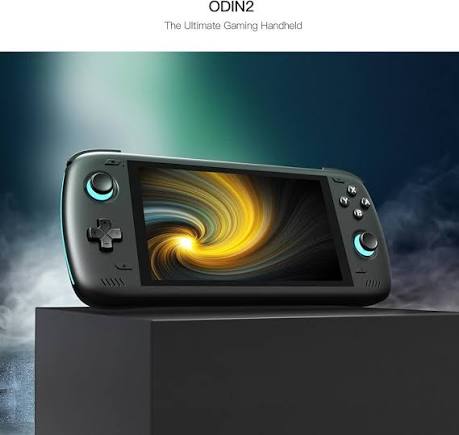
AYN is a small outfit that shipped the first Odin in 2021 on a Snapdragon 845, and it sells the way these boutique handhelds all sell: through Indiegogo campaigns and AliExpress rather than on shelves at Best Buy. The Odin 2 is aimed at a crowd Logitech and Razer were barely talking to, the emulation people, the ones who want to run PS2, GameCube, PSP, and increasingly Switch libraries at high resolution on something that fits in a bag. On that specific job the 8 Gen 2 is wildly overqualified. It chews through emulators that make lesser chips sweat, and the battery lets you do it for most of a day.
| Category | Snapdragon G3x Gen 1 (2021/2022) | Snapdragon 8 Gen 2 (2022) | Winner & Notes |
|---|---|---|---|
| Process Node | 4nm Samsung | 4nm TSMC | 8 Gen 2 (better node efficiency) |
| CPU | Octa-core Kryo (Cortex-A78/A55 based, 8 Gen 1 level) | 1× Cortex-X3 @ 3.2 GHz + 2× A715 + 2× A710 + 3× A510 | 8 Gen 2 (much stronger cores & configuration) |
| GPU | High-performance Adreno (730-level) | Adreno 740 (significant leap) | 8 Gen 2 (better raw power & features) |
| Memory | LPDDR5 | LPDDR5X (faster) | 8 Gen 2 |
| ISP | Advanced Spectra | Spectra (next-gen, better computational photography) | 8 Gen 2 |
| AI / NPU | Strong Hexagon | Much stronger Hexagon AI Engine | 8 Gen 2 |
| Modem | X65-level 5G (Sub-6 + mmWave) | X70 5G (improved efficiency & speed) | 8 Gen 2 |
| Connectivity | Wi-Fi 6E, Bluetooth 5.2+ | Wi-Fi 7, Bluetooth 5.3+ | 8 Gen 2 |
| Gaming Features | Elite Gaming optimized for handhelds | Elite Gaming with ray tracing & upscaling | 8 Gen 2 (more advanced) |
| Sustained Performance | Excellent in handhelds (better cooling) | Very good (phone thermal limits) | G3x Gen 1 (handheld advantage) |
| Target Devices | Gaming handhelds (e.g., Razer Edge) | Flagship smartphones | Segment-specific |
| AnTuTu (approx) | ~700,000–900,000+ | ~1,300,000–1,500,000+ | 8 Gen 2 (significantly higher) |
What I appreciate here is the refusal to play the mainstream game at all. AYN skipped the cloud pitch and the carrier deal entirely and went straight for the enthusiast who knows exactly what a Vulkan driver is and will happily wait six weeks for a package from Shenzhen to save money and get more power. That is a narrower market than the one Razer and Logitech are chasing, but it is a real one, and AYN is serving it better than the big names are serving theirs.
The catches are the ones that come with buying directly from a small company on the other side of the world. Shipping windows slip, and the support story is a Discord server rather than a warranty counter. The panel is a 1080p LCD rather than the AMOLED Razer will happily sell you. None of that scares the target buyer, who has done this dance before with a dozen other Chinese handhelds. It might scare everyone else, which is rather the point.
I did not expect the most interesting handheld of this stretch to come from a company without a marketing budget, but here we are. The Odin 2 makes the big-brand devices look like they are solving for the wrong customer. I am leaving the legal fog around emulation itself out of this, because it is a thorny topic that deserves more than a paragraph. What I will say is that AYN understood something Logitech and Razer did not: the people who most want a dedicated gaming handheld already know exactly what they want, and it is not a thin client for Game Pass.