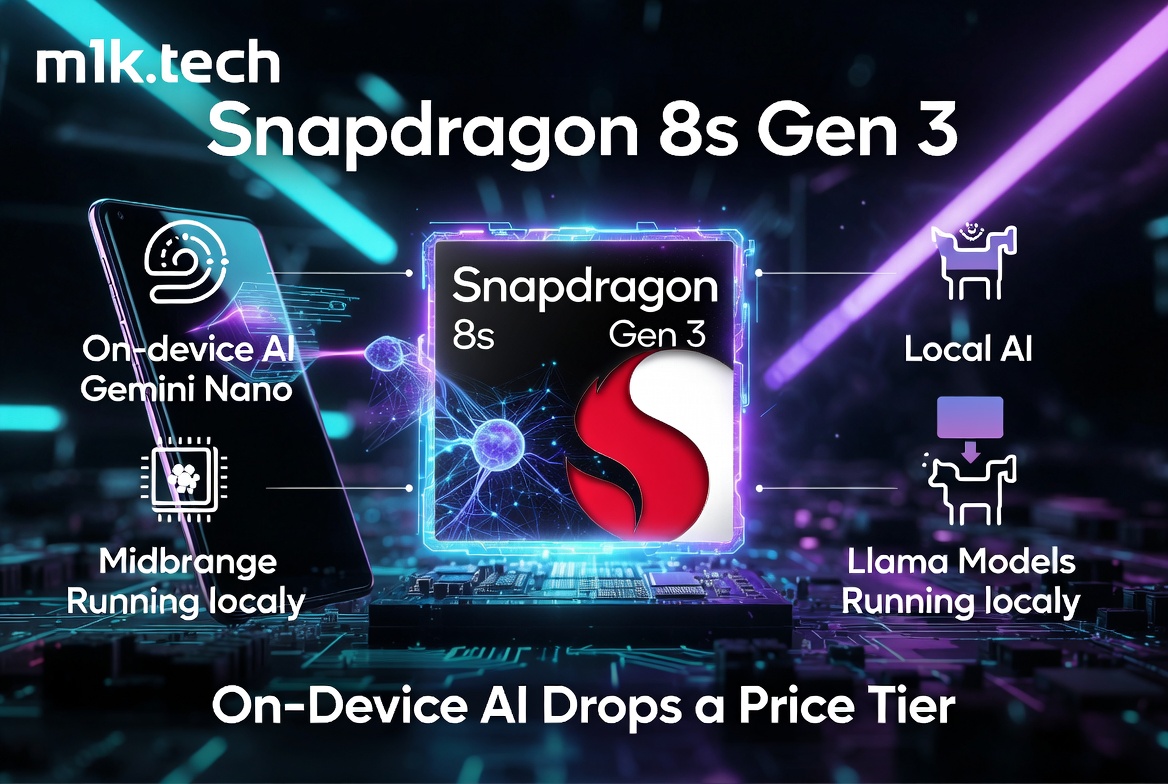
Today Qualcomm dropped the Snapdragon 8s Gen 3, and the headline that matters isn’t on the spec sheet. This is a chip built for phones that cost half what a Galaxy S24 Ultra does, and those phones will still run Google’s Gemini Nano and a 7-billion-parameter Llama model without ever touching a server. That single fact is the whole story here, and I’d bet most of the coverage this week buries it under gaming benchmarks.
The flagship got the spotlight last October, and on paper it earned some of it. The 8 Gen 3 shipped on TSMC’s N4P process with a Cortex-X4 prime core at 3.3 GHz over a 1+3+2+2 Kryo cluster, 12 MB of L3, and the Adreno 750, which landed about 25% faster than the 740 with a real ray-tracing jump and global illumination that showed up in the three or four games that actually supported it. It ran roughly thirty percent more CPU and twenty percent better efficiency than the Gen 2, clean generational math that didn’t make me sit up.
What made me sit up was the Hexagon NPU. Qualcomm claimed it ran 98% faster than the 8 Gen 2’s, and the demo that stuck with me wasn’t a TOPS slide, it was a 7-billion-parameter Llama 2 generating text at roughly 20 tokens a second entirely on the phone, weights streaming out of LPDDR5X. Twenty tokens a second isn’t fast in any absolute sense. It’s faster than you read, though, and that turns out to be the only threshold that matters when you’re watching a reply fill in on a screen in your hand. That was the moment on-device AI stopped being a slide and started being real, back at the Snapdragon Summit last fall.
The 8s Gen 3 is where it gets interesting, because this is the part that actually moves the needle. It isn’t a downclocked flagship, and it isn’t a rebadged 7-series either, which is what a lot of us expected. It’s its own part: one Cortex-X4 at 3.0 GHz, four A720 cores at 2.8, three A520s at 2.0, a 1+4+3 layout that doesn’t match the flagship’s at all. The GPU drops to the Adreno 735, it loses global illumination, and the modem is the older X70 pulled up from the 8 Gen 2 generation, though Wi-Fi 7 survives. On a spec sheet it reads like a compromise, and in raw gaming it is one.
But Qualcomm kept the piece that counts. The 8s Gen 3 carries the flagship’s entire on-device generative-AI stack, the AI Hub included, and runs Baichuan-7B, Llama 2, and Gemini Nano locally. That’s the whole point of the thing. The flagship proved a phone could hold a language model in memory and talk back; the 8s Gen 3 is what makes that capability cheap enough to put in phones that undercut a Galaxy flagship by half. Honor, iQOO, Realme, Redmi, and Xiaomi are all lined up already, and Qualcomm says the first device lands before the end of the month. This is on-device AI moving from a flagship party trick toward a baseline expectation for anything above the true budget tier, and I don’t think that shift is getting the credit it deserves today.
The competition tells you why it works. Apple’s A17 Pro, over on a 3nm node, beats the 8 Gen 3 on raw single-core and GPU by a comfortable margin, and it isn’t close on peak silicon. What Apple doesn’t have right now is any real on-device LLM story; the Neural Engine is strong at the camera-and-Siri workloads it’s tuned for, but Apple isn’t handing developers a way to run a 7B model on the phone. MediaTek’s Dimensity 9300 is the genuine Android rival on the flagship end, and a good one, but Qualcomm has the thing MediaTek can’t match this spring: an ‘s’ part that pushes the same generative-AI capability down a full price tier while MediaTek is still fighting for the top. Fragmentation, the thing everyone treats as Android’s curse, is Qualcomm’s weapon here.
I’m not going to relitigate the sustained-performance question in this post, because the 8 Gen 3’s thermal throttling under long loads is its own can of worms and deserves its own teardown. What I’ll say is that the AI workloads people will actually run on these chips are bursty, not sustained, so the throttling that hammers gaming benchmarks should matter a lot less for the use case that looks like it will define this generation.
So the industry spends its keynote selling hero silicon, and the part that quietly rewires what a cheap phone can do ships the same season without a poster. If the 8s Gen 3 delivers what Qualcomm demoed today, the phones carrying it this spring will be the first time a local language model on mid-priced hardware feels ordinary instead of like a stunt. That’s the thing I’ll be watching for when the first units land this month, and I suspect it will end up mattering more than anything on the flagship’s benchmark chart.