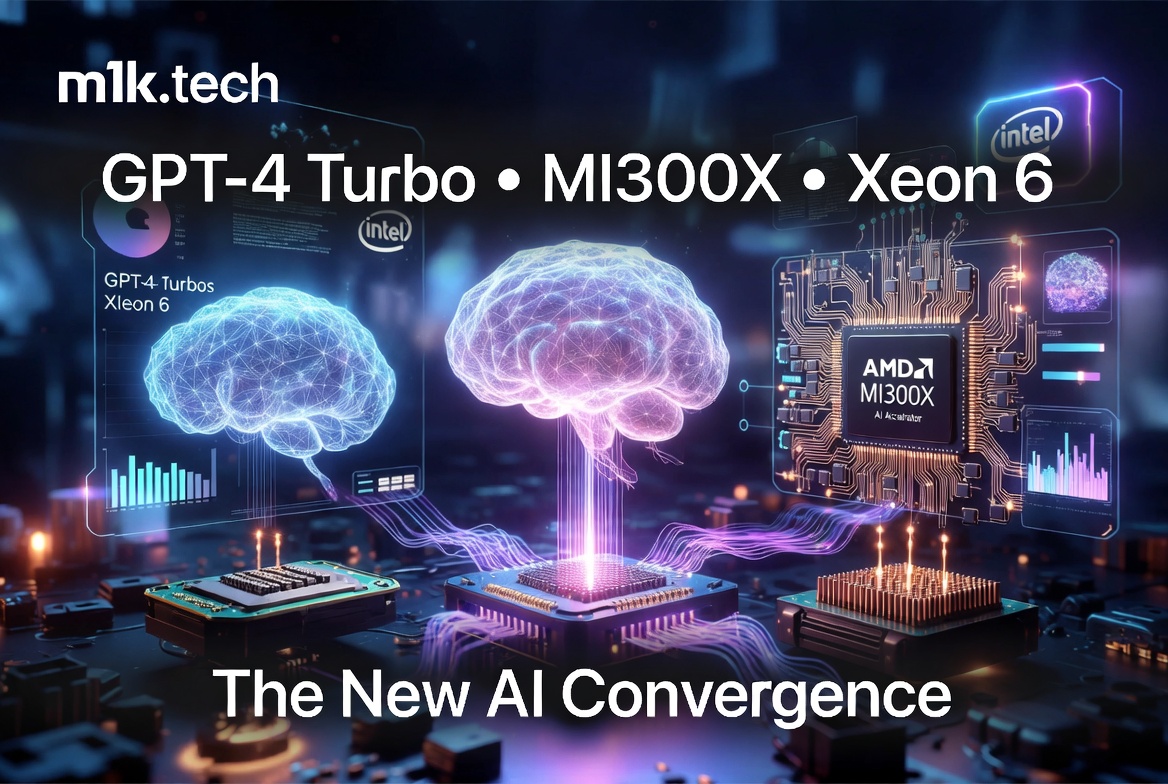
Three hardware announcements landed this week that, taken together, tell you exactly where the AI compute stack is heading. OpenAI shipped GPT-4 Turbo with measurably better reasoning. AMD dropped the MI300X with memory bandwidth that embarrasses everything Nvidia ships at the same price point. And Intel launched Xeon 6 to prove the CPU still matters in an AI world that is increasingly GPU-obsessed. None of these is a revolution on its own. Together, they are a roadmap.
GPT-4 Turbo: reasoning as a product feature
The GPT-4 Turbo update is less about raw capability and more about reliability. Multi-step reasoning tasks and code generation accuracy both improved measurably, according to The Verge. That sounds incremental until you realize what it means in practice: engineers can trust the output enough to ship it without a second verification pass. OpenAI is not selling a smarter chatbot. It is selling reduced human review time, which is the metric that actually drives enterprise adoption.
From my FDI seat, this kind of refinement matters more than flashy launches for global enterprise markets. European companies evaluating AI tools for production workflows prioritize predictability over benchmarks. A model that is right 95% of the time is interesting. A model that is right 98% of the time is deployable. That gap is where GPT-4 Turbo is trying to land.
AMD MI300X: the memory bandwidth play
AMD’s MI300X is the chip that should worry Nvidia. It delivers 192 GB of HBM3 memory and 5.3 TB/s of memory bandwidth on a single accelerator. For AI inference workloads, where the bottleneck is often moving data to the compute cores rather than the compute itself, that bandwidth advantage is significant. AMD claims 40% better performance per watt than the previous generation, which matters enormously in data centers where power and cooling are the binding constraints.
The strategic context is direct: AMD is not trying to out-compute Nvidia on raw FLOPS. It targets the cost-per-inference metric, which determines which chip wins the cloud deployment. If the MI300X can run the same model at the same quality for less money per query, hyperscalers will buy it regardless of what Nvidia’s marketing says. The Cerebras WSE approach attacks inference from the architecture side. AMD attacks it from the memory side. Both are betting that Nvidia’s dominance has a cost floor that can be undercut.
Intel Xeon 6: the CPU still matters
Intel’s Xeon 6 targets the part of the AI stack that does not make headlines: orchestration, preprocessing, data movement, and control logic. Every GPU cluster needs CPUs to coordinate it, and Xeon 6’s enhanced vector processing and improved memory controllers are designed for exactly that role. Intel is not pretending it can compete with GPUs on training or inference. It is arguing, correctly, that the CPU is the glue that holds the AI data center together.
As hyperscalers build out 100-plus megawatt campuses across the Midwest, every rack needs CPUs alongside GPUs. The Xeon 6 line is Intel’s play to remain the default in that build-out, even as the GPU vendors grab all the attention.
The AI hardware stack is splitting into three layers that barely compete with each other: the model layer (OpenAI, Anthropic, Mistral), the accelerator layer (Nvidia, AMD, Cerebras), and the infrastructure layer (Intel, the hyperscalers, the data center builders). The interesting question is not which chip wins. It is whether the model companies vertically integrate into hardware, as xAI did with Colossus, or keep the hardware layer independent. That is the structural question that determines who captures the margin.