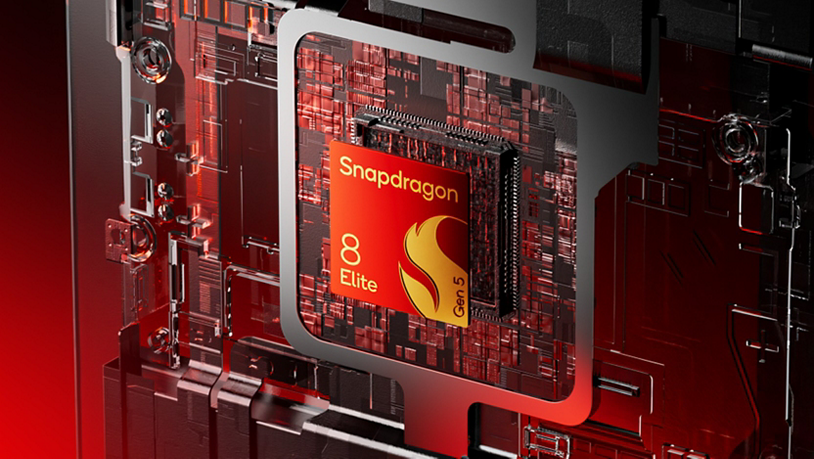
Qualcomm spent a big chunk of its Snapdragon Summit keynote talking about on-device AI agents and never once put a TOPS number on the screen for the phone chip. That omission is the most telling thing about the Snapdragon 8 Elite Gen 5, and I went back through the product brief twice to be sure I wasn’t missing it. I wasn’t. For years the NPU TOPS figure was the number Qualcomm led with. This generation it quietly disappeared, swapped out for a percentage.
So let me lay out what the silicon actually is, because the chip is a real piece of engineering, and then come back to why that missing number bugs me.
The 2+6 all-Oryon gamble
The CPU is where the story starts. The 8 Elite Gen 5 runs Qualcomm’s third-generation Oryon cores in a 2+6 layout: two Prime cores up to 4.6 GHz, with a 4.74 GHz binned version in some devices, and six Performance cores at 3.62 GHz. There are no small efficiency cores in the old big.LITTLE sense. The whole cluster is custom Oryon, the same lineage that powers Qualcomm’s laptop chips, shrunk onto TSMC’s 3nm N3P process. Qualcomm claims 20% more performance and 35% better CPU efficiency against last year’s Snapdragon 8 Elite, with the full SoC pulling 16% less power. Early Geekbench 6 runs landed around 3,800 single-core and 12,400 multi-core, which finally puts it in spitting distance of Apple’s A19 Pro on single-thread, the gap Qualcomm has been chasing for three generations.
The all-big approach is a bet, though. Two cores past 4.6 GHz with no efficiency cores underneath them is a serious thermal load, and some early teardown analysis pegs the sustained draw high enough to force hard throttling once the phone heats up. I’d treat the scarier numbers floating around as unverified until more retail units get tested, but the direction is real: whether your specific phone holds those clocks comes down entirely to the cooling the OEM bolted around the chip, which is the one thing no spec sheet will ever tell you.
The GPU nobody will argue with
The Adreno GPU is the easy win. It clocks to 1.2 GHz on Qualcomm’s sliced architecture, with 23% more graphics performance, 20% less power, 25% better ray tracing, and an 18 MB block of dedicated Adreno High Performance Memory to cut bandwidth trips to main RAM. Full Unreal Engine 5 support, Mesh Shading, hardware Lumen. This is the least controversial part of the whole package: faster, cooler, friendlier to modern engines. Gamers get the cleanest upgrade of anyone here, and I don’t have much to pick at, which is rare for me.
The NPU, and the number that’s missing
Now the part the AI pitch rests on. The Hexagon NPU is, per Qualcomm, 37% faster than last generation with 16% better performance per watt. The architecture is a fused AI accelerator in a 12 scalar + 8 vector + 1 accelerator configuration, with Hexagon Direct Link, Micro Tile Inferencing, and native support across a wide precision range: INT2, INT4, INT8, INT16, FP8, and FP16, mixed precision included. The INT2 support is the spicy detail, because 2-bit quantization is exactly what you reach for to cram a usable language model into phone memory without torching the battery. That tells you Qualcomm designed this NPU to run LLMs locally, not just to sharpen photos.
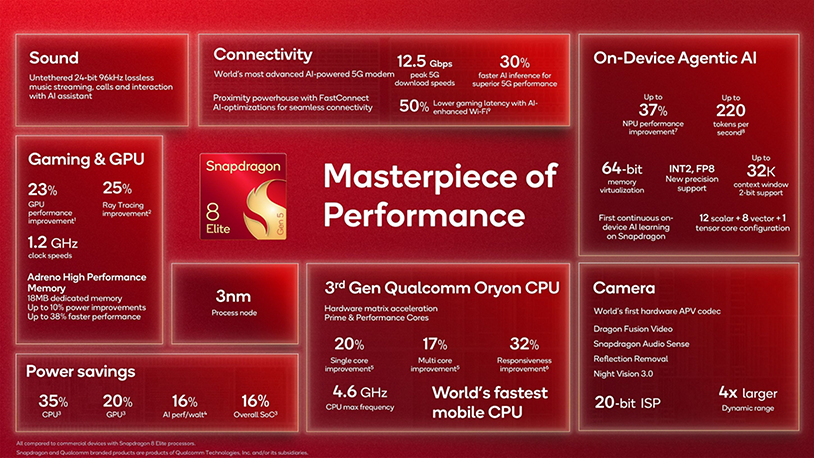
But look at what isn’t there: an absolute TOPS figure. Qualcomm gave its new laptop chips, the Snapdragon X2 Elite and X2 Elite Extreme, a clean 80 TOPS headline at the very same event. The phone NPU got a relative percentage and nothing you can actually measure against a rival. I think that’s a choice, not an oversight. “37% faster” sounds great and conveniently avoids parking a new absolute number next to last year’s, next to Apple’s, next to MediaTek’s NPU 990. When a company that loves a big round TOPS number suddenly won’t print one for its flagship phone, the absence is the data point.
| Block | Snapdragon 8 Elite Gen 5 |
|---|---|
| CPU | 3rd-gen Oryon, 2+6, up to 4.6 GHz prime (4.74 GHz binned) |
| Process | TSMC N3P (3nm) |
| GPU | Adreno, 1.2 GHz, 18 MB High Performance Memory |
| NPU | Hexagon, 37% faster, INT2 to FP16, no quoted TOPS |
| ISP | Triple 20-bit AI ISP, APV codec |
| Modem | Snapdragon X85 5G (discrete), up to 12.5 Gbps down |
| Memory | LPDDR5X, UFS 4.1 |
What it can actually run
Here’s the framing the keynote skated past. This CPU and NPU together can run small-to-medium generative models on the device, the translation, the summarization, a conversational assistant, while anything large or latency-sensitive still phones the cloud. That’s the real boundary, the same split I traced when I looked at how inference ends up running in two places that barely talk to each other. The Hexagon block here is plenty fast but walled off behind Qualcomm’s own toolchain unless an app is compiled specifically for it, which is exactly the wall I hit back when I dug into the 8 Elite’s on-device AI. The 8 Elite Gen 5 widens the on-device envelope. It does not move the cloud line nearly as far as the agentic-AI language wants you to believe.
The Sensing Hub additions are the part that feels new: dual micro NPUs feeding a Personal Knowledge Graph and a Personal Scribe, always-on low-power context that builds a private on-device picture of your habits. Whether that turns into something useful or just another background battery tax depends on software Qualcomm doesn’t write, since the OEMs and Google decide what actually ships on top. That’s the recurring theme with Qualcomm right now: the AI push is real, but it isn’t only about the chip.
I’m not going deep on the camera stack here, even though the triple 20-bit AI ISP is a real first and the new APV codec is a genuine gift for anyone who grades footage after the fact. That side deserves its own hands-on once a Galaxy S26 or Xiaomi 17 is actually in my pocket, because lab dynamic-range numbers and real photos are different animals.
So what is the Snapdragon 8 Elite Gen 5 once you scrape the agentic-AI varnish off? It’s an excellent piece of silicon, the fastest Android CPU you can buy with a GPU that finally makes mobile UE5 feel real. The NPU is clearly engineered to run language models on the device, and the engineering is not what I’m questioning. What I’m questioning is the story stacked on top of it, where “agentic AI” does an awful lot of work and the single number that would let you size up the AI claim against last year just happened not to make the slide. I’ll take the chip. I’m not going to pretend I didn’t notice the gap where the TOPS figure used to be.
Related reading: the Qualcomm-Xiaomi pact that puts this exact chip in Xiaomi’s next flagship, the 8 Gen 3 this generation succeeds, and the Snapdragon 888 that defined the pre-Oryon flagship era.