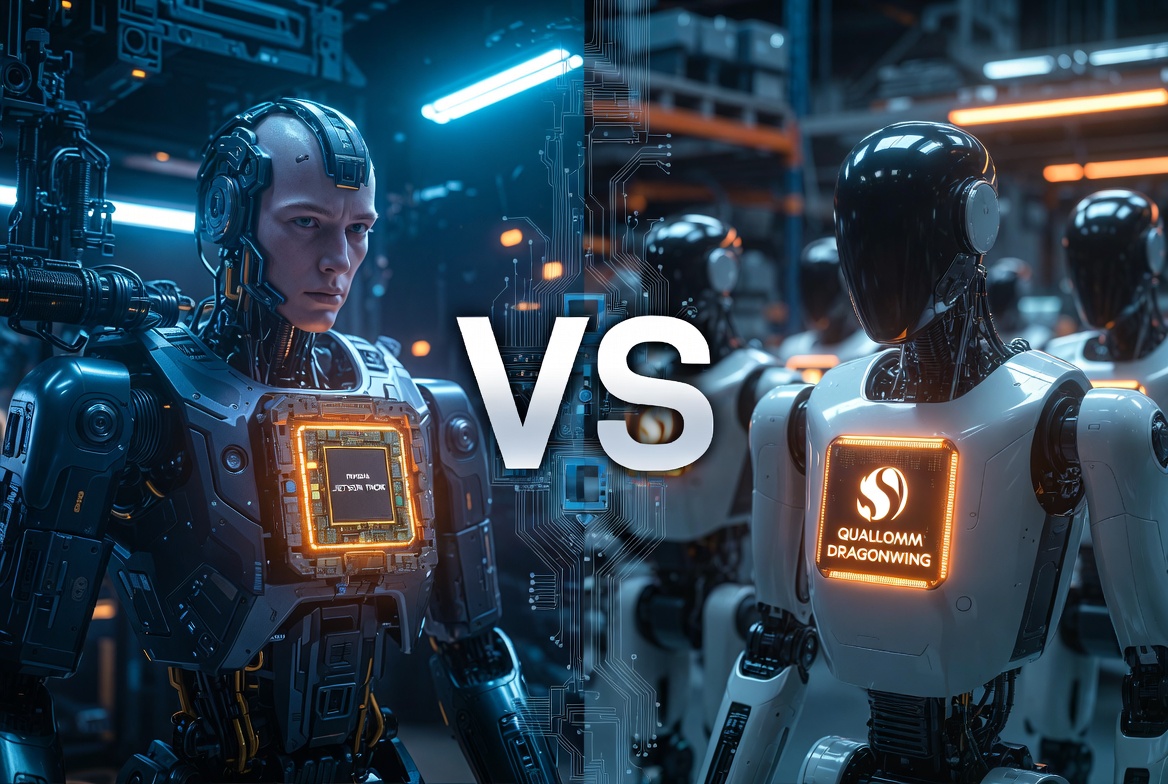
Boston Dynamics put Jetson Thor inside Atlas, and Agility Robotics is moving Digit onto it for the sixth generation. Two of the most-watched humanoid programs on the planet, same brain. Look only at the marquee wins, and you’d call robotics for NVIDIA and tell Qualcomm to pack up. I don’t read it that way, and the reason lies in one phrase Qualcomm used when launching the Dragonwing IQ10 at CES this January: the power-efficient alternative for machines that don’t need 2,000 teraflops.
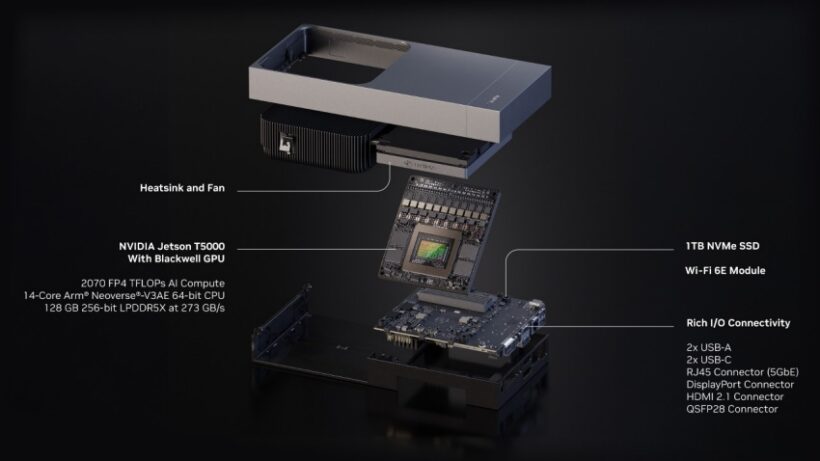
Jetson Thor earns the hype. It does up to 2,070 FP4 TFLOPS off a Blackwell GPU with 128GB of memory, 7.5 times the AI performance of the AGX Orin it replaces at 3.5 times the efficiency, in a 40 to 130W envelope, and it runs vision-language-action models and the full generative zoo locally, Cosmos Reason, DeepSeek, and Llama and Qwen and NVIDIA’s own Isaac GR00T N1.5, with Isaac and Holoscan and Metropolis wrapped around it. For a generalist humanoid reasoning about an unstructured warehouse in real time, that’s the right amount of compute, and nothing else currently touches it.
A 130W brain on a battery robot is a tax on everything else, and nobody building a humanoid likes to say it out loud. Every watt the computer burns is runtime the actuators don’t get. Thor earns its envelope when the robot’s job is open-ended cognition and makes no sense at all on a floor scrubber, a fixed inspection arm, a warehouse AMR running a known route, or an agricultural robot doing one task ten thousand times. Those single-purpose machines outnumber the humanoids by a wide margin and probably always will.
Qualcomm built for exactly that gap. It has been in robotics since the Robotics RB3 in 2019 and the RB5 in 2021, the latter doing around 15 TOPS through its AI Engine with 5G baked in, an arc I traced in the broader edge AI evolution, and the constant has been performance-per-watt plus integrated connectivity over raw ceiling. The IQ10 leans all the way into it. Qualcomm isn’t claiming it beats Thor on compute because it doesn’t, and they know it; the claim is that most robots need a fraction of Thor’s compute at a fraction of the power, with a wireless stack that already works, which is a fairer match to what those machines actually do.
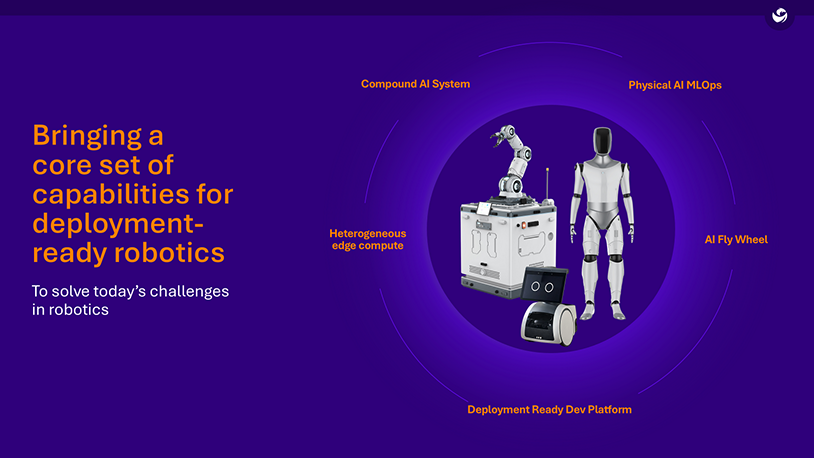
NVIDIA’s lead is software gravity, not silicon: Isaac, the GR00T foundation models, the simulation-to-deployment pipeline that makes switching costs brutal once a robotics team is trained on it. It’s the same lock-in that took the data center, ported onto wheels and legs. Qualcomm can’t out-CUDA NVIDIA and isn’t trying. It’s coming from underneath, on developer democratization, and the full version of that argument is the Qualcomm full-stack piece; the short version is that the Arduino plus Edge Impulse plus Foundries.io combination is built to make a modest robot on Dragonwing trivial for a small team while NVIDIA’s stack still assumes a funded robotics lab.
NVIDIA sees the cost problem too, which messes up any tidy two-camp split. It shipped the Jetson T4000 module, Blackwell for general robotics at $1,999 in volume, 1,200 FP4 TFLOPS and 64GB inside a 70W envelope, plus the IGX Thor variant for the industrial edge with functional safety. So NVIDIA reaches down toward the middle while Qualcomm reaches up, and they collide somewhere around the mid-tier AMR and cobot segment. I keep flip-flopping on who takes that fight and I’m not going to fake a verdict.
I’m skipping the automotive ADAS overlap on purpose; that convergence is more than a crammed paragraph can hold. NVIDIA has the humanoid crown and a software moat that I don’t see cracking soon. But the robots that ship in real volume are the boring single-purpose ones, won on cost-to-build and cost-to-power rather than teraflops, and that’s the fight Qualcomm picked. That’s the number I’d watch.