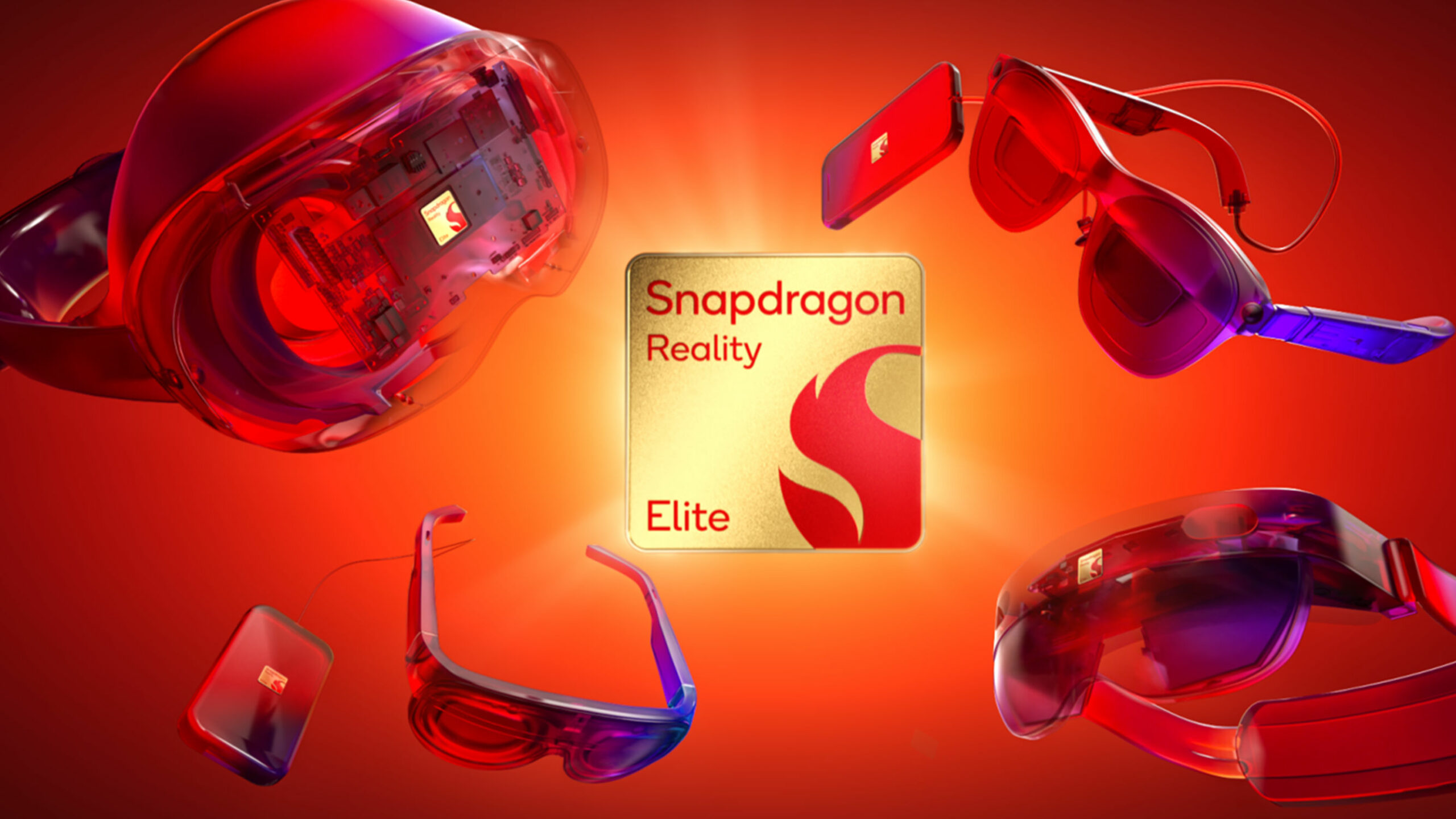
Qualcomm announced the Snapdragon Reality Elite at AWE 2026, delivering 48 TOPS of on-device AI compute — a 160% NPU increase over the XR2+ Gen 2 — alongside 60% GPU and 30% CPU improvements. The chip enables 4.4K per-eye at 90 FPS, runs 12 degrees Celsius cooler under load, and supports local generative AI without a network connection.
The XREAL AURA, an optical see-through Android XR glasses product, is the first confirmed device launching Fall 2026. The new “Reality Elite” naming signals a multi-year platform strategy rather than an incremental update, and the chip’s flexible architecture supports standalone, disaggregated, OST, and VST form factors without requiring separate silicon per device category.
A 160% jump in NPU is not a spec refresh. It is the number that decides whether generative AI in XR is a cloud feature or a device feature, and Qualcomm just answered that question with the Snapdragon Reality Elite, announced at AWE 2026 today. The practical difference between 48 TOPS of local AI compute and the previous generation is simple: a headset that can understand the room you are standing in without a Wi-Fi connection, versus one that cannot. That distinction is what the XR category has been waiting on for three years.
For context on that 48 TOPS number: Microsoft’s Copilot+ PC requirement sits at 40 TOPS. Qualcomm is building more AI compute into XR headsets than a Copilot-class laptop carries, in a device that runs on battery and sits on your face. To put that in perspective, the NVIDIA RTX Spark, which redrew the PC industry conversation at Computex, targets the same on-device AI tier from the desktop side. The GPU and CPU improvements, 60% and 30% respectively versus the Snapdragon XR2+ Gen 2, translate to 4.4K per-eye at 90 FPS, and the chip runs 12 degrees Celsius cooler under load. That last detail sounds minor in a spec table. On a device worn for a two-hour session, it is the difference between something people put on and something they take off after forty minutes.
The naming change is doing some work
“Reality Elite,” instead of a numbered XR2 continuation, signals a platform shift, not a generational tick. The XR2 cadence tracked incremental silicon; the “Reality” family name positions this the same way “Snapdragon X” positioned the laptop push: a named architecture intended to carry a multi-year roadmap rather than a component version number. The “Elite” tier mirrors the laptop naming exactly. The platform also adds a dedicated EVA block, a hardware accelerator for computer vision workloads, that handles spatial mapping and depth sensing at lower power. That is the implementation detail that matters to OEMs building OST glasses, where the compute budget is tight, and the pipeline never stops running.
XREAL AURA is the launch device, and that is the right call
The first confirmed device is the XREAL AURA, an Android XR optical see-through glasses product arriving in Fall 2026. XREAL has been building consumer-grade OST glasses at price points that make the Vision Pro look like a car payment, and pairing them with this platform is the right showcase for the launch. Lighter form factor, consumer pricing, a use case that maps directly to on-device AI: smart glasses that understand what you are looking at in real time, locally, without pinging a server. That is the demo that sells the Snapdragon Reality Elite story, and XREAL AURA is that demo.
Qualcomm is not naming additional partners yet. The architecture explicitly supports all-in-one and disaggregated designs, as well as OST and VST form factors, meaning OEMs can run it in a standalone headset or split the compute into a pocket unit connected to lightweight glasses, with no different chip per category. For a market that still has not settled on a dominant form factor, that flexibility is worth more than it sounds.
Sixty million XR devices in the market is the figure Qualcomm cited at the announcement. That is a meaningful installed base and also a reminder that XR has spent most of this decade in the “about to break through” phase without quite getting there. What the Snapdragon Reality Elite changes is the ceiling: if any headset on this platform can run vision and language models locally, the primary failure mode for spatial computing stops being a hardware constraint and becomes a software and content problem. That is real progress. It is also a more honest description of where the category actually is.
Related reading: Samsung’s Galaxy XR headset, the Android XR device that shipped on the prior-generation Qualcomm XR silicon this platform supersedes.