Sony’s LYT-L910 mobile image sensor shares nearly identical specs with its predecessor, the LYT-828—50 megapixels, 1/1.28-inch format, 1.22 µm pixels, and 100 dB dynamic range—but achieves this range through fundamentally different technology. Using a lateral overflow integration capacitor (LOFIC) and triple conversion gain (TCG-HDR), the L910 captures full dynamic range in a single exposure, eliminating the motion artifacts and ghosting common in multi-frame HDR approaches used by the 828 and competitors like Samsung’s ISOCELL line.
The sensor, announced June 17, 2026 for summer mass production, represents Sony’s bet that hardware-level fixes can surpass software-based computational HDR. OmniVision is pursuing similar single-exposure architecture, while Samsung continues with multi-frame processing. No shipping device yet uses the L910, and its real-world performance—dependent on OEM ISP tuning—remains unverified independently.
Put the L910 next to the LYT-828, and the spec sheet plays a cruel joke on you. 50 MP. 1/1.28-inch. 1.22 µm pixels. 100 dB dynamic range. The predecessor already claimed that last number. Stare at the two columns long enough, and you’d swear Sony shipped a renamed clone on June 17, 2026, slated for mass production this summer.
Look closer. The numbers held still while the entire machine underneath them got rebuilt. The L910 reaches 100 dB in a completely different way from the 828, and that way is the whole story. It decides what happens to a face that moves, a car that passes, water that won’t sit still for your multi-frame merge.
Underneath, it’s a stacked CMOS sensor: the pixel array on one die, the signal-processing logic bonded to a second die beneath it, which is nothing exotic for Sony’s premium mobile line anymore. The stacking is what buys the faster readout and lets Sony pack more transistors per pixel without eating into fill factor on the imaging layer. Resolution lands at roughly 50 effective megapixels on a 1/1.28-inch sensor with a 1.22 µm native pitch, the same physical footprint as the 828. That last detail matters more than it sounds, because an OEM that already qualified a module for that format can drop the L910 in without re-engineering its optics.
The rebuild starts in the silicon, with a lateral overflow integration capacitor, the first time Sony has put LOFIC into any LYTIA mobile sensor. It fixes a specific failure. A photodiode absorbs charge as photons strike it, and once that charge exceeds the photodiode’s full-well capacity, the excess spills over and vanishes. That vanished charge is a blown highlight: the sensor keeps no record of how bright the window or the sky actually was, because the bucket overflowed and nothing caught the spill. LOFIC catches it. A lateral capacitor sits next to the photodiode inside the pixel, and when the photodiode saturates, the overflow pours into that capacitor instead of into nothing. The pixel now has two tanks, the photodiode for normal-to-bright light and the capacitor for the extreme stuff, and their combined saturation capacity runs well past what the photodiode manages alone. That headroom is what keeps detail in highlights that used to clip straight to white. What makes everything else work is that it all happens in one exposure: the capacitor is read out alongside the photodiode in the same acquisition cycle, with no second frame for the bright regions.
Catching the overflow is only half of it. The other half is how that charge gets read, and that is where triple conversion gain comes in. Conversion gain is the ratio of output voltage to accumulated charge: crank it up and you amplify the signal harder, which helps in low light but narrows the range of charge levels you can still tell apart before everything clips. The old approach, dual conversion gain, flips between two gain states across multiple exposures, high gain for the shadows and low gain for the highlights, then merges the frames. That is what the LYT-828 did. TCG-HDR instead reads a single exposure at three gain levels, either simultaneously or in rapid sequence within the same frame window, pulling highlights, midtones, and shadows from a single capture event. Layer that on top of LOFIC’s highlight headroom, and the sensor reconstructs an HDR image without ever stitching together frames shot at different moments. Sony quotes 100 dB from this single-shot path, about 16.6 stops, matching or beating what the 828 wrung out of multi-exposure DCG-HDR, and it gets there with no temporal seams.
One more change works at the readout itself. Ultra-high conversion gain amplifies small charge differences into larger, more distinguishable voltage differences, which reduces read noise relative to the signal. Sony credits UHCG with roughly 30% less random noise than the previous generation, though that is a manufacturer’s figure and it covers only temporal noise; fixed-pattern noise gets no separate mention in the announcement.
Line the L910 up against the 828, and nearly every number matches: roughly 50 megapixels, a 1/1.28-inch format, 1.22 µm pixels, and even the 100 dB dynamic range the 828 already advertised. One thing changed, and it never shows up as a spec. The 828 reached its range with multiple exposures, and multi-exposure HDR is a dream for static scenes and a liability for anything that moves. The high- and low-gain frames land at slightly different times, so a walking person or water that won’t hold still appears in a different place in each frame, and merging them smears those edges into ghosts. De-ghosting algorithms exist to paper over it, and they fall apart exactly where motion gets complicated, at the edges of moving objects. The L910 never has that problem because every bit of tonal data comes from a single exposure. There is nothing to realign. The subject is frozen at a single instant, and the LOFIC capacitor and the triple-gain readout resolve the whole dynamic range inside it. The spec sheet calls the two sensors twins. They aren’t.
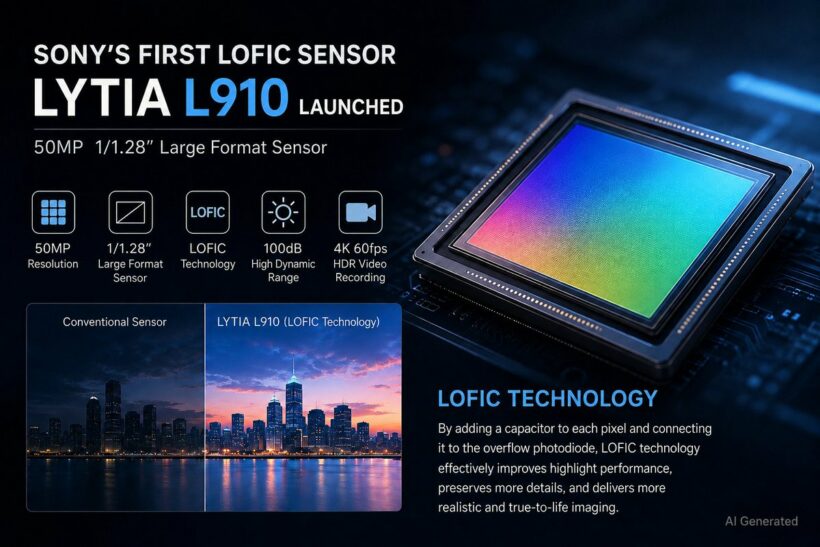
https://x.com/Saurav_DJ47/status/2067108315746939057
Sony isn’t the only one that reached this conclusion. OmniVision is swinging at the same problem with its TheiaCel line, chasing LOFIC-adjacent pixel architectures built for wide dynamic range without multi-frame synthesis. The structural details differ from Sony’s LOFIC, but the intent is identical, holding the highlights in hardware on a single shot. Both are targeting summer 2026, no independent side-by-side exists, and the thing that will actually decide it isn’t on either datasheet. It’s whose implementation survives once an OEM’s ISP tuning and software tone-mapping get their hands on the output, and nobody answers that until real devices ship. That two of the biggest sensor makers landed on single-exposure HDR in the same season is a tell in itself: multi-frame computational HDR is running out of room, and the companies building the sensors clearly know it.
Samsung is the holdout. Its ISOCELL HP series goes in the opposite direction, stacking up to 200 megapixels via 16-in-1 Tetra²pixel binning and relying on multi-frame processing and computational photography for HDR, rather than a pixel-level hardware fix like LOFIC. There is no LOFIC equivalent in ISOCELL as of this announcement. That is not automatically a mistake, because multi-frame HDR really does look gorgeous under controlled conditions, but it means Samsung is still carrying the same motion-artifact baggage as the 828.
And don’t confuse the L910 with Sony’s own LYT-901, announced in March 2026. The 901 is a different animal: a 200-megapixel sensor with QQBC binning and on-chip AI zoom, built to chase resolution and reach, while the L910 goes after dynamic range. They are parallel branches of the LYTIA family, not one succeeding the other, and the 901 turning up in something like the Vivo X300 Ultra makes it neither the L910’s ancestor nor its heir.
Step back from the silicon and the L910 is really a bet in an argument that has run for a decade: fix dynamic range at the sensor, or paper over it in software? Software won that argument convincingly for ten years. Multi-frame HDR and AI tone-mapping pulled stunning images out of mediocre sensors, and the case for staying that course is still strong because software is cheap to iterate on and rides the ever-fatter ISPs and NPUs in every new chip. But software can only work with what the sensor handed it. A blown highlight was never recorded, so nothing downstream rebuilds it, and a ghost baked into a multi-frame merge is welded in for good. LOFIC and TCG-HDR deal with both at the only moment that still holds the information, the instant of capture, before the ISP sees a single value.
None of this is proven yet, and that is the part worth sitting with. Mass production is still months out, summer 2026, and no shipping phone carries the sensor. The 100 dB single-exposure figure is Sony’s own, with no independent measurement under anything like ISO 15739. The 30% noise reduction is quoted against a baseline Sony doesn’t specify and applies only to random noise, so whether you ever see it depends on the scene and how hard the OEM leans on its own tuning. And the OEM is where the real doubt lives. Qualcomm’s Spectra ISP gets the sensor output before anything else does, and if a phone maker pushes its own software HDR on top of it or simply ignores the LOFIC data, the hardware advantage evaporates before the shot is even saved. A sensor with brilliant native range can be gutted by an ISP that throws away the information it just worked to capture. Adoption is unconfirmed, too. Vivo has shipped LYTIA parts before, the 901 in the X300 Ultra, which makes it the obvious first home, but nobody has announced anything.
Here is where I land. This is the most interesting thing Sony has done in a mobile sensor in years, and on paper, it kills the exact failure that has bugged me about computational HDR from the start. But I have watched too many excellent sensors get flattened by an OEM convinced its own tone-mapping knows better, and single-vendor dynamic-range numbers tend to shrink the second someone independent points a real chart at them. I want this to be the sensor that finally makes the hardware case stick. I am not going to believe the 100 dB until a phone I can actually buy proves it in a frame with something moving in it.
Sources: Sony Semiconductor Solutions official announcement (sony-semicon.com, June 17, 2026); Gadget Hacks technical breakdown; Gizmochina spec coverage; Y.M.Cinema; The Week India.