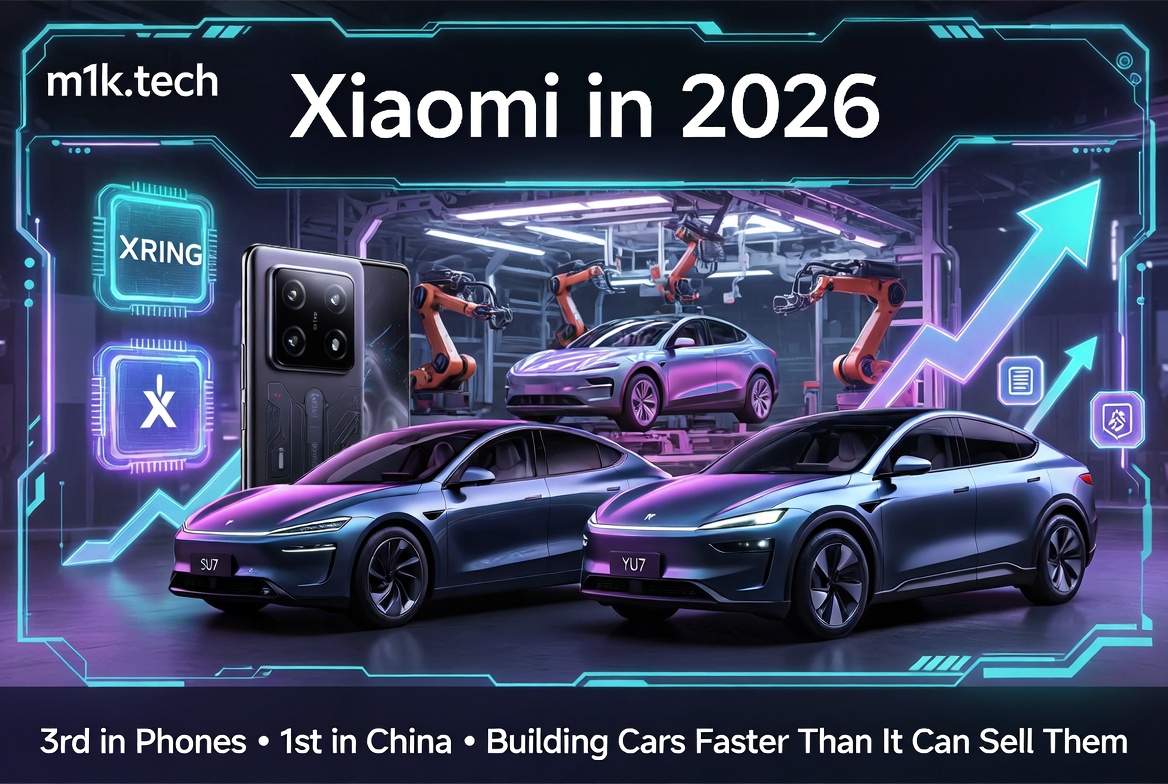
Last month, Xiaomi launched a 990-horsepower electric SUV that holds the SUV lap record at the Nürburgring. The same spring, it is pushing a phone built to go toe-to-toe with the iPhone 17 Pro Max. Six years ago, this company’s reputation was for cheap handsets that punched above their price. I want to lay out where it actually stands now, because the breadth has gotten faintly ridiculous.
The phone business, the original one, is healthy and lopsided. Xiaomi has sat in the global top three for something like nineteen straight quarters, and it has clawed its way back to number one in China, the most brutal smartphone market on the planet, on the back of a premium push and a wall of new offline stores. The ugly spot is India, once its stronghold, where shipments cratered by more than a third year-on-year and Xiaomi slid to fourth behind Vivo, Samsung, and Oppo. Being first at home and stumbling in the market that made you is a strange place to be.
The clearest sign of the new ambition is the naming. Xiaomi skipped the “16” entirely and jumped to the Xiaomi 17 series last September, and President Lu Weibing said the quiet part out loud: the company has spent five years benchmarking the iPhone, so it numbered its flagship to line up directly against Apple’s. The 17 was among the first phones anywhere on Qualcomm’s Snapdragon 8 Elite Gen 5, the Pro models carry a second screen grafted onto the camera island, and the whole line runs HyperOS 3 on Android 16. Calling your phone a 17 to chase an iPhone 17 is either confidence or insecurity, and I genuinely cannot decide which.
The silicon story is the one I find most revealing, because it is unfinished. Xiaomi proved last year it could design a flagship-class SoC that beats Qualcomm on a benchmark, and then shipped its actual volume flagship, the 17 series, on a Snapdragon anyway. The XRING O1 was a halo in a limited-run anniversary phone, not the workhorse in the phone most people buy. The Plan B that the 2021 blacklist scare kicked off is real, but it is a long way from done, and a company that can build a chip yet still puts someone else’s in its best-selling flagship has not actually changed its dependence yet, only proved it could.
The cars are where the growth and the danger both live. Xiaomi delivered north of 400,000 vehicles in 2025, the SU7 was China’s best-selling sedan above 200,000 yuan, and the company is targeting more than half a million units this year with a facelifted SU7, the YU7 SUV ramping hard, and now the YU7 GT at the top. For a company that sold its first car in early 2024, building more than a thousand vehicles a day in 2026 is a genuinely absurd ramp, the kind legacy automakers spend decades failing to match.
None of which erased the smart-driving reckoning. The fatal SU7 crash and the recall that followed set a regulatory precedent, the marketing-language crackdown is real, and yet the SU7 kept outselling its segment right through the controversy, which says something uncomfortable about how little safety scrutiny dents demand. Europe is the next test, and Xiaomi has confirmed it will not sell cars there before 2027, partly because EU tariffs add up to roughly 30% and partly because the home market is still soaking up everything the factories can build.
I am not going to pretend the India collapse or the thin EV margins are solved, because they are not, and both are real drags under the triumphant headline numbers. I am also leaving the services and AIoT side of the ledger alone here, the connected-device empire that quietly funds a lot of this; that is its own post and it deserves more than a paragraph.
Back in 2020 I wrote about Xiaomi becoming the world’s third-largest phone maker as Huawei fell, and at the time that felt like the ceiling. Six years on it is still third in phones, and that is now the least interesting fact about it. The company that scared itself into building cars after a US blacklist now sells more than a thousand of them a day and numbers its phones to taunt Apple. Whether Xiaomi is a serious company is settled. The open question is whether anyone can be genuinely great at phones, cars, chips, and an ecosystem all at once, or whether doing four hard things simultaneously eventually pulls one of them apart. Ask me in a couple of years.
Related: Five Years Inside the Xiaomi Ecosystem, my history of how Xiaomi built the machine that got it here.