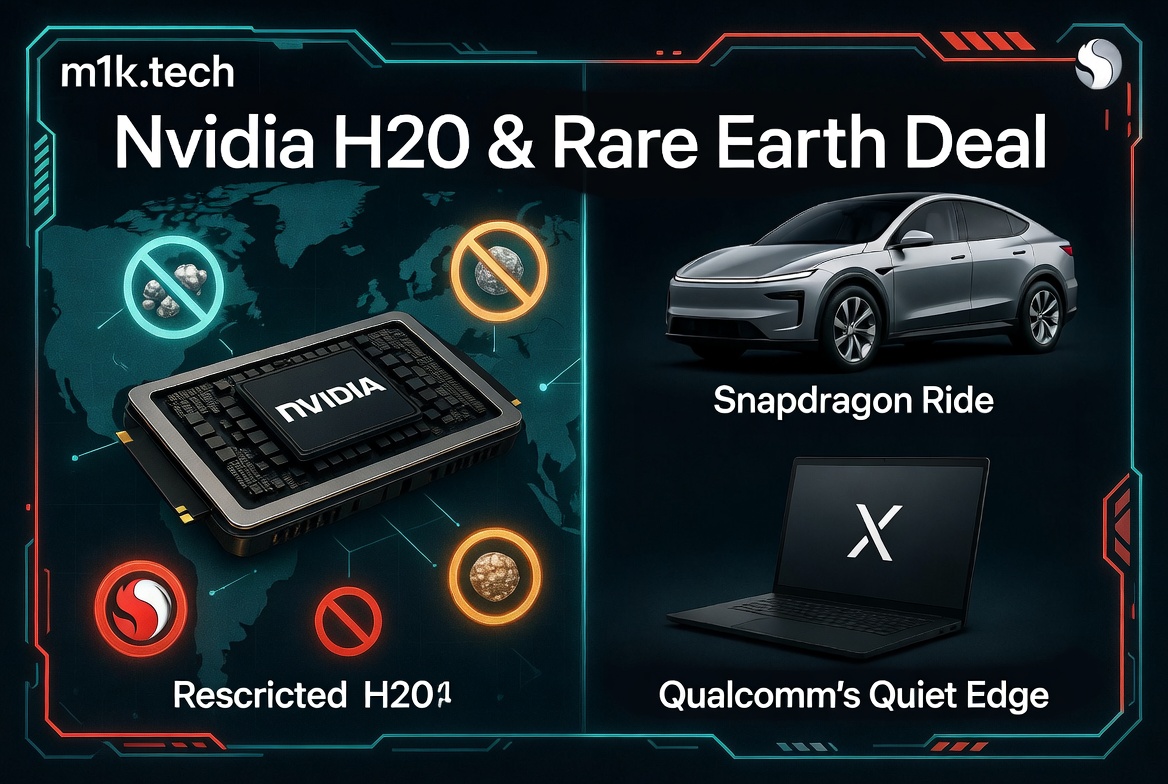
Jensen Huang spent the back half of July working as a one-person trade delegation. He met Trump at the White House on July 10. Four days later, Nvidia posted a blog post saying the government had assured the company that H20 export licenses to China were on the way. Two days after that, Huang was on a stage at the China International Supply Chain Expo in Beijing. That is not a travel coincidence. It is a chip executive carrying U.S. trade policy in his luggage, and the chip he carried back into China is one of the strangest pieces of deliberate engineering I have looked at in years.
The H20 is a Hopper part, the same GH100 family as the H100, that Nvidia deliberately broke to clear the export thresholds in force before April. Compute got gutted to roughly seven percent of an H100’s. Memory did not: 96GB of HBM3 at 4.0 TB/s, more capacity and more bandwidth than the H100 it descends from, with NVLink left fully intact at 900 GB/s. That makes it useless for training and close to ideal for serving large language models, where the bottleneck is pulling weights from memory rather than arithmetic, and a pod of eight networked over NVLink becomes a cluster large enough to run a model in the 400- to 600-billion-parameter range. I went through that teardown in detail back in July, so I will not relitigate the silicon here. What matters in this story is why the ban was lifted.
The ban came off because of magnets. Commerce Secretary Howard Lutnick told Reuters the H20 reprieve was tied to a rare earth deal: “We put that in the trade deal with the magnets.” China had halted heavy rare earth exports back in March during the tariff fight, the dysprosium, terbium, and the rest that go into the NdFeB permanent magnets in electric motors, and the late-June London talks had Beijing resuming shipments. The H20 license was the American side of that ledger.
The dependency is not in the GPU die, which is mostly silicon and copper. It is in the machinery around it. The variable-speed motors that cool a GPU rack use those magnets, and so do the robots running advanced packaging lines, TSMC’s included. A long magnet embargo would not have stopped wafers from being etched. It would have throttled the data center build-out that every AI capex projection quietly assumes. So the U.S. traded inference silicon for motor magnets, which tells you the export status of any China-facing chip is a moving target you cannot model twelve months out.
The first licenses did not even show up until August, and when they did, they carried a 15 percent cut of China’s revenue payable to the U.S. government, an arrangement with no real precedent. Then Beijing turned around and told its own national champions to avoid the chip on security grounds. So: a GPU Nvidia designed, Washington banned, unbanned for magnets, taxed on the way out, and that Chinese regulators then waved their own firms away from. AMD’s MI308, the compute-clipped cousin of the MI300X, rode the same rollercoaster. None of that is a market. It is a negotiation with a die attached.
The logic Lutnick keeps repeating is that selling China a hobbled H20 keeps it hooked on the American tech stack rather than pouring everything into Huawei; his line is that the U.S. should sell its “fourth best” chip and nothing better. There is something to it. Huawei’s Ascend 910C is aimed at H100-class numbers but was not shipping in volume over the summer, and the real ceiling is manufacturing: SMIC’s 7nm process sits a generation or two behind TSMC, so Huawei cannot match Nvidia’s performance per watt at the same die area, which caps cluster density before the power budget blows up. Whether feeding China H20s actually slows Huawei or buys it a year depends on how fast SMIC closes that gap, and nobody outside a few rooms in Shanghai really knows.
While that circus played out, Qualcomm spent the summer building the opposite kind of position, the kind nobody revokes with a policy memo. I am a declared Snapdragon Insider, so take my enthusiasm with a grain of salt. The Snapdragon X laptop line crossed roughly 150 confirmed designs this year, up from about 20 at the May 2024 launch, with ASUS, Lenovo, Dell, HP, the whole Surface line, and Samsung’s Galaxy Book on board. The part that actually moved things was the entry tier finally clearing Microsoft’s 40-TOPS Copilot+ bar under $700, because every Snapdragon X SKU ships the same 45-TOPS Hexagon NPU, and Intel and AMD still struggle to hit that certification at the same price.
The platform is not finished. Windows on ARM still leans on the Prism emulation layer, which costs you 20 to 40 percent on heavy x86 apps, and the native column, full as it now is with Office, Chrome, Photoshop, Premiere, DaVinci Resolve, and Visual Studio, still has holes where After Effects and AutoCAD sit in emulation. That gap in pro-creative and engineering tools is the actual reason these machines have not hit x86 parity, even while they win the battery-life benchmarks. Qualcomm gets another swing at it soon: Cristiano Amon confirmed a new Snapdragon X chip at Computex, and the Snapdragon Summit runs in Maui at the end of this month, almost certainly with a juiced Hexagon chasing whatever Microsoft sets as the next Copilot+ floor.
At IAA Mobility in Munich this week, Qualcomm and BMW pulled the wraps off Snapdragon Ride Pilot, the automated-driving system going into the new iX3, the first car on BMW’s Neue Klasse platform. This is not a chip drop; it is a full stack: Snapdragon Ride SoCs running a co-developed software layer, built over three years by more than 1,400 engineers across Germany, the U.S., Sweden, Romania, and BMW’s test center in the Czech Republic, validated in 60 countries with another 40-plus due in 2026. BMW calls the central computer the “superbrain” and claims it has 20 times the computing power of its last-gen assistance system. It scales from entry-level NCAP safety up through Level 2+ highway and urban navigation on autopilot, hands-free on approved roads, with lane changes that trigger off a mirror glance.
Running Level 2+ in a production car means hitting ASIL-D under ISO 26262, the top tier, the one written for systems that kill people when they fail. On a SoC this complex, that means redundant computing across independent power domains, a separate safety island monitoring the main processors, hardware walls around the safety-critical partitions, and a fail-operational design that can still bring the car to a controlled stop if the primary compute dies mid-maneuver. Qualcomm’s Ride platform carries that certification, and that is exactly why this kind of win does not evaporate. You do not re-bid a safety-certified compute platform on a whim once it is sitting in a car people have already bought.
Qualcomm sells that same Ride platform into Chinese automakers, NIO, Geely, Great Wall, Dongfeng, with none of the license drama that snared the H20, because ADAS chips count as vehicle safety hardware rather than data-center AI accelerators and sit outside the export regime entirely. Same company, the same Hexagon and Adreno silicon underneath, wildly different political exposure depending on which box it ships in. That is the asymmetry that ties the two halves of this together. And the automotive business is no longer a rounding error: Qualcomm just posted a record $984 million automotive quarter, up 21 percent, against a design-win pipeline it pegs past $45 billion and an $8 billion revenue target by FY2029, a long way from the handset-and-licensing company it used to be.
The shared IP is the whole moat. Hexagon, Adreno, and the Oryon core amortize across phones, PCs, and cars at once, leveraging a pure-play like Mobileye or Renesas cannot touch. Win thirty automotive sockets in a quarter, and you are locked into five- to seven-year programs that do not get rebid casually. Qualcomm is already eyeing Tesla’s move to charge the automaker for software features like navigation-on-autopilot on top of the chip. That is what owning a platform looks like; instead of selling parts, the same trick it ran in mobile.
So set the two stories side by side. The H20 reversal is a fifteen-billion-dollar chip with its NVLink left intact on purpose, handed to China for magnets, taxed on the way out, and revocable the next time a trade round sours. The BMW win is slower and a lot harder to take away, because nobody rips a safety-certified compute platform out of a shipping car with a policy memo. The hardware is done and certified into a car you can buy, and those contracts run for years, not news cycles. What I still cannot tell you is whether a company that spent twenty years selling other people’s silicon knows how to turn that into the kind of software lock-in that made Wintel and iOS impossible to dislodge. I am not sure it does. I am not sure Qualcomm is either. We find out a little more in Maui at the end of the month.