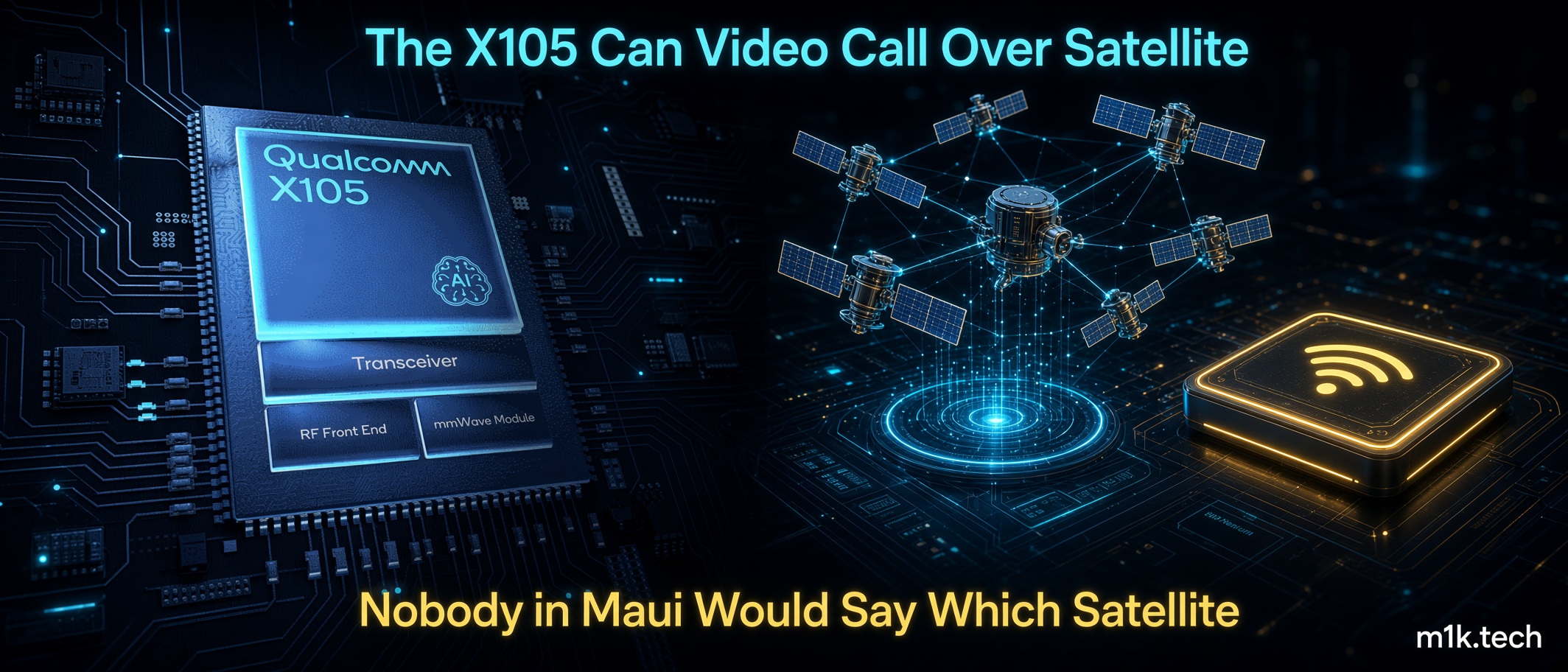
Video calling over satellite, from an ordinary phone, with no dish and no special antenna. That is the claim printed on the Snapdragon X105 spec sheet, and as of this week it is inside retail phones: both the Snapdragon 8 Elite Gen 6 and the Extreme Gen 6 platforms carry the X105, starting with Xiaomi’s 18 Pro and 18 Pro Max on sale in China, with iQOO, OnePlus and the rest of the launch list following over the coming weeks. What nobody in Maui would tell me is which satellite the video call is supposed to go through.
In my Day 1 Summit post I said the modem and the new Wi-Fi chip deserved their own piece, and I privately planned to hold it until the first phone actually lit up a satellite link. I changed my mind, because the gap between what this silicon can do and what any network will let it do is the story, and it’s easier to see before the marketing fills that gap with renders.
What the X105 actually is
Qualcomm unveiled the X105 at MWC on March 1 and skipped a generation number, going straight from the X85 to the X105. That’s a marketing decision more than an engineering one, but the feature list does justify a louder name than usual. It’s the first modem Qualcomm calls 3GPP Release 19-ready, the second phase of 5G-Advanced and the last stop before 6G work gets serious. It pairs the baseband with a 6nm RF transceiver, which Qualcomm calls an industry first for power efficiency and board footprint, adds quad-band GNSS for positioning, and integrates NR-NTN, the 3GPP standard for 5G over non-terrestrial networks, for voice, video, and data. Below that sits NB-NTN for satellite messaging, and a separate NB-IoT fallback designed to keep messages moving in dead zones like elevators and underground car parks. A fifth-generation AI processor inside the modem handles link optimization, and Qualcomm is exposing some of that predictive network intelligence to developers through APIs.
The peak numbers are 14.8Gbps down and 4.2Gbps up, with up to 13.2Gbps achievable on sub-6GHz bands alone. I’ll be blunt about the download figure: it’s a lab number that requires a combination of carrier aggregation and millimeter-wave spectrum almost no operator on Earth deploys, and nobody will see it on a phone in 2026. The uplink number is the one I’d actually pay attention to. Phones increasingly push more data up than they used to: video calls, cloud backup, and now AI assistants shipping camera frames and audio to a model, and 4.2Gbps of peak uplink capacity tells you where Qualcomm thinks the traffic is heading. Uplink has been the neglected half of mobile networks for a decade.
The NB-IoT fallback is the feature I think most people will actually notice, and it’s the least glamorous item on the list. A phone that can still send a message from a parking garage or the back of a concrete building solves a problem everyone has had today, without anyone launching a rocket.
Two ways to put a phone on a satellite, and the X105 bets on one
This is the section I care about most, because the satellite-to-phone market split into two technical camps while everyone was busy calling it all “direct to cell,” and the X105’s headline feature only matters in one of them.
The camp that’s live and making money uses terrestrial waveforms in mobile operators’ own spectrum, talking to phones that were never designed for space. Starlink’s Direct to Cell service, sold through T-Mobile as T-Satellite, is the biggest example: more than 650 direct-to-cell satellites in orbit, service across 22 countries, about 60 compatible phone models, and a $10-a-month add-on in the US. The phone sees a Starlink satellite the way it sees a cell tower. In the UK, Virgin Media O2 switched on O2 Satellite in February on Starlink, lifting its landmass coverage from 89 to 95 percent. AST SpaceMobile takes the same unmodified-phone approach with enormous satellites instead of many small ones, working with AT&T, Verizon, Vodafone, Orange and Rakuten, and is targeting beta service later this year with non-continuous US coverage while it adds BlueBirds. Here’s the awkward part for the X105: none of these services needs NR-NTN. They’re designed specifically so that the phone doesn’t have to know it’s talking to space.
The other camp is the 3GPP standards path, NTN proper, which usually runs over dedicated mobile-satellite spectrum rather than borrowed terrestrial bands. Skylo is the commercial leader there, and it’s Qualcomm’s existing partner: in September 2024, Skylo turned on satellite connectivity for phones using the Snapdragon X80, running over dedicated mobile-satellite spectrum through partner constellations, with Verizon offering free satellite texting on supported phones. That path is where NB-NTN messaging lives today, and it’s the natural home for NR-NTN as it grows. Certification bodies are working on it right now: the GCF has had NTN NB-IoT conformance testing for geostationary systems since 2024 and wants to extend it to low-orbit systems and to NTN 5G NR.
Physics sits under both camps. A phone transmits at roughly 23dBm through a tiny internal antenna, and closing a broadband link from that to something hundreds or thousands of kilometers away needs either an enormous receiving antenna in orbit, which is AST’s entire design philosophy with arrays measured in tens of square meters, or modest throughput. Starlink’s own roadmap puts full voice and data comparable to regular cellular on its V2 satellite generation, targeted for the second half of 2027. So when the X105 says video over NR-NTN, read it as the modem being ready for a network that mostly doesn’t exist at consumer scale yet. The chip is early on purpose, as modems always ship, but the gap here is bigger than usual.
That’s why Maui’s unanswered question matters. Qualcomm named no operator partner for NR-NTN voice or video on the X105 during the Summit, and no phone maker on the launch list did either. A modem vendor can’t sell satellite service; carriers and satellite operators do, and they decide which phones get provisioned. Until one of them announces NR-NTN service on a Gen 6 phone, the satellite video call is a capability, not a feature.
The competitive picture makes this more pointed. Huawei has shipped satellite calling on its own Balong modem through China’s Tiantong system for years, and the latest version in the Kirin 9050 Pro claims a 42 percent better satellite performance. MediaTek has been chasing NTN work alongside its flagship business, as I noted when it shipped its first 2nm phone chip. And Apple, which Qualcomm just re-signed as a patent licensee while losing it as a modem customer, was tipped before launch to support NR-NTN in its own C2 modem. Apple has spent years offering satellite messaging through Globalstar. Every one of these companies has its own relationship with a satellite operator. Qualcomm’s plan relies on everyone else’s.
FastConnect 8800: a Wi-Fi 8 chip with no Wi-Fi 8 routers to talk to
The FastConnect 8800 is the other half of the connectivity story in Gen 6 phones, and it has a similar shape: capable silicon, an ecosystem that isn’t there yet. It’s the first mobile connectivity chip with a 4×4 Wi-Fi radio, which is a bold thing to fit inside a phone given how little room there is for four antennas, and Qualcomm claims 11.6Gbps peak, about twice its previous FastConnect 7900, with up to three times the gigabit-class range. It puts Wi-Fi 8 (802.11bn), what Qualcomm calls Bluetooth 7 with High Data Throughput, Ultra Wideband on the new 802.15.4ab spec, and Thread 1.5 on a single 6nm chip. The Bluetooth piece is a real upgrade I expect people to feel: throughput goes from 2Mbps to 7.5Mbps, which matters for multi-device audio and anything that has been starving on classic Bluetooth.
Here’s what bugs me about the marketing. Wi-Fi 8 is not primarily a speed standard. The theoretical maximum rate is expected to stay around 23Gbps, the same as Wi-Fi 7. The whole point of 802.11bn is Ultra High Reliability: coordination between multiple access points, smoother roaming, extended long-range modes, better behavior when a network is loaded with devices. Leading with 11.6Gbps sells Wi-Fi 8 as the thing it explicitly isn’t. And the standard isn’t done. IEEE ratification is targeted for May 2028, with the task group’s own reporting citing a date as late as September 2028, and Wi-Fi Alliance certification is expected to start around mid-2027. Qualcomm’s Dragonwing Wi-Fi 8 access-point platforms are sampling, so pre-standard routers will show up, but on the Wi-Fi 7 router most people will buy this year, the FastConnect 8800 falls back to standard Wi-Fi 7 multi-link operation without the reliability refinements that justify the new name.
The first phone on the platform makes the point for me. Xiaomi’s launch spec for the 18 Pro Max lists Wi-Fi 7 and Bluetooth 6.0, not Wi-Fi 8, on the same sheet that confirms it ships LPDDR5X instead of LPDDR6. Either the phone uses a different connectivity chip, or Xiaomi decided a pre-certification Wi-Fi 8 badge isn’t worth printing on a box yet. I’d bet on the second, and it’s a telling choice from a company that never met a spec it didn’t want to headline.
The more interesting feature for 2026 buyers is Proximity AI, which fuses Wi-Fi ranging, Bluetooth Channel Sounding, UWB and GPS to locate nearby devices down to centimeters. Qualcomm pitches it as finding lost earbuds and handing sessions between devices, and it ties into Snapdragon Seamless and XPAN. It’s the kind of feature that only works if the other device speaks the same protocols, which puts it in the same bucket as the satellite video call: very good once the partner shows up.
Why sell hardware the network can’t use yet
The go-to-market logic is the oldest one in Qualcomm’s playbook, and it usually works. Modems and connectivity chips ship a year or two ahead of the networks so that when operators flip features on, there’s already an installed base worth provisioning. Qualcomm did it with 5G in 2019 and mmWave after that. The difference in 2026 is who holds the switch. With 5G, the switch was a handful of mobile operators Qualcomm has worked with for decades. With satellite, the switch sits partly with SpaceX, AST SpaceMobile and Skylo, companies whose incentives don’t necessarily line up with a phone modem’s feature list, and SpaceX’s approach is specifically built to make phone-side NTN support optional.
There’s also a customer-base angle that follows directly from this week’s other Qualcomm news. Qualcomm’s licensing business still collects on every 5G iPhone, but the modem silicon lead now only reaches Android buyers: US iPhone 18 Pro Max units are very likely the last Apple phones carrying a Qualcomm radio, and teardowns say that radio is last year’s X80, not the X105. The best cellular modem Qualcomm has ever made is going mostly into phones from Chinese OEMs this autumn, with Motorola promising its Signature 27 for the US at some point, and Samsung hasn’t confirmed which chip its next Galaxy S uses. That changes what “modem leadership” is worth as a marketing line. It’s a feature Qualcomm has to sell through partners who, in China, mostly already have their own satellite messaging arrangements with domestic systems.
I’m not going to get into Release 20 and the 6G roadmap Qualcomm keeps attaching to this modem; the X105 has enough unresolved questions of its own without borrowing ones from 2029.
Here’s the only test I care about, and I’d gladly be proven wrong on it by Christmas. Take a Gen 6 phone somewhere with no terrestrial coverage, a national park, a boat, and place a video call over NR-NTN on a named commercial service. Until an operator stands on a stage and says “our network, this phone, this price,” the X105’s most useful new trick is getting a message out of an underground car park. That’s a perfectly good feature. It’s just not the one on the slide.
Sources
- Qualcomm: X105 5G Modem-RF announcement, MWC 2026
- Android Central: X105 NB-IoT fallback for elevators and garages
- Skylo: satellite connectivity for smartphones with Snapdragon X80
- 5G World Pro: Starlink T-Satellite rollout status in 2026
- Telecoms Tech News: AST SpaceMobile targets beta service later this year
- Consultant Alliance: O2 Satellite UK launch and direct-to-cell landscape
- RCR Wireless: NTN certification push
- CNX Software: FastConnect 8800 and Dragonwing Wi-Fi 8 platforms
- FoneArena: FastConnect 8800 features, Bluetooth HDT and Proximity AI
- Wikipedia: Wi-Fi 8 (802.11bn) ratification and certification timeline
- PhoneArena: Xiaomi 18 Pro Max official specs, Wi-Fi 7 and Bluetooth 6