On June 23 the European Parliament’s ECON committee voted the digital euro file through, 43 to 14 with one abstention. That is the moment this stopped being a Brussels PowerPoint and started being a thing that ships. The vote opens trilogue negotiations between Parliament, the Council and the Commission, a plenary vote is expected in July, and if the regulation lands in 2026 like the ECB keeps insisting it will, a pilot starts mid-2027 and first issuance is targeted for 2029.
Three years out, still conditional on legislation that isn’t passed yet, and already one of the most argued-over pieces of monetary plumbing in Europe. Perso, I find the fights more interesting than the product, so let me get the product out of the way first.
What it actually is
Central bank money, in digital form, issued straight by the ECB. Not crypto. Not a stablecoin. Not blockchain in the way your portfolio is blockchain. It is a centralised instrument that one institution issues and controls, with no fixed supply, no decentralisation, and the full faith and credit of the ECB sitting behind it. The ECB writes the rules, sets the limits, and can change the design whenever it wants. That is the opposite of trustless, and the people building it will tell you that openly. The pitch is simple: an electronic equivalent to cash that sits next to banknotes instead of replacing them, free for basic use, legal tender across the 21 eurozone countries.
It runs on a two-tier model. The Eurosystem (the ECB plus the 21 national central banks) issues and settles, and that’s the only layer the ECB actually touches. You never deal with it directly. Your bank or a licensed payment provider hands you the wallet, does the KYC and onboarding, takes the support call when something breaks. Banks, payment institutions, e-money outfits and certain regulated crypto-asset firms all get to distribute it. The central bank just runs the basement.
The cap, and the thing that makes the cap survivable
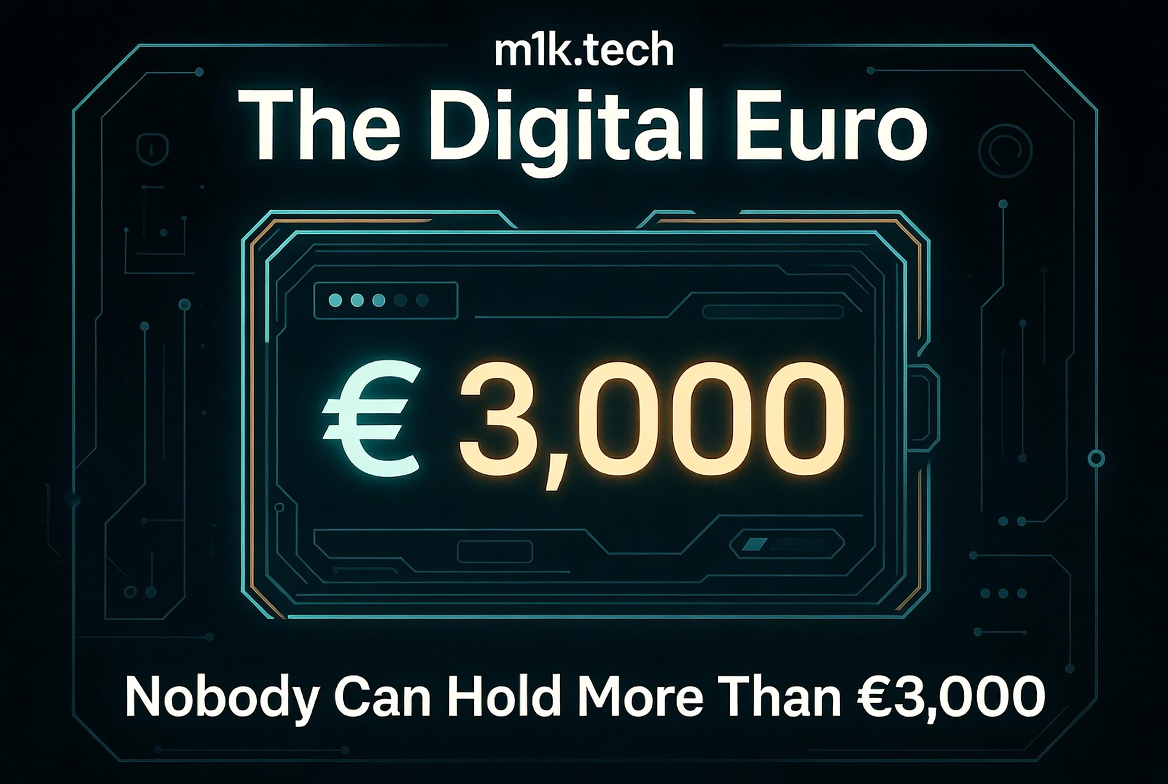
Here is the design choice that tells you what the digital euro is for. You will not be able to hold an unlimited amount. The number floating around negotiations is roughly €3,000 per person, and businesses get an even rougher deal: zero or near-zero standing balance, with incoming payments forced to clear out fast to a linked commercial bank account. The final ceiling isn’t locked, by the way. MEPs want the Commission to set it on ECB advice and revisit it at least every two years, so treat €3,000 as a placeholder, not gospel.
The reason is deposit flight. If you could park your life savings in risk-free central bank money during a wobble, you would, and so would everyone else, and the commercial banks would hemorrhage deposits at the worst possible moment. The cap exists so that doesn’t happen, and there are explicitly no incentives to hold a fat balance.
Now here’s the part I shortchanged the first time I looked at this, because the cap sounds more brutal than it actually plays in daily life. There’s an automated linkage between your digital euro wallet and your regular bank account called the waterfall. Money landing above your limit sweeps automatically into the bank account. And the reverse waterfall pulls the other way: if you go to pay €2,000 and only €400 is sitting in the wallet, the system tops up the shortfall from your linked account on the spot. So in practice you don’t bounce off a €3,000 wall mid-checkout. You barely notice the limit at all for normal spending. It still kills the store-of-value function stone dead, which is the point, but the everyday friction I assumed was there mostly isn’t. For businesses the waterfall isn’t a convenience, it’s the whole mechanism, because near-zero holding means everything they receive has to clear immediately. Franchement that’s a clever bit of design, and it deflates a chunk of the “the cap makes it useless” criticism, mine included.
How it works under the hood
The architecture is split, and the two halves don’t share a foundation.
The online version is account-based. You hold a balance in a digital euro payment account at your PSP, and every transaction is authenticated and settled in real time against a central ledger the Eurosystem runs. The ECB looked at going full decentralised and decided against it for the retail core, because a centralised settlement engine gives you the throughput and the power efficiency a distributed ledger does not. What’s interesting is that “centralised” here doesn’t mean one box in Frankfurt. The ledger is multi-region, three geographic zones each with servers in separate locations, and if an entire region falls over the system reroutes automatically. They borrowed a few DLT design principles for it, atomicity, immutable transactions, distributed consensus for resilience, without making it a blockchain. Smart, honestly, because it gets the robustness story without the energy bill or the throughput ceiling of proof-of-work.
The offline version is a different animal, and this is the part I actually care about. It’s bearer tokens, chunks of value issued and validated centrally but transferred device-to-device over NFC with no internet in the loop. The value lives in tamper-resistant secure hardware on your device: an embedded Secure Element, a secure enclave, or an eSIM, with standards written so your wallet doesn’t end up hostage to your mobile operator. The security target they’re aiming at is Common Criteria AVA_VAN.5, which is the high-assurance tier, the stuff that’s supposed to survive a well-funded attacker with physical access to the chip. Double-spend prevention happens locally, enforced by the secure element itself, and the full reconciliation against the central ledger only happens later when the device reconnects. You pre-fund the offline balance, and the AML checks land at funding and defunding time, exactly like withdrawing and depositing cash. That’s a genuinely cash-like model, and the hardware-root-of-trust approach is the right call. Software-only would have been a joke.
Sitting on top is the DESP, the Digital Euro Service Platform, the shared backbone: issuance and redemption, settlement, tokenisation, the alias system for pay-by-phone-number, fraud tooling, a reference app and SDK. Core settlement and issuance stayed inside the national central banks. The external pieces went out to tender to EU-controlled providers, Giesecke+Devrient on the offline solution, Feedzai and Capgemini on the fraud side, and in April the ECB nailed down standards deals with CPACE, nexo standards and the Berlin Group so tap-to-pay and merchant integration actually work at the terminal. That last one matters more than it sounds. A CBDC that doesn’t tap cleanly is dead on arrival, and the card networks have a twenty-year head start on exactly that.
The biggest political scrap, by the way, was over the offline track. Parliament’s rapporteur Fernando Navarrete wanted it carved out as a fully separate solution that didn’t touch the ECB’s central infrastructure at all. In a closed-door meeting in March, Commission and ECB officials told him flat out it wasn’t technically feasible, and on March 24 lawmakers cut a deal to keep it unified. So the clean separation exists at the token and hardware level, but not on the org chart.
They’re also already worrying about quantum, which I didn’t expect to find this early. The design leans on cryptographic agility, meaning the signatures and key exchange are built to be swapped out without tearing up the architecture, because nobody locks in an algorithm for infrastructure meant to run for decades. And it’s not just slideware. The Eurosystem already pushed post-quantum signatures through TARGET2, the wholesale settlement backbone, in the BIS Project Leap work with Banca d’Italia, Banque de France, the Bundesbank, Nexi-Colt and Swift, and the Phase 2 results dropped in December. The math worked: PQC-signed liquidity transfers went through and bad signatures got rejected. The interesting part was what strained. Running a CRYSTALS-Dilithium signature next to the classical RSA one, the hybrid belt-and-braces approach for the transition, blew the signature from 256 bytes up to roughly 3,300, about thirteen times bigger, and TARGET2’s legacy ESMIG connector only accepts one algorithm at a time. Packet sizes overran the buffers, and verification ran meaningfully slower because the hybrid hedge means running the classical and the post-quantum stack in parallel, so parts of the plumbing had to be redeveloped before any of it ran clean. They couldn’t even test the newer standardised ML-DSA variant yet. None of that is a failure, it’s exactly the kind of thing you want to break in a controlled 2025 trial instead of discovering on Q-Day. No public word yet on which algorithms the retail euro lands on, which is fine, the standards are still settling and those offline secure elements have brutal constraints on key and signature sizes. Agility now, lock-in later. That’s the right order, and it’s more foresight than I’d credited them with going in.
Privacy, which is where it gets loud
Offline, you get something close to cash: only payer and payee know about the transaction, nothing goes to the PSP or the Eurosystem at the moment of payment, reconciliation happens later without spilling the metadata. Online is murkier. The ECB’s line is that everything is pseudonymised and encrypted at its level, so it sees codes for payer, payee and amount, and only the banks can tie those codes to a human. There’s even a Single Access Point that manages holding limits across PSPs on pseudonymised identifiers, and the AI fraud detection runs on pseudonymised data only. Sounds reassuring until you remember that your PSP still sees every online transaction in full, because it has to for AML.
This isn’t really my lane, monetary surveillance theory, but the critique I can’t wave away is that privacy is not just a cryptography problem. You can have beautiful encryption and a tidy plan to swap the algorithms out before they age, and still leak through onboarding, account recovery, provider trust, metadata, holding-limit logic, logs, fraud analysis. Privacy depends on limiting power and data and future uses, not on the strength of a cipher. The ECB has made real design commitments here. Whether the implementation honours them when AML rules and law enforcement start pulling the other way is the thing nobody can promise you today, and I’d be lying if I said the offline-equals-cash framing fully settled it for me.
Who pays for it
Worth knowing where the money comes from, because “free” always means someone else is paying. The ECB reckons roughly €1.3 billion to build the thing to first issuance, then about €320 million a year to run it from 2029, funded out of seigniorage, which is the central bank’s printing-press float. That’s why there are no user fees for basic services. The banks, though, are looking at an estimated €4 to €5.8 billion across the industry to integrate it, spread over about four years. Manageable in the abstract, comparable to what SEPA and PSD2 cost them, but it’s not nothing, and it’s part of why the enthusiasm from the banking sector has been, let’s say, polite rather than warm. They’re being handed a competitor to their own card revenue and a multi-billion integration bill to build it. You can see why they’re not throwing a parade.
The actual reason this exists
Forget convenience. The engine behind the digital euro is sovereignty, and the numbers are embarrassing for Europe. Thirteen European countries depend entirely on non-European card providers. There are nine national card schemes remaining across the continent. When a French person taps a card in Lyon, the rails are very often American.
Then stablecoins showed up and turned the dial to eleven. Around 99% of stablecoins are dollar-denominated, so if euro-area citizens start paying each other in USDC the eurozone is, in effect, importing US monetary conditions into its own economy. It got sharper in January when the US executive order suspended work on an American CBDC and threw its weight behind private dollar stablecoins instead. Cipollone has been blunt: dollar stablecoins now threaten the euro’s monetary sovereignty, and the digital euro is the counterweight. Lagarde framed it years ago as a “digital backbone.” As a French guy living in Chicago who watches both sides of this, I get the anxiety. Payment rails are infrastructure, and Europe outsourced its own.
Where I lose conviction is whether this specific product fixes it. Some serious economists think the sovereignty argument confuses two different things, money and payments, and that the real challenge from stablecoins lands on bank deposits, not on cash, so you’d address it more credibly by regulating stablecoin reserves than by shipping a retail CBDC. The German banking association put it more sharply still: a digital euro only counters dollar stablecoins if it makes them unnecessary, and a capped, lightly used instrument won’t do that. I don’t think they’re wrong. A €3,000-limited payment pipe is not going to dislodge a dollar stablecoin embedded in a global platform.
The bit that quietly undermines its own ambition
You can’t use it outside the eurozone. As designed, it’s unusable beyond the euro area unless there’s a bilateral agreement in place, and it’s residency-restricted on top of the holding caps. So the instrument Europe is positioning as a tool of global monetary projection is, by construction, the least globally usable form of money in the conversation. Stablecoins impose none of these restrictions, which is exactly why they spread.
Meanwhile, the part that ships first
The wholesale track lands three years before the consumer one, and almost nobody outside finance is watching it. Pontes, the Eurosystem’s DLT settlement layer, launches in Q3 2026, well ahead of anything you’ll hold in a wallet. It’s a bridge, stitched together from the three settlement solutions the Eurosystem trialed in 2024: the Bundesbank’s trigger approach, the Banque de France’s full-DLT DL3S, and the Banca d’Italia’s TIPS Hash-Link. In practice, it runs a dual model. A participant parks central bank money in a TARGET account, receives matching cash tokens minted into a Dedicated Cash Wallet on the Eurosystem’s permissioned DLT, and spends those tokens to settle the cash leg of a tokenized trade, with final legal settlement returning to T2. The Hash-Link protocol ties the asset leg and the cash leg together so they either both settle or neither does, which is the entire point of delivery-versus-payment. The whole thing exists to keep tokenized securities and collateral anchored to central bank money instead of drifting onto private stablecoins or foreign rails. Same sovereignty argument as the retail euro, just aimed at the part of the system where the serious money actually moves. Pontes is the pragmatic near-term piece. Appia is the bigger vision behind it: the Eurosystem dropped the Appia roadmap in March, with a full blueprint due in 2028, laying out a more native, tokenized settlement ecosystem on European DLT with common standards and European governance built in from the start. They named it after the Via Appia, the Roman road, which makes Pontes (Latin for bridges) the on-ramp. Cipollone’s framing was building a road from today’s financial system to tomorrow’s tokenized markets, and Pontes is expected to fold into Appia as it matures. I’m not going to pretend I can model what atomic delivery-versus-payment does to repo and collateral markets; that’s well past my pay grade. But the strategic read is simple: the wholesale euro is the quiet, low-risk, ship-it-now move, and the retail euro is the loud, slow, politically radioactive one. I went deeper on Pontes, Appia, and the post-quantum plumbing underneath all this in a separate piece.
So, is it good
Depends who you are.
If you’re a citizen who wants a public, sovereign alternative to Visa and a dollar stablecoin, with cash-like offline payments, real hardware security, and no counterparty risk, there’s a genuine thing here worth wanting. The accessibility work has been serious too; the ECB partnered with Spain’s ONCE Foundation specifically to make the app usable for people with disabilities, and the waterfall mechanics mean the holding cap won’t actually nag you at the till.
If you’re looking for somewhere to keep money, or pay someone in another currency, or build programmable money on top, this isn’t it and was never meant to be. It’s retail-only, capped, residency-walled. It does support conditional and reserved payments online, so it’s not completely inert, but the core deliberately rules out the usage-restriction “programmable money” people fear, and arbitrary smart-contract logic isn’t in scope. One peer-reviewed teardown went so far as to say that both versions show clear disadvantages compared with cash and ordinary bank money, with no discernible customer benefit, and that proprietary rather than open-source software undermines trust. That’s harsh, and the waterfall and offline design answer part of it, but the core complaint that there’s no obvious reason for a normal person to choose this over what they already tap is the question the ECB still hasn’t answered convincingly.
The honest position in mid-2026 is that politics matter more than tech right now. The architecture works, the engineering is mostly sound, and the secure-element offline model is better than I expected going in. The trilogue is the real fight, the holding limit is still a live number, and the whole 2029 timeline collapses if the legislation stalls. I still don’t know whether anyone outside a policy seminar will actually want to use this thing on launch day. Ask me again when the 2027 pilot puts it in front of real merchants and we find out if “sovereign” is a feature people tap their phone for.