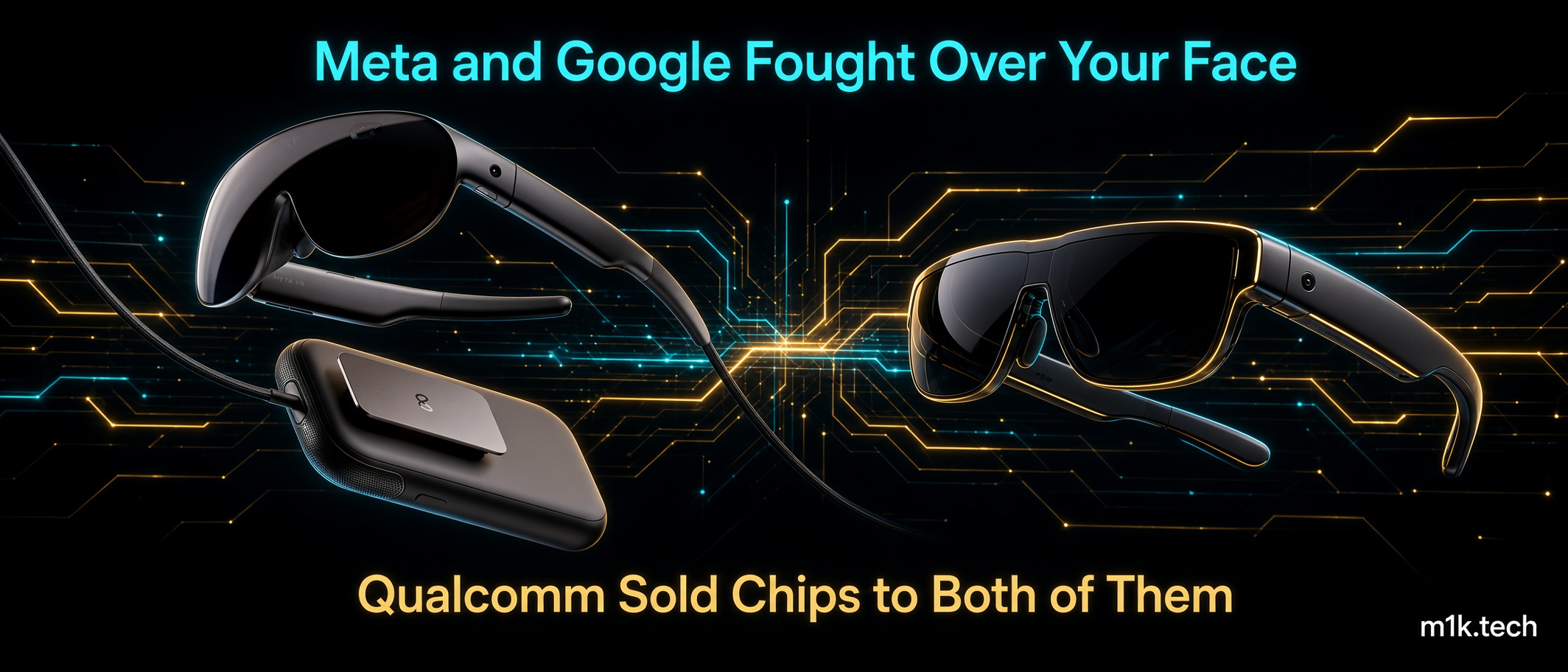
Meta’s headline product at Connect this week, a $1,299.99 pair of VR glasses that weighs about 100 grams on your face, gets its brain from a pocket puck running Qualcomm’s Snapdragon Reality Elite. Roughly 2,400 miles southwest, at the same hour, Google’s Shahram Izadi was on stage in Maui telling Qualcomm’s Summit audience that Google’s own glasses would run on Snapdragon too. The two biggest companies fighting over smart glasses spent the same Wednesday buying from the same supplier.
I promised this post in my Day 2 Summit recap, and I had the thesis written in my head before Connect started: Google and Samsung buy their glasses silicon from Qualcomm, Meta increasingly builds its own. That thesis died on stage. Meta’s most ambitious hardware of the year runs on the same platform that powers XREAL’s Aura, and its new camera-free glasses run on a Qualcomm audio chip. Qualcomm didn’t need to win the glasses war this week. It sold both armies their rifles, and it helped both rename them on the way out the door.
Meta renamed a headset. Qualcomm renamed a chip.
The device Meta called VR Glasses on stage is the one that spent a year in leaks as Project Phoenix, the rumored Quest Pro successor. Meta didn’t say the codename out loud and didn’t put the word Quest anywhere near it. That’s a deliberate choice, and I think it’s the most interesting marketing decision Meta made this week, because technically this is still a passthrough headset. Cameras on the outside film the room and the displays show it back to you; you are not looking through clear lenses at the world. It runs the same Horizon OS as the Quest 3, and existing Quest apps carry over. What changed is where the weight lives. Sensors, displays, and lenses sit on the face at around 100 grams; compute, battery, storage, and a cooling fan move into a roughly 300-gram puck on an optical tether that clips to a pocket or sits on a table.
Calling that “glasses” borrows credibility from the one part of Meta’s hardware business that is actually working. The Ray-Ban Display sold out for most of the year, and no Quest has had a year like that lately. So the new VR product gets the glasses name, the glasses silhouette and a glasses price conversation, even though it’s a VR display you strap to your face with a cable.
Qualcomm pulled the exact same move one layer down. Snapdragon Reality Elite, announced at AWE in June, is the XR2 Gen 3 by any engineering definition, the successor to the XR2 Gen 2 in the Quest 3 and the XR2+ Gen 2 in Samsung’s Galaxy XR. Qualcomm dropped the XR2 name, and Meta’s own spokesperson still called the chip an XR2 Gen 3 when a reviewer asked during hands-on demos, which tells you how new the rebrand is even inside its biggest customer. Both companies are running away from the same word. “XR2” and “Quest” both mean gaming headset to the people these products are supposed to reach next, and neither Meta nor Qualcomm wants the 2027 lineup filed under gaming.
The spec sheet explains why Meta leans on media rather than games. Each eye gets a 2,412 × 2,288 micro-OLED panel at up to 120Hz behind pancake lenses, Meta’s first non-LCD headset since the original Quest in 2019. Meta quotes 37 pixels per degree against roughly 25 on the Quest 3, and claims that it edges out Apple’s Vision Pro at 34. The “5K Infinite Display” branding is itself a bit of creative accounting: two panels side by side add up to a little over 4,800 pixels across, which is how you get to a “5K” label for a headset whose individual eyes are closer to 2.4K. The price for all that sharpness is field of view: 70 degrees horizontal by 66 vertical, against about 110 by 96 on the Quest 3. Meta’s answer is an open-periphery design: leave the optional light blockers off and you see the real room around the image, with color passthrough at 26 PPD filling the middle.
The rest reads like a portable cinema brief. The puck carries Reality Elite with 12GB of RAM, 128GB of storage with microSD up to 1TB, 45W charging, and up to three hours of continuous high-resolution media playback by Meta’s rating. Four internal cameras handle eye tracking, controllers are optional and sold separately, IPD adjusts manually from 56 to 70 millimeters, and prescription inserts come through Zenni. The on-stage pitch was Disney+ 3D, IMAX-certified movies and live sports, then games. A sharper, narrower image suits a movie screen far better than a sword fight, and the naming, display choice, and demo order all point the same way.
The camera-free pair runs on an earbud chip
The other new product I care about from Connect is Ray-Ban Meta Audio, Meta’s first glasses with no camera. They weigh 43 grams, are the thinnest Ray-Ban Metas Meta has made, run up to 12 hours on a charge with another 48 from the case, and come in Clubmaster and Burbank frames across 23 lens and color combinations at $349, shipping October 13. You keep the voice half of Meta AI, music, calls and translation, and lose everything that points a lens at a stranger.
I read that as a direct response to the privacy fight that has followed these glasses into courtrooms and cinemas, from the class action that added bystanders who never bought a pair to the LED loophole Meta has now patched twice. Removing the camera is the only fix that doesn’t depend on a light or a policy, and it’s the one the institutions writing their own rules have been asking for since the summer.
The silicon is what surprised me. Qualcomm’s own post-Summit takeaways named the platform inside Ray-Ban Meta Audio as Snapdragon S7 Gen 1. That’s not a glasses chip. It’s a Qualcomm Sound platform, the family built for earbuds, and it’s the older part Qualcomm used as its comparison baseline for the Sound Elite Gen 2 it launched in Maui on the same day. In silicon terms, Meta’s camera-free glasses are premium earbuds bent into a Ray-Ban frame, shipping on last year’s audio platform the week its successor was unveiled. For a $349 product that has to run all day, it’s a sensible cost and battery call. It also tells you how Meta thinks about the category: audio glasses are hearables, not cut-down camera glasses.
That framing fits the other audio announcement. Hearing Enhancement, an FDA-cleared over-the-counter hearing feature for mild to moderate hearing loss, costs a one-time $149.99 or comes bundled in the Meta One subscription, and it reaches Meta’s own-brand glasses first before arriving on Ray-Ban Meta Audio later. It’s a sharp commercial move with an awkward partnership edge: EssilorLuxottica, the company that makes Meta’s frames, already sells its own hearing-aid glasses under the Nuance Audio brand. Meta is now competing with its frame partner’s hearing product, using that partner’s frames.
The silicon map
Put Meta’s two new products next to everything Google and its partners confirmed in Maui, and the chip column is almost boringly uniform.
| Device | Chip | Price | Availability | Notable |
|---|---|---|---|---|
| Meta VR Glasses | Snapdragon Reality Elite (in puck), 12GB RAM | $1,299.99 | Spring 2027 | ~100g glasses, ~300g puck, 70° × 66° FOV, 37 PPD |
| Ray-Ban Meta Audio | Snapdragon S7 Gen 1 (audio platform) | $349 | Ships October 13 | No camera, 43g, 12h plus 48h from case |
| Samsung/Google intelligent eyewear (Gentle Monster, Warby Parker) | Snapdragon AR1 Gen 1 | Not announced | Later 2026 | Android XR, Gemini, camera, 9h plus 7 case charges |
| XREAL Aura | Snapdragon Reality Elite (puck) + XREAL X1S (glasses) | Under $1,500 (stated cap) | This fall | Android XR, 95g glasses, 4,455mAh puck battery |
| Snap Specs | Two Snapdragon XR chips (unnamed) | $2,195 | Launched June | Waveguide AR, Snap OS |
Reality Elite is a thermal answer wearing a performance badge
Against the XR2 Gen 2 in the Quest 3, Qualcomm claims Reality Elite delivers up to 60 percent more GPU performance, 30 percent more CPU, 160 percent more NPU throughput, and up to 48 TOPS. Those numbers get the headlines. The numbers that decided the form factor are quieter: up to 20 percent longer battery life at the same workload versus the XR2+ Gen 2 in Galaxy XR, and running up to 12°C cooler under load.
That cooling figure is the whole reason the puck architecture exists. A chip in your pocket has a very different thermal budget from one strapped to your forehead, and Qualcomm designed Reality Elite to work in either spot. Meta and XREAL both chose the pocket. XREAL adds a twist: its X1S co-processor stays in the glasses to handle the low-latency sensor and display work, so the tether carries only what can tolerate the round trip. I find XREAL’s split more interesting from an engineering standpoint, because it treats the latency-critical path as something you don’t outsource to a cable. Meta’s puck needs a fan, which says a lot about how hard it plans to push the chip.
Further down the stack, the AR1 family handles everyday camera-and-voice glasses where there’s no puck and no display, and Qualcomm’s new Snapdragon START program, which I covered on Day 2, packages an AR1+ module with software and white-label designs so eyewear companies can ship without building a hardware team. UK eyewear maker Inspecs went from kickoff to a working device in four months; Awear built its agentic glasses on AR1+ in three. That program is the most underrated part of Qualcomm’s glasses strategy, because it turns every frame brand into a potential Snapdragon customer.
Three ways to sell the same chip
Meta’s go-to-market is vertical everywhere except the silicon. It owns the agent, Muse, which launched September 8 on iOS, Android, the web, and WhatsApp before it came anywhere near glasses. It owns the operating system experience and the subscription, and it borrows the frames and retail footprint of EssilorLuxottica, with more than 100 styles promised across its glasses lines by the end of the year. The VR Glasses rebrand fits that playbook neatly: one agent, one subscription, and every device, even the VR one, marketed as glasses.
Google’s play is horizontal, the Android playbook applied to your face. Google provides Android XR and Gemini, calls Android XR a platform built with Samsung and Qualcomm, and lets partners supply everything else. The intelligent eyewear Izadi talked about is Samsung-built hardware that Samsung introduced at Unpacked in London in July, on Snapdragon AR1 Gen 1, with frames from Gentle Monster and Warby Parker. Google split the category into audio glasses and display glasses back at I/O in May, so it will meet Meta’s camera-free pair head-on. XREAL builds Aura on the same OS with a puck. The Pixel Watch 5 runs Gemini Intelligence on Snapdragon. Izadi gave no final price for the glasses, only that more details are coming in the months ahead.
Qualcomm’s play is to be indifferent to which of those two wins. Ziad Asghar, who runs XR at Qualcomm, spent the week defending smart glasses as a category and blaming the backlash on novelty. Of course he did: every glasses scenario on the table this week ends with a Snapdragon inside. Snap’s Specs, at $2,195 on proprietary Snap OS, use two unnamed Snapdragon XR chips. HTC’s Vive Eagle, which landed in Europe on a 2023 Snapdragon two days before Connect, uses AR1. Play For Dream has committed its next headset to Reality Elite. The only meaningful absence is Apple, whose glasses are running late and will run on Apple silicon whenever they arrive, a story I covered when Apple cut the Vision Pro gaming team.
Qualcomm’s obvious long-term risk is the one it’s living through with Apple in modems: the biggest customer deciding it can build the chip itself. Nothing announced this week suggests Meta is there. If anything, handing its flagship device to a Qualcomm puck and its privacy-friendly glasses to a Qualcomm earbud platform says Meta decided the silicon isn’t where it wants to spend its differentiation budget, at least through 2027.
The price problem nobody on either stage wanted to discuss
$1,299.99 for Meta’s VR Glasses, with no controllers included, lands about $241 above the 256GB Steam Frame, which itself costs $1,059 largely because of RAM. XREAL caps Aura at under $1,500. Snap wants $2,195. The memory crunch that shaped every phone price this week is shaping these too, and a puck with 12GB of RAM carries the same memory bill a phone does. Meta also has no new headset to sell until spring, which leaves Quest buyers staring at an old lineup through the holidays.
I haven’t worn any of these, so I’m not weighing in on comfort. One early side-by-side put Specs at 51 degrees against Aura’s 70, and Meta’s VR Glasses land at the same 70 horizontal, which tells you where the industry thinks the sweet spot between weight and immersion sits right now. I’d rather wait for my own face on it.
What stays with me from this week is how completely the fight has moved off the hardware. Meta, Google, Snap, and XREAL are all buying from one supplier, all putting compute in a pocket or a tiny module, and all shipping frames made by eyewear companies rather than electronics companies. Even the names are converging: Meta’s VR headset is now glasses, Qualcomm’s XR chip is now a Reality platform, and the audio glasses are earbuds with hinges. The layer they’re actually fighting over is the agent, which is the same thing every partner in Maui pitched to me on Day 2: the thing that listens, watches, and remembers your day. Muse on one side, Gemini on the other, a small startup like Awear trying to wedge in with cryptographic memory. The hardware converged so fast that the chip spec sheet stopped telling you anything about who wins. The question I’d ask of any of these now isn’t the SoC or the weight. It’s which company’s agent I’m willing to let sit on my face all day, and I haven’t answered that for myself yet.
Sources
- Qualcomm: Snapdragon Summit 2026, three key takeaways from Maui (platforms in Meta Audio and VR Glasses)
- VR.org: Phoenix arrives as Meta VR Glasses, $1,299.99, spring 2027, 300-gram puck
- Hardware Busters: Meta VR Glasses and the 70-degree field of view
- Tom’s Guide: Meta VR Glasses hands-on, Meta confirms XR2 Gen 3 / Reality Elite
- Popular Science: Meta Connect prices and ship dates, Ray-Ban Meta Audio October 13
- The Next Web: Meta unveils $1,299 VR glasses and turns its AI glasses into hearing aids
- Digital Today: Google Android XR uses Snapdragon by form factor, Izadi keynote
- Samsung Newsroom: Samsung intelligent eyewear on Snapdragon AR1 Gen 1
- Google: Intelligent eyewear with Gemini is coming this fall
- UploadVR: Qualcomm announces Snapdragon Reality Elite
- GSMArena: XREAL Aura with Android XR and Reality Elite
- Gizmodo: Snap Specs versus XREAL Aura