Xiaomi just became the fourth phone maker on earth that designs its own processor, after Apple, Samsung and Huawei. The chip is called the Surge S1, it is going into a mid-range phone called the Mi 5C, and the most telling decision in the whole thing is how little it tries to do.
Owning the silicon is the deepest cut of vertical integration there is in phones. It is why Apple’s A-series runs away from everyone, and it is why Huawei’s Kirin lets it stop writing checks to Qualcomm. Xiaomi stood up its Pinecone subsidiary back in 2014 precisely so it would not have to rent its brains forever, and shipping real silicon three years later puts it in a club of four companies. That is the headline. The chip underneath the headline is deliberately unambitious, and I think that is exactly the right call.
The Surge S1 is an octa-core part built entirely from ARM’s Cortex-A53, four of them running up to 2.2 GHz for the heavy work and four more capped at 1.4 GHz for everything else, paired with a Mali-T860 MP4 GPU, LPDDR3 memory and an integrated image signal processor. It is fabricated on a mature 28nm process, not anything close to the leading edge. There are no custom cores and no exotic node. It is aimed squarely at the mid-range tier where the Snapdragon 625 and MediaTek’s Helio P20 live, and nowhere near the flagship.
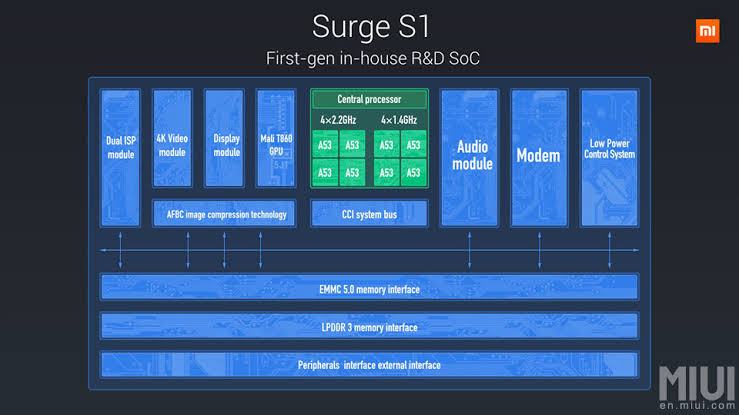
That restraint is the smartest thing about it. Almost everyone who designs a first chip wants to swing for a flagship and then faceplants on heat and modem bring-up; even the giants had ugly first-generation parts. Xiaomi did the reverse and picked proven A53 cores on a cheap, thermally forgiving node, the same kind of 28nm generation Qualcomm leaned on for its first integrated-LTE Krait chips, and pointed the whole thing at the segment where “good enough and cheap” is the entire job. Set it next to a Snapdragon 835 and it is not in the conversation, which is fine, because it is a learning chip that also happens to have to ship inside a phone people pay for.
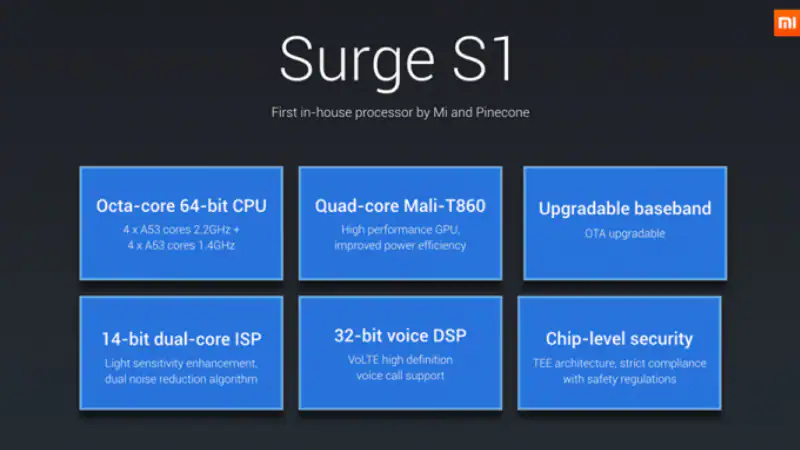
The catch is that 28nm in 2017 is two nodes behind the flagships, so the S1 is going to run hotter and thirstier than the 14nm Snapdragon 625 it is nominally fighting, which is an awkward way to debut. The modem is the part I would watch hardest, because modems are exactly where in-house silicon dreams go to die, and Xiaomi’s is completely unproven. I am not getting into the patent and licensing swamp around building a cellular modem, because that is its own multi-year nightmare and it is the reason Apple, of all companies, still buys them from someone else.
The Surge S1 is not a good chip measured against flagships, and it was never meant to be. It is Xiaomi buying itself an education in silicon on the cheapest possible terms, dropped into a phone that can comfortably absorb a mediocre first attempt. The real question is whether there is ever a Surge S2 that climbs a tier, because one modest mid-range SoC proves you can tape out a design, not that you can ever replace Qualcomm. I would call it even odds. Drawing the chip is the easy part. Affording to keep drawing them, generation after generation, is where this gets hard.