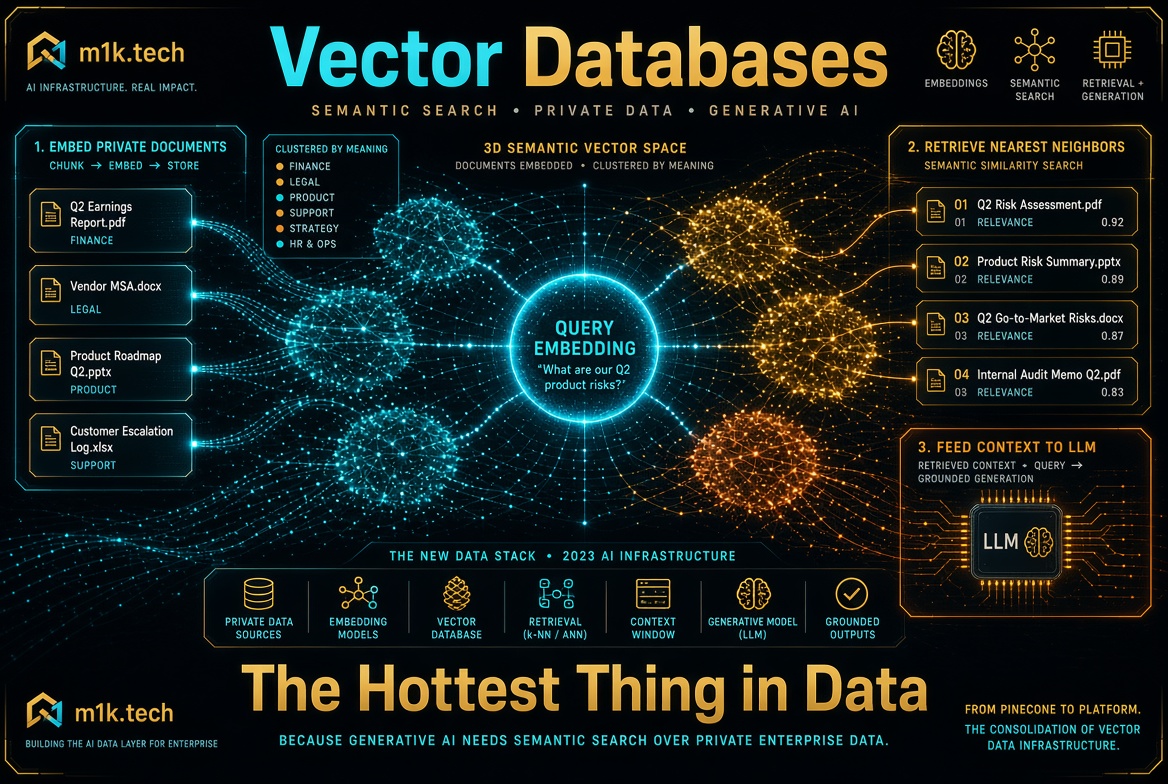
As enterprises race to build applications on top of ChatGPT and GPT-4, a previously obscure technology category is suddenly becoming one of the hottest corners of the data world: vector databases. Companies building these systems, names like Pinecone, are raising large sums almost overnight, and established databases are scrambling to add vector capabilities, including an open-source extension for the popular PostgreSQL database called pgvector that is becoming enormously popular. To understand why a niche piece of database technology is suddenly famous, you have to understand a problem that every company trying to use large language models on their own data runs into immediately, and the elegant solution that vectors provide.
The Problem: Models Do Not Know Your Data
A model like GPT-4 is trained on a vast snapshot of public text, but it knows nothing about your company’s internal documents, product manuals, support tickets, or private knowledge. Worse, it will confidently make things up when it does not know an answer. So the central challenge for enterprise AI is this: how do you get a general-purpose model to answer questions accurately using your specific, private information?
One option is to retrain the model on your data, but that is expensive, slow, and has to be redone every time your data changes. A far more practical approach is emerging: when a user asks a question, first find the relevant pieces of your company’s information, then hand those pieces to the model along with the question, instructing it to answer based on them. This is like giving a brilliant but uninformed consultant the exact reference documents they need right before they answer, rather than sending them to years of school. But this approach hinges on one hard step: how do you quickly find the relevant pieces of information out of millions of documents, based on meaning rather than exact keywords? That is the problem vectors solve.
What a Vector Actually Is
Here is the core idea, and it is genuinely beautiful once it clicks. AI models can convert any piece of text, a sentence, a paragraph, a document, into a long list of numbers called a vector, or an embedding. The remarkable property is that these numbers capture the text’s meaning: pieces of text with similar meanings get similar lists of numbers, placing them close together in a mathematical space, while unrelated texts land far apart.
Picture a vast library where, instead of shelving books alphabetically, you place them in a giant space according to their meaning, so that all the books about cooking cluster in one region, all the books about space travel in another, and a book about the history of pizza sits somewhere between the cooking section and the history section. Now, to find books relevant to a question, you do not search for matching words; you go to the location in the space that matches the meaning of your question and grab whatever is nearby. That is what vectors enable: search by meaning, by proximity in this space, rather than by exact word matching.
So if a user asks “how do I reset my password,” a vector search can find a support document titled “account recovery steps” even though it shares no keywords, because the meanings are close and so their vectors sit near each other. Traditional keyword search would miss that connection entirely. This semantic search, finding things by meaning, is the capability that makes it possible to feed a language model the right context to answer questions about your private data.
Why a Whole New Database Category Is Appearing
Storing and searching these vectors efficiently, especially at the scale of millions or billions, is a specialized technical challenge that traditional databases were not built for. Finding the nearest vectors to a query vector, among billions, very quickly requires purpose-built indexing and storage. That need is creating an opening for dedicated vector databases like Pinecone, designed from the ground up to do exactly this, and they are riding the AI boom to sudden prominence and large funding rounds.
At the same time, existing databases recognize the demand and are racing to add vector capabilities so customers do not need a separate system. pgvector, the open-source extension that adds vector search to the widely used PostgreSQL database, is becoming hugely popular precisely because it lets companies add this capability to a database they already run. This raises a classic competitive question: will companies adopt specialized standalone vector databases, or will vector search become a feature absorbed into the databases and data platforms they already use?
What It Means for the Market
The vector database boom is a direct consequence of the generative AI explosion, and it lands squarely in the territory of the data platforms. Both Databricks and Snowflake are moving to add vector search and storage capabilities to their platforms, viewing it as essential to being the place where enterprises connect their data to AI. Their argument is the familiar consolidation pitch: why run a separate specialized vector database when your data platform can handle vectors alongside everything else, keeping it all in one place? This puts pressure on the standalone vector database startups, whose specialized advantage risks being absorbed as a mere feature by the larger platforms, the same fragmentation-versus-consolidation dynamic that recurs across the industry.
The benefit to enterprises is the technical foundation for making AI actually useful on their own information: the ability to build systems that answer questions accurately from private company data rather than relying on a general model’s incomplete and sometimes fabricated knowledge. Vector search is the unglamorous plumbing that makes trustworthy enterprise AI possible, and it is becoming a standard expected capability of any serious data platform almost overnight. The vector database moment perfectly illustrates how the generative AI boom creates entirely new categories of data infrastructure, and how big platforms move quickly to absorb them. It also sets up the next piece of the puzzle: the specific technique that ties vectors and language models together into a reliable enterprise system.