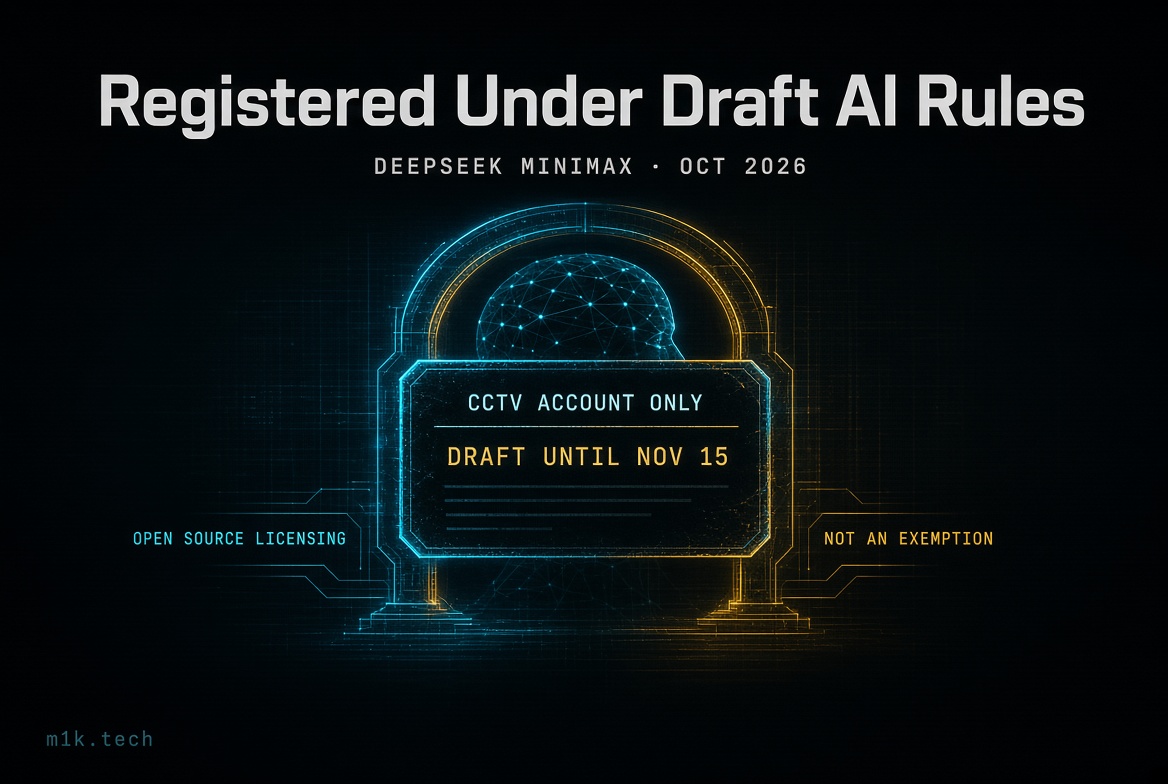
DeepSeek and MiniMax have finished registering under China’s draft AI export rules and are moving ahead with open-source releases and overseas licensing, according to a post late Thursday from Yuyuan Tantian, a social media account affiliated with state broadcaster CCTV.
That account is the only source. The Next Web, relaying Reuters, says it hasn’t verified the post, and neither company replied to Reuters when it ran. I’m uneasy building anything on one state-adjacent account, so read the rest as how Beijing wants these rules described.
The post does add detail I didn’t have when I wrote up the draft on the 16th. For large models, it gives three tests: training compute above 10^26 floating-point operations (the article’s text renders this as “1026,” which I read as a lost superscript), more than 2 trillion parameters, or capability in the global top ten. The last two match the Bloomberg reading I used then. It also says models trained on “core data” would be banned from export, and models trained on “important data” restricted whatever their size; agents above a set performance level are restricted, and agents built mainly for critical infrastructure, defense or core government affairs are banned.
Registration is not an exemption.
In my write-up, I said the ministry called open source exempt. The account’s wording is different: open-source technology gets automatic licensing, which it describes as “immediate reporting and export,” so developers still report. Technology already public through open source or academic papers falls outside the rules entirely. Calls through an API, an app, a web page, or SaaS, and lightweight local deployment aren’t treated as exports, and neither are Chinese companies’ own computing centers abroad, overseas chip tape-out, joint research, and standards work, which also get automatic licenses. Whether that is a genuine change from the first reading or a translation difference, I can’t say without the Chinese text.
The timing is hard to ignore. DeepSeek reportedly raised about $15 billion this week from Tencent and CATL, days after the US federal ban, and a lab with that much new money and an overseas user base has every reason to be first through a registration window. The post goes further and sets the rules against Washington: it cites the Commerce Department’s January 2025 AI diffusion framework and what it calls an alliance strategy from Anthropic’s CEO, then says China did not take that path. That is persuasion aimed at developers abroad, and it may even be fair, but it is not a legal reading.
The account lists AI chip design and high-speed links for large computing clusters as covered and says nothing more, so the clause I expected to draw the fight is where the detail is thinnest. That is the territory of Alibaba’s Zhenwu V900 and Huawei’s pulled-forward Ascend 960DT, and neither company has been mentioned in any of this coverage.
Public comment closes on 15 November, and lawyers who took part in the consultations say some control points have already moved since the first draft. I don’t expect final text before December.
Sources
The Next Web, DeepSeek and MiniMax clear China AI export controls for overseas use, October 25, 2026