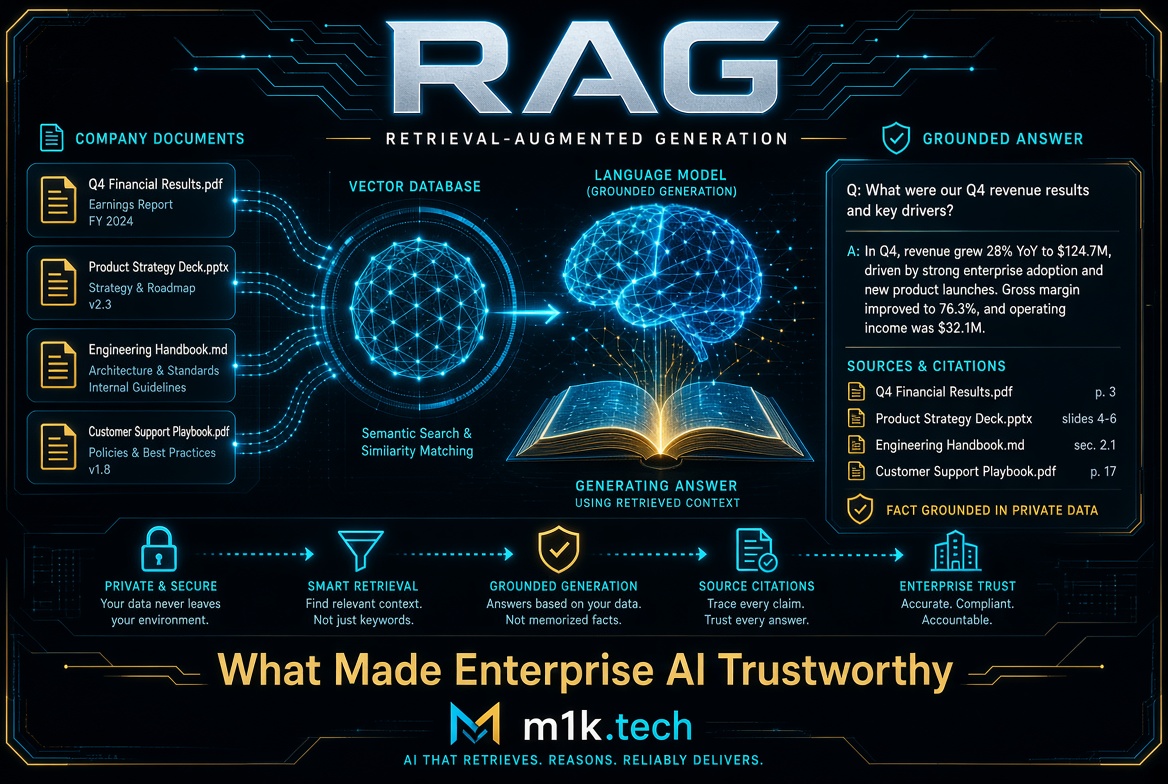
As enterprises move from playing with ChatGPT to actually deploying AI in their businesses, one technique is rising above all others as the practical workhorse of enterprise generative AI. It is called retrieval-augmented generation, almost always shortened to RAG, and while the name is forgettable, the idea behind it is becoming the dominant pattern for building useful, trustworthy AI applications on top of company data. It is the technique that assembles the pieces- the language models and the vector databases- into something a business can actually rely on. Understanding it explains how enterprises are taming the hallucination problem and why the data platforms are becoming the natural home for enterprise AI.
The Problem RAG Solves
Two core problems arise when using a general language model in a business. First, the model knows nothing about your private, internal information, your policies, products, customers, or documents. Second, when it does not know something, it tends to confidently invent an answer- the hallucination problem. Both are fatal for serious enterprise use. A customer-service AI that makes up your return policy, or a financial assistant that fabricates a number, is worse than useless; it is a liability.
RAG addresses both problems at once with a simple, powerful idea: do not ask the model to answer from its own memory. Instead, first retrieve the relevant facts from your trusted company data, then give those facts to the model and ask it to compose an answer based only on them. The model’s job shifts from remembering to summarizing and explaining the specific information you provide.
How It Works, Step by Step
Picture an open-book exam versus a closed-book one. A closed-book exam forces the student to answer purely from memory, and a student who half-remembers will guess and sometimes guess wrong, confidently. An open-book exam lets the student look up the relevant passage and base their answer on it, producing far more accurate results. RAG turns enterprise AI from a closed-book exam into an open-book one.
Concretely, when a user asks a question, the system does three things. First, retrieval: it searches the company’s data, typically using vector search, to find the pieces of information most relevant to the question- the right pages of the textbook, so to speak. Second, augmentation: it takes those retrieved pieces and inserts them into the prompt it sends to the language model, along with the user’s question and an instruction to answer based on the provided information. Third, generation: the model produces a fluent answer grounded in those specific facts. Because the model works from supplied, verified information rather than its own fuzzy memory, the answers are far more accurate and less prone to hallucination; crucially, the system can cite which documents it used, so a human can check.
The ability to cite sources is a big deal for enterprise trust. A RAG system can say, in effect, here is my answer, and here are the three internal documents I based it on, which lets users verify the answer and builds confidence that the AI is not simply making things up. For regulated industries and high-stakes decisions, this traceability is often the difference between an AI tool you can deploy and one you can’t.
Why RAG Beats the Alternatives
An alternative approach to getting a model to know your data is fine-tuning, which means further training the model on your specific information so it absorbs that knowledge into itself. Fine-tuning has its place, but for keeping a model current with changing facts, RAG usually wins, and it is worth understanding why. Fine-tuning bakes knowledge in permanently, so every time your data changes, you have to retrain, which is slow and costly. RAG keeps the knowledge external, in your live data, so when your information changes, the system simply retrieves the new version, no retraining required. Update a document, and the next answer reflects it instantly.
This makes RAG far more practical for the constantly changing information most businesses run on, current prices, latest policies, recent records. It also keeps sensitive data under the company’s control in its own systems, rather than baking it into a model that’s harder to govern. For most enterprise use cases, RAG offers the best balance of accuracy, freshness, control, and cost.
What It Means for the Market
RAG’s rise to dominance has profound implications for data platforms, and it explains much of the current competitive moves. If the winning pattern for enterprise AI is to retrieve a company’s data and feed it to a model, then whoever manages that company’s data sits in the most valuable position of all. The data platform becomes the natural foundation for enterprise AI, because it already holds the data, can already search it, and can now connect it directly to language models through RAG. This is precisely why Databricks and Snowflake are racing to build integrated AI capabilities, vector search, model serving, and RAG tooling directly into their platforms. They want to be the one-stop home where a company’s data and its AI live together.
This dynamic is turning the data platforms from suppliers of raw material into the central stage for enterprise AI itself. The competitive battle between Databricks and Snowflake increasingly becomes a battle over who can best enable RAG and related techniques on a company’s data, each racing to make building a trustworthy AI application on their platform as easy as possible. The benefit to enterprises is the ability to finally deploy generative AI they can trust: systems that answer from verified company information, cite their sources, stay current as data changes, and largely avoid the confident fabrication that makes raw models too risky for serious use. RAG is the unglamorous technique that makes enterprise AI practical, and in doing so, it confirms that the company holding the data holds the keys to the AI era.