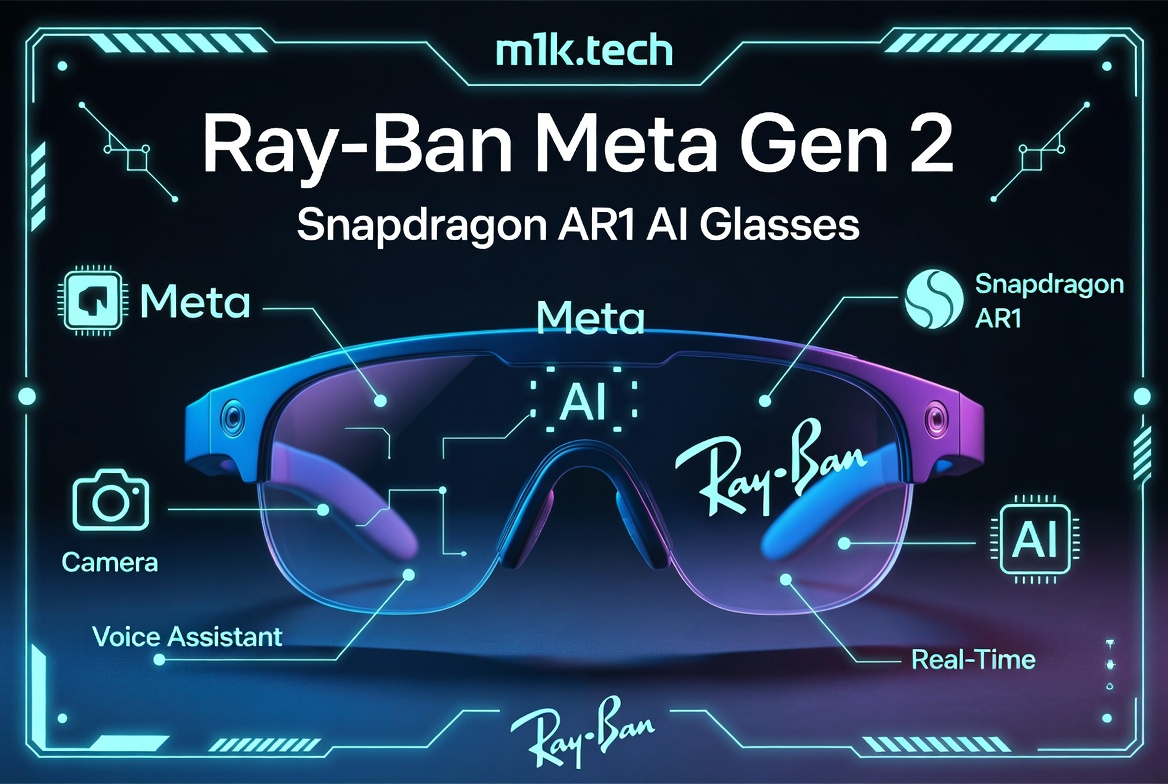
Meta Connect just delivered two products that tell different stories. I covered the Quest 3 and the XR2 Gen 2 chip separately because it deserves its own space. This post is about the other announcement, which might matter more long-term: the second-generation Ray-Ban Meta smart glasses, now running on Qualcomm’s Snapdragon AR1 Gen 1, the first chip built specifically for screenless smart glasses. Snapdragon Insider bias declared upfront.
The AR1 changes the equation
The original Ray-Ban Stories ran on a repurposed phone chip. The AR1 Gen 1 is purpose-built for the thermal and power constraints of a glasses arm. The result: a 12MP camera instead of 5MP, better audio, and enough headroom for Meta AI, a voice assistant that turns the glasses from a capture device into something that can answer questions, identify objects in front of you, and translate text in real time. You can also livestream to Instagram or Facebook directly from your point of view. At $299, the price holds flat from generation one, which means Meta is subsidizing the hardware to build the installed base. Same playbook as Quest 2.
The platform play
Meta AI is the real upgrade here. The hardware is the delivery mechanism; the software is the product. If Meta AI gets meaningfully smarter through updates over the next twelve months without requiring new glasses, that is a strong retention loop. The AR1 makes that possible: enough compute to run the models locally without the arm getting hot enough to melt off your face.
The trend for the year ahead
AI on the face is now a product, not a concept. Watch the attach rate on Meta AI usage, because that is the metric that tells you whether these are a gadget or a platform. The glasses that can answer your questions have a fundamentally different value proposition from the glasses that just take photos.
The Trojan horse just got its intelligence. Generation one normalized the form factor. Generation two installs the brain. This is the product cycle I predicted when the partnership was announced: fashion first, then silicon, then intelligence. The AR1 is why that sequence works.
Part of Two Decades of XR, my running diary of virtual, augmented, and mixed reality.