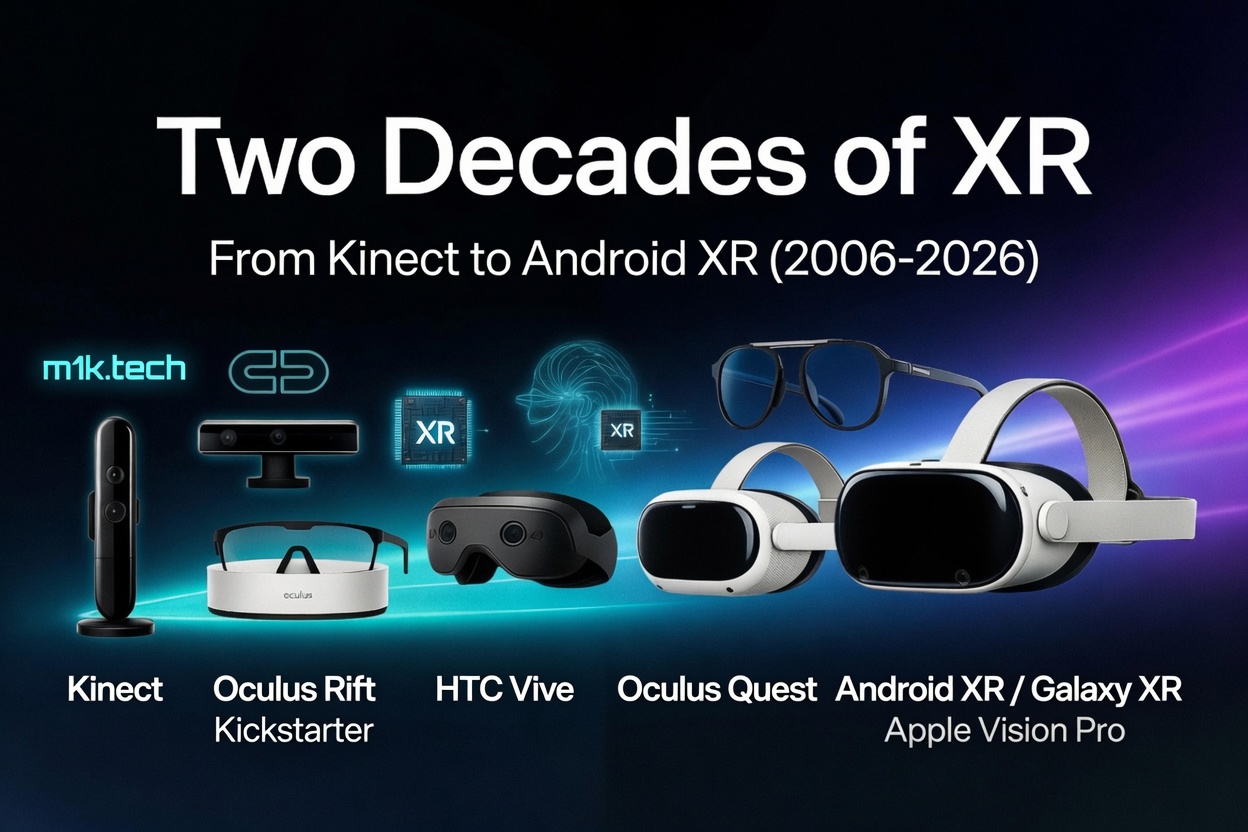
I have been tracking XR for almost two decades, from the Kinect’s depth camera to the Snapdragon XR2+ Gen 2 powering today’s headsets. This is the retrospective: what worked, what died, and how a niche curiosity became a three-way platform war between Apple, Meta, and the Samsung-Google-Qualcomm alliance. Each entry below links to the diary post I wrote at the time, present-tense and without hindsight, so you can see what the moment actually felt like before the market told us who won.
The prologue: sensors and the Kickstarter (2010 to 2014)
It started with a depth camera in the living room and a $2.4 million Kickstarter. Kinect gave the world cheap 3D sensing. Palmer Luckey’s Rift rebooted VR on phone screens and latency hacks. Google Glass flared and died as a consumer product, killed by social awkwardness. Facebook’s $2 billion Oculus bet and Samsung’s Gear VR turned the phone into a headset. Lesson one: the Kickstarter darlings set the direction, the platform companies set the pace.
Full entries: Kinect, Rift Kickstarter, DK1 and Glass, Facebook buys Oculus, Cardboard and Gear VR.
Consumer VR arrives, sort of (2015 to 2017)
HoloLens gave the world “mixed reality” and an impressive demo that enterprise loved and consumers never touched. The Vive delivered room-scale. The Rift CV1 and PSVR shipped alongside, and CES 2016 was VR’s big swing. Then ARKit and ARCore quietly put AR in a billion pockets without needing a headset at all. Lesson two: the biggest AR deployment happened on the phone, not on your face.
Full entries: HoloLens, HTC Vive, Rift and Vive ship, PlayStation VR, ARKit and ARCore.
Standalone and the SoC spine (2018 to 2020)
This is where Qualcomm committed to XR as a product line. The Snapdragon XR1 was the first dedicated XR chip. Oculus Go shipped standalone at $199. Magic Leap spent billions and shipped a product that could not find its audience. Then the Quest landed with standalone 6DoF on a Snapdragon 835 and proved the cord was the real barrier. The XR2 followed, powering the Quest 2 at $299, which outsold every VR headset before it combined. Lesson three: cut the cable, lower the price, and VR actually scales.
Full entries: XR1 and Oculus Go, Magic Leap One, Oculus Quest, Quest 2 and Half-Life: Alyx.
The Meta-Ray-Ban arc: fashion beats tech (2020 to 2026)
Running parallel to the headset wars is the quieter, more commercially successful story: Meta’s partnership with EssilorLuxottica. Facebook chose a fashion house, not a tech company, and the patience paid off. Ray-Ban Stories launched in 2021 as a deliberately modest camera-and-speaker pair at $299. The second generation in 2023 added the Snapdragon AR1 Gen 1 and Meta AI, turning the glasses from a capture device into an assistant. A multimodal AI update in 2024 made the glasses actually useful without changing the hardware. The Ray-Ban Display shipped in 2025 with a monocular HUD at $799, creating a two-tier product strategy. By the end of 2025, Meta’s share of the global smart glasses market had reached 82% according to Counterpoint Research, with EssilorLuxottica confirming 7 million units sold in 2025 alone, roughly 9 million cumulative since the October 2023 launch. Demand outstripped supply badly enough to delay the international rollout. Lesson four: fashion-first distribution is the moat nobody else can copy.
Full entries: EssilorLuxottica partnership, Ray-Ban Stories, Ray-Ban Meta Gen 2 and AR1, Multimodal AI update, Ray-Ban Display and Neural Band, 76% market share.
The platform wars (2021 to 2025)
Facebook became Meta and bet the company on the metaverse, a word that peaked in hype and cooled. Quest Pro tried mixed reality for productivity. Qualcomm split its silicon into AR glasses chips and headset chips. Apple entered with Vision Pro, the most impressive and most expensive spatial computer ever made, and proved the technology works without proving anyone needs it at $3,499. Meta answered with the Orion glasses prototype. Samsung, Google, and Qualcomm shipped Android XR on the Galaxy XR headset, giving XR its third OS. The Snapdragon XR2+ Gen 2 underneath is the culmination of a chip arc that started with the XR1. CES 2026’s physical AI story fits right in: the same silicon logic driving headsets now drives robots. Lesson five: the chip outlasts the hype cycle.
Full entries: Meta rebrand, Quest Pro and AR2, Vision Pro and Quest 3, Vision Pro ships and Orion, Android XR and Galaxy XR.
What panned out, and what did not
Dead or niche: Google Glass as a consumer product, Magic Leap’s consumer ambitions, phone-slot VR (Gear VR, Cardboard), the metaverse as a social destination. Underdelivered but alive: HoloLens (enterprise only), AR glasses for consumers. Won outright: standalone VR headsets, inside-out tracking, dedicated XR silicon, phone-based AR, and the Meta-Ray-Ban fashion-first model. The single best long bet was the SoC. Qualcomm’s arc from XR1 to XR2+ Gen 2, and the parallel AR1 line powering the glasses, is the throughline that actually paid off.
The full diary
- Kinect and the Controllerless Interface (2010)
- The Oculus Rift Kickstarter: VR Reborn (2012)
- The Rift DK1 Ships and Google Glass Goes Wild (2013)
- Facebook Buys Oculus, Sony Joins the VR Race (2014)
- Google Cardboard and Gear VR (2014)
- Microsoft HoloLens: Mixed Reality Arrives (2015)
- HTC Vive and SteamVR: Room-Scale VR Is Real (2015)
- The Rift and the Vive Ship: Consumer VR Is Here (2016)
- PlayStation VR: Console VR Goes Mainstream (2016)
- ARKit and ARCore: AR Goes Mainstream on the Phone (2017)
- Snapdragon XR1 and Oculus Go: The Standalone Era Begins (2018)
- Magic Leap One Ships: The Reality Gap (2018)
- The Oculus Quest: Standalone 6DoF Changes Everything (2019)
- Facebook and EssilorLuxottica: The Fashion-First Bet (2020)
- Quest 2 and Half-Life: Alyx: The Mass-Market Breakout (2020)
- Ray-Ban Stories: The Trojan Horse (2021)
- Facebook Becomes Meta: The Metaverse Bet (2021)
- Quest Pro, Pico 4, and Snapdragon AR2 (2022)
- Ray-Ban Meta Gen 2: The AR1 Chip (2023)
- Vision Pro, Quest 3, and XR2 Gen 2 (2023)
- Ray-Ban Meta’s Multimodal AI Update (2024)
- Vision Pro Ships and Meta Shows Orion (2024)
- Ray-Ban Display and Neural Band (2025)
- Android XR and Samsung Galaxy XR (2025)
- Ray-Ban Meta: 82% Market Share and the Supply Crunch (2026)
Two decades in, the lesson is that the VR hype dies, the AR glasses stay just out of reach, and the silicon keeps getting better. The Snapdragon XR line is the constant underneath every generation: it outlasted the metaverse hype, outlasted Google Glass, outlasted Magic Leap’s billions, and now powers both the headsets and the robots. The Meta-Ray-Ban arc is the other throughline: patient, fashion-first, and now the dominant smart glasses platform on the planet. I will keep writing this diary, bias and all, because the next entry is always the one where the form factor finally catches up to the chip.