Snapdragon Insider bias on the table: The Snapdragon 8 Gen 3 just launched at Snapdragon Summit, and the question everyone is asking is whether this is a genuine leap or another incremental tick. After spending the week with the specs and the early benchmarks, I think the answer is neither. It is a strategic repositioning of what a mobile chip is supposed to do, and the AI engine is the part that matters most.
The CPU: Cortex-X4 and the efficiency math
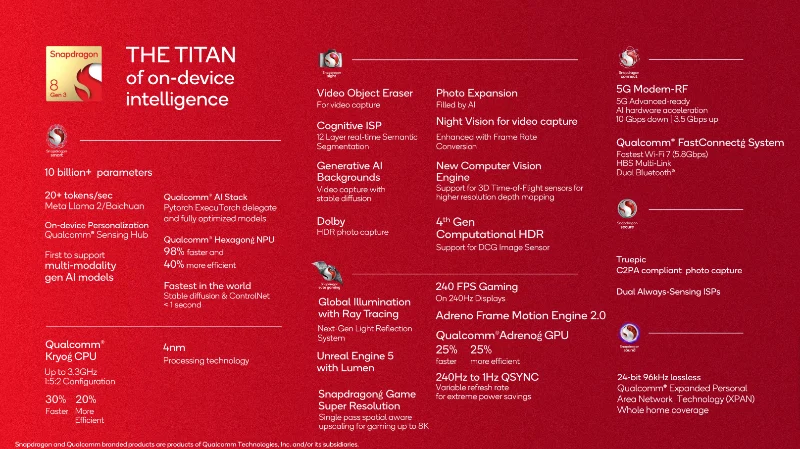
The new CPU architecture runs one Cortex-X4 prime core, five Cortex-A720 performance cores (split across two frequency clusters), and two Cortex-A520 efficiency cores on TSMC’s 4nm process. The single-core performance improvement over the 8 Gen 2 is around 30%, which is meaningful but expected. What matters more is the power efficiency curve: the 8 Gen 3 sustains performance under load without throttling as aggressively as its predecessor, which translates directly into battery life for the flagships that carry it.
Samsung, OnePlus, Xiaomi, and OPPO will all ship devices on this chip through 2024. The design wins are locked. The real competition is not MediaTek’s Dimensity 9300 (which is strong but lacks the global carrier relationships). It is Apple’s A17 Pro, which leads on single-core and efficiency thanks to TSMC’s 3nm process that Qualcomm will not access until the next generation.
The AI engine: ~45 TOPS on-device
The Hexagon NPU in the 8 Gen 3 delivers up to ~45 TOPS of AI compute (with the full AI Engine across CPU + GPU + NPU reaching higher when combined), a massive jump over the previous generation. In practical terms, this means on-device inference for image generation, real-time language translation, and multimodal AI assistants that do not require a cloud round-trip. Qualcomm demonstrated large language models running locally on the chip, which will not replace GPT-4 but is more than enough for on-device summarization, photo enhancement, and voice processing.
This is the strategic pivot. Qualcomm is positioning the Snapdragon platform as an AI inference engine, not just a phone processor. The same architectural thinking that drove the Born Mobile keynote back at CES 2013, where Qualcomm first staked its claim as a brand rather than a component, is now playing out in the AI era. The brand promise is shifting from “fastest phone chip” to “the AI chip you carry.”
The GPU and the gaming angle
The Adreno 750 GPU brings hardware ray tracing and support for Unreal Engine 5 Lumen, which is impressive on paper. In practice, mobile ray tracing is still more of a spec-sheet feature than a daily-use one: the games that use it are few, and the visual difference on a 6.7-inch screen is subtle. The more useful GPU improvement is the ~25% increase in sustained performance and efficiency, which means flagship games run smoother for longer before thermal throttling kicks in.
The competitive picture in late 2023 / early 2024
Apple’s A17 Pro has the process-node advantage (3nm vs 4nm) and the vertical-integration advantage (chip + OS + frameworks). Samsung’s Exynos 2400 is fighting for relevance but remains a tier below in GPU performance. MediaTek’s Dimensity 9300 is the dark horse, trading blows on benchmarks but lacking carrier penetration outside Asia. Qualcomm’s moat is strong: it powers the vast majority of premium Android phones globally, and the 8 Gen 3 keeps that position secure for another generation.
The on-device AI capability is the differentiator that matters for the enterprise market. European companies evaluating mobile platforms for field workers, logistics, and healthcare increasingly care about what the device can do without connectivity. A chip that can run a local language model is a different value proposition than one that can play Genshin Impact at max settings.
The 8 Gen 3 is not a revolution. It is a consolidation of Qualcomm’s position and a clear signal that the next generation, the one that moves to 3nm and brings custom Oryon cores to phones, is the one that will change the game. This chip holds the line. The next one draws a new one.
Related reading: the Xiaomi design wins that lock in each Snapdragon generation.