OpenAI has officially made GPT-4 Turbo with Vision generally available to developers. The model, first previewed at DevDay in November 2023, became accessible via the OpenAI API on April 9, 2024, and through Microsoft Azure OpenAI Service on May 1, 2024. It combines text processing power with vision capabilities, enabling multimodal applications that can understand images and respond in natural language.
This is more than just a technical update. Developers are already building tools that rely on both visual and textual input. The model’s integration into existing platforms unlocks new possibilities for content creation, document analysis, and even visual Q&A systems, applications that increasingly depend on robust infrastructure and API orchestration.
What Makes GPT-4 Turbo with Vision Different?
Unlike earlier versions of GPT-4, this model supports both image and text inputs simultaneously. Developers can feed it images and receive human-readable responses, something especially valuable in fields like robotics, augmented reality interfaces, and automated visual inspection systems.
The performance improvements are significant. Compared to previous GPT-4 iterations, the new version offers reduced latency and more competitive pricing per token. These changes make it a cost-effective solution for companies scaling AI applications without compromising on quality.
For teams working on visual question answering, automated document review, or image-based content generation, this represents a major leap forward. OpenAI’s push reflects a broader industry trend toward multimodal AI models that blend different data types seamlessly, a shift that demands equally sophisticated deployment strategies.
AMD Launches MI300X for Generative AI Workloads
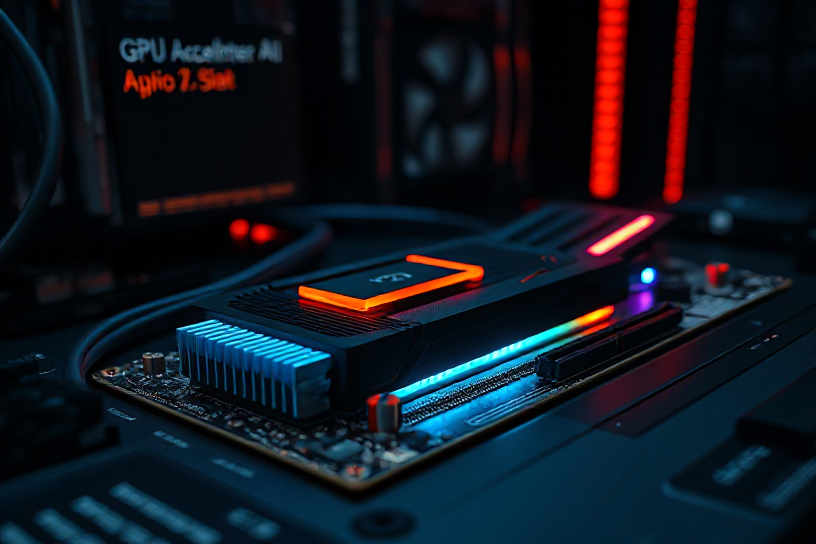
AMD introduced the Instinct MI300X accelerator on December 6, 2023, built specifically for large-scale generative AI and high-performance computing tasks. The chip delivers 192 GB of HBM3 memory and peak performance of up to 81.7 TFLOPS in FP64 vector operations.
Supporting multiple floating-point formats, including FP16, BF16, FP8, INT8, TF32, and FP32, the MI300X handles both training and inference workloads across diverse AI applications. This format versatility allows developers to optimize model precision against computational efficiency.
What distinguishes the MI300X is its exceptional memory capacity. With 5.3 TB/s of peak memory bandwidth, it outperforms many competitors when processing large language models or deep learning frameworks requiring massive datasets. This memory advantage proves critical when context windows expand or model parameters scale beyond conventional limits.
The chip integrates with major cloud platforms including Microsoft Azure OpenAI Service and works alongside supercomputers from Dell, HPE, and Lenovo. AMD’s launch signals evolving priorities in AI infrastructure development, where memory bandwidth increasingly rivals raw compute power.
The Bigger Picture: Implications for Developers and Enterprises
Both announcements center on access, speed, and capability. OpenAI’s move democratizes multimodal AI implementation across broader application categories. Meanwhile, AMD’s MI300X provides developers with a powerful hardware alternative that balances computational performance with memory efficiency.
For enterprise users, this translates to expanded choices in building and deploying AI systems. The availability of these models and accelerators enables greater flexibility, whether scaling production workloads or experimenting with novel architectures, without vendor lock-in.
The real test will come from adoption velocity. If GPT-4 Turbo with Vision appears in everyday applications, it could fundamentally alter how we interact with digital content. Similarly, if the MI300X gains traction in HPC and AI training environments, it could reshape data center hardware competition.
Both developments reflect a maturing AI infrastructure ecosystem, one where developers optimize for specific use cases across performance, cost, and integration rather than simply choosing between vendors. Success increasingly depends not just on selecting the right models or chips, but on orchestrating them effectively within existing technical architectures.
For technical teams navigating these infrastructure decisions, understanding how to integrate emerging AI capabilities with existing systems remains critical to capturing their full value.