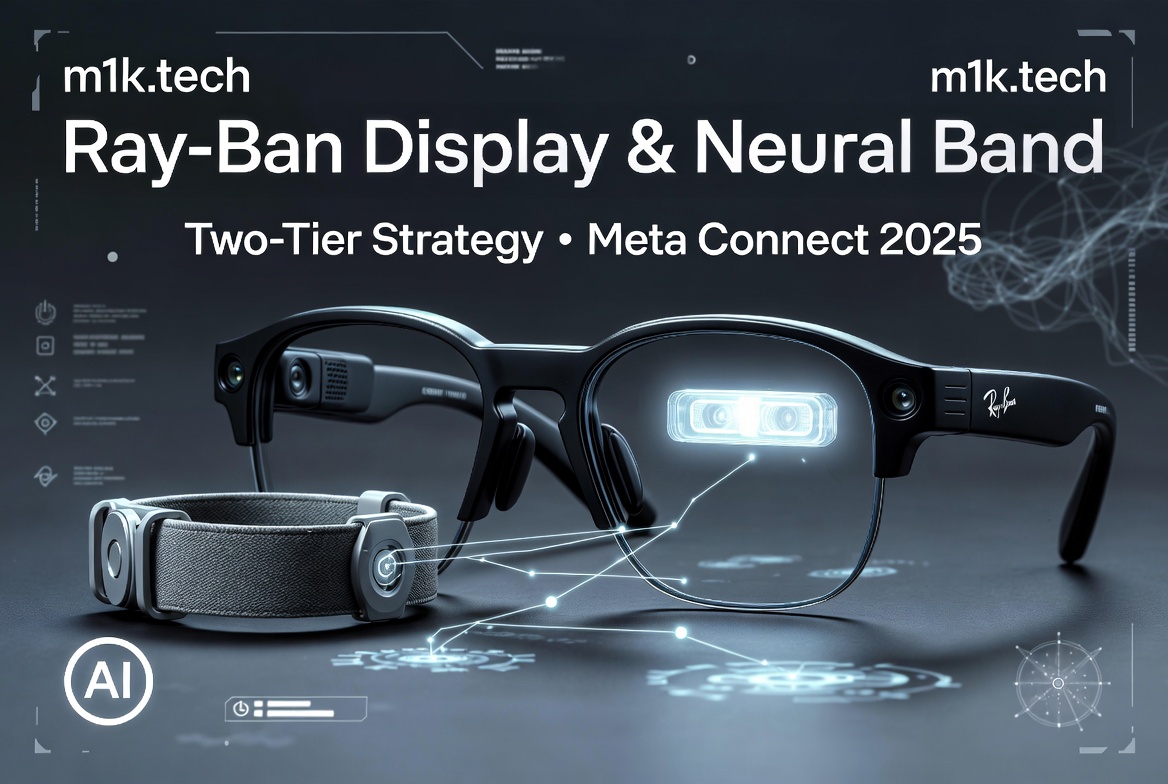
Meta Connect just gave the Ray-Ban line the thing everyone has been asking for. The Ray-Ban Display launches this month at $799 with a full-color monocular heads-up display in the right lens: 600 by 600 pixels, 20-degree field of view, 90Hz, still running on the Snapdragon AR1 Gen 1. It ships with a wrist-worn Neural Band that uses EMG, electromyography, to detect fine finger movements and let you control the glasses with subtle gestures you do not have to say out loud.

The tiered product strategy
Here is the business architecture that matters: the screenless Ray-Ban Meta stays at $299 as the volume play. The Ray-Ban Display sits at $799 as the premium tier. One pair for the mainstream who want AI and audio. Another for early adopters who want visual output. Meta is now running a two-tier smart glasses business under the same Ray-Ban brand, and that is something nobody else in XR can replicate because nobody else has EssilorLuxottica’s distribution and brand credibility behind them.
The Neural Band as an input bet
The wrist band is the signal to watch. Glasses need an input method that is not your voice in every situation, and Meta is betting on EMG to read nerve signals from the wrist and detect finger movements. The gesture vocabulary is still limited. The intent is clear: as the glasses become the primary display, the band becomes the controller, and the phone becomes optional. That is a significant shift if the technology scales.
The trend for the year ahead
Display-equipped smart glasses at $799 are now a product, not a concept. Expect the Samsung-Google Android XR ecosystem to respond with its own glasses play. The input problem, how you interact with a screen on your face without looking strange, is the next big UX battleground.
The two-tier strategy is smart. Meta does not force the display on everyone: it gives the mainstream a proven $299 pair and an upgrade path for those who want more. The Neural Band is the wild card. If wrist-based EMG input works at scale, it may matter more than the display itself, because it solves the fundamental problem of how you use a screen you are wearing.
Part of Two Decades of XR, my running diary of virtual, augmented, and mixed reality.