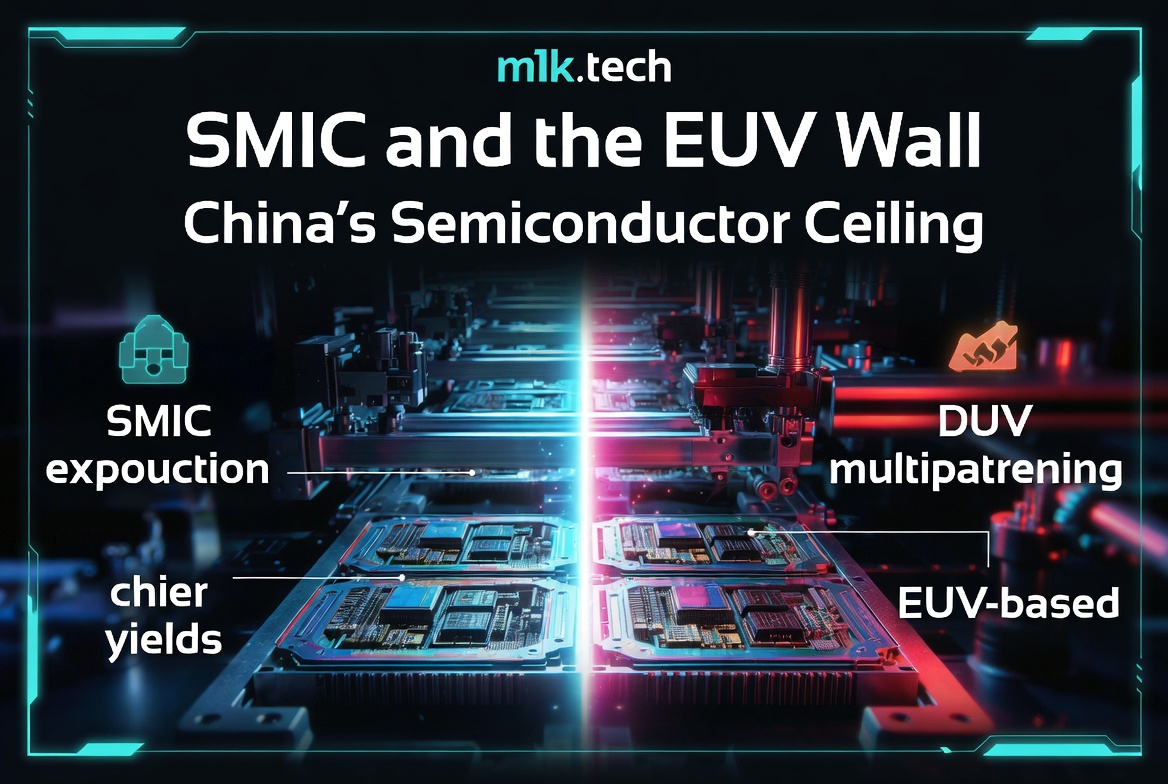
“SMIC EUV” describes a piece of hardware that does not exist and, under the current export regime, never will. That single absence is the wall SMIC has spent five years building against. SMIC can do 7nm on deep ultraviolet lithography. It is fighting for 5nm-class on DUV at ruinous cost. Below that, at 3nm and down, DUV runs out of physics, and the only way through is the 13.5nm machine SMIC cannot import. The question that defines SMIC’s capacity at the start of 2026 is no longer how fast it climbs. It is whether there is any climb left at all.
Self-aligned quadruple patterning (SAQP) is how you brute-force an older DUV machine into printing a 5nm transistor. You stack four separate exposures per layer instead of one EUV pass. SMIC’s N+3 node uses exactly this to build Huawei’s Ascend 910C accelerators with no extreme-ultraviolet tool anywhere in the line. The physics work. The math turns ugly. Every extra pass multiplies the machine time and the defect probability, pushing cost somewhere around 40 to 50% over a TSMC EUV 5nm wafer while yields sit stubbornly near a third. The state will eat that bleed to get the silicon. But somewhere close to 3nm the alignment tolerances stop making physical sense and you simply run out of room. The wall is not the embargo anymore. It is the light itself.
A state-backed consortium coordinated by Huawei approved the operation of a functional EUV prototype at a Shenzhen facility late last year. It is an experimental rig, not a production tool, built to throw the 13.5nm wavelength the whole game runs on. How it actually gets there is murky: some reporting points to a laser-induced discharge plasma source out of the Harbin Institute, other accounts describe a laser-produced plasma setup much closer to ASML’s own design, which is exactly why the espionage talk will not die down. The stated production target is 2028, and that number deserves a healthy pinch of salt. A prototype on a factory floor is not a machine pushing well over a hundred wafers an hour off defect-free multilayer mirrors in a fully evacuated chamber, and ASML spent decades and tens of billions wiring together a hyper-specialized global supply chain to scale precisely that. China is rebuilding the entire stack alone, under sanctions, from behind. Could be five years, could be fifteen, could be never. The alternative is a permanent cap on domestic transistor density, and no one serious in Beijing treats that as acceptable.
What began as a foundry climbing on borrowed knowledge is now the chokepoint the whole Chinese technology project has to squeeze through. Huawei’s Ascend 910C clusters run on SMIC silicon. So does the processor in every domestic flagship phone, and so does any serious plan to stand up sovereign AI data centers without asking Washington first. The United States has built an elaborate, constantly tightening lattice of export controls around this one company and its handful of partners, pulling in Dutch immersion scanners, EDA software, advanced packaging, testing gear. Beijing’s answer has been to quietly turn SMIC from a margin-driven commercial foundry into something closer to a state utility whose actual product is independence. It does not really compete on yield or price anymore. What it competes on is whether a country gets to make its own advanced chips at all.
TSMC is shipping 2nm-class gate-all-around silicon for Apple and Nvidia while SMIC burns sub-40% yields just to hold the 5nm line. Four, maybe five nodes of distance, and it has barely moved in two years. Every few months a US rule tightens on some testing component, a Shenzhen line answers with a workaround, and the needle twitches without shifting the picture. The embargo did not stop SMIC from putting the Kirin 9000S into a phone or the Ascend 910C into a server rack. SMIC has not beaten the physics of multipatterned DUV either. They are stuck in the same expensive clinch, and it can grind on for another decade.
SMIC was built on the assumption that the door stays open, that the tools and talent of a global industry flow to whoever pays the invoice. That assumption died about five years ago, and the company has been rebuilt on top of the corpse. Perso, I am not going to pretend I know how this ends. The whole trajectory hangs on a Shenzhen prototype nobody outside Huawei’s orbit can properly handicap, and on a political fight that could break either way. People who counted SMIC out looked very smart right up until the Mate 60 Pro shipped, so writing it off now is a lazy reflex. But assuming the Chinese state can will an EUV machine into existence just because it willed everything else is the opposite mistake, and a costlier one. You can throw enough state capital at an old DUV machine to brute-force a 5nm chip. You can’t bribe the wavelength of light.