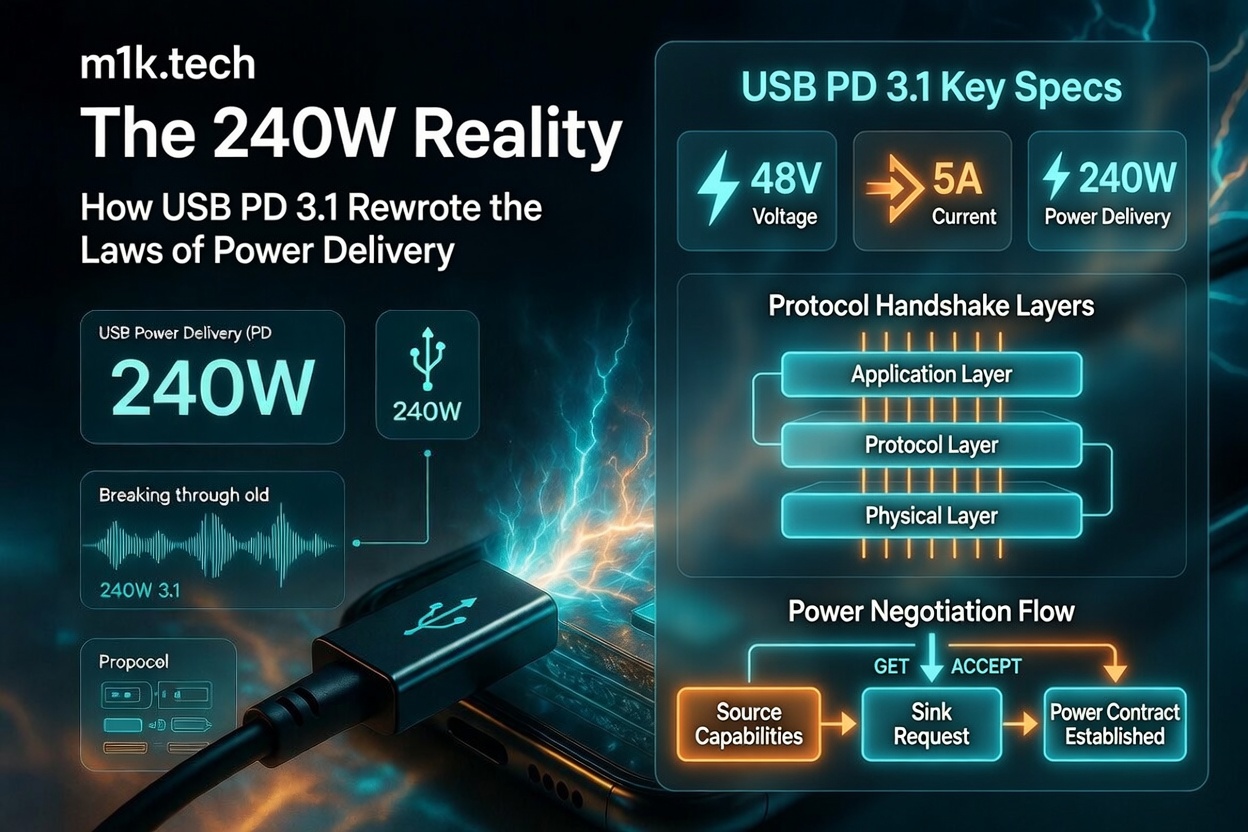
USB Power Delivery 3.1 extended the charging ceiling from 100W to 240W by introducing higher fixed-voltage levels up to 48V, keeping current within safe thermal limits for USB-C connectors. The standard also requires E-Marked cables to verify compatibility and replaces Programmable Power Supply with Adjustable Voltage Supply for dynamic power requests.
Gallium Nitride semiconductors made compact 240W chargers physically possible by enabling higher switching frequencies that reduce component size. However, multi-port chargers marketed at 240W typically cannot sustain that output on a single port when additional devices are connected, limiting real-world performance despite the protocol’s technical capabilities.
For a decade, the universal charging standard was defined by a hard physical limit: 100 watts. If your device needed more than 100W, you were carrying a proprietary power brick. Gaming laptops, mobile workstations, and high-performance docks were excluded from the single-cable utopia.
Then came USB Power Delivery (PD) 3.1 and the Extended Power Range (EPR). The specification raised the ceiling from 100W to 240W. By 2026, almost every premium laptop ships with EPR as its primary power input. The proprietary barrel jack is effectively dead.
But getting 240W to travel over a universal cable without starting a fire required rewriting the power-delivery architecture. Here is how the USB Implementers Forum (USB-IF) actually did it.
The Physics of 240W
The fundamental law of electrical power is simple:
P = V x I
Under the older USB PD 3.0 Standard Power Range (SPR), the maximum profile was 20V at 5A, yielding 100W. When engineers needed to hit 240W, they had to increase either the voltage (V) or the current (I).
They chose voltage because choosing current would melt the connector.
Pushing 12A or 15A down a USB-C cable generates massive resistive heating (I^2R loss). The thermal limit for the tiny pins inside a USB-C connector is rigidly capped at 5 Amps. To increase the wattage without exceeding the 5A thermal limit, the USB PD 3.1 specification added three new fixed-voltage levels: 28V, 36V, and 48V.
At 48V and 5A, you hit exactly 240W. The cable stays cool, but the electrical design inside the charger and the laptop becomes significantly more complex. Managing 48V on a consumer desk requires advanced switching to keep the charger brick physically portable, and heavy-duty buck-boost converters inside the laptop to step that 48V down to safely charge the internal battery cells.
The E-Marker Mandate
You cannot push 48V through a cheap gas station cable. If a device negotiated 240W over a wire not designed for it, the insulation would fail, resulting in a short circuit.
To prevent this, USB PD 3.1 relies on an E-Marker, a microscopic chip embedded in the cable head. When you plug an EPR charger into a laptop, the charger pings the cable. The cable’s E-Marker must reply with a digital handshake confirming it is rated for 50V/5A.
If the charger detects a standard 100W cable (20V/5A), or a cable with no E-Marker at all, it politely refuses to output EPR voltages and falls back to a maximum of 100W. If you buy a 240W brick but use the wrong cable, you just bought a very expensive 100W charger.
AVS: The Successor to PPS
In previous charging generations, a Programmable Power Supply (PPS) enabled micro-adjustments to the charging voltage for efficient phone charging.
Under EPR, PPS is replaced by Adjustable Voltage Supply (AVS). AVS is required for any source supporting EPR. It allows the powered device to request voltages from 15V up to the charger’s maximum available fixed voltage (up to 48V), in tiny 100mV increments.
Key Insight: A gaming laptop under heavy load does not pull a flat 240W. It dynamically requests power based on CPU/GPU spikes. AVS allows the laptop’s internal power management to pull exactly the voltage it needs in real-time, maximizing conversion efficiency and minimizing thermal throttling.
The GaN Revolution: Why It Fits in Your Bag
Delivering 240W is one thing. Doing it without a charger the size of a masonry brick is another.
For decades, power supplies relied on silicon MOSFETs to switch electrical current on and off. Silicon has a hard physical limit: if you switch it too fast, it generates massive heat. So, legacy chargers operated at lower frequencies (around 65 kHz). Low-frequency systems require large magnetic components, such as inductors and transformers, to temporarily store and convert energy. That is why your old Xbox or Dell workstation had a power supply that weighed two pounds.
Gallium Nitride (GaN) breaks that thermal wall. GaN is a wide-bandgap semiconductor. It allows electrons to flow much faster than silicon, meaning GaN transistors can switch at 300 kHz to 500 kHz with virtually no thermal penalty.
When you increase the switching frequency by a factor of five, the physical size of the internal magnetics shrinks proportionally. You need less copper. You need less space. By 2026, manufacturers will be packing 240W of power into a chassis smaller than Apple’s old 96W silicon charger.
GaN did not change the USB specifications. It changed the physical reality of carrying them. Without it, the PD 3.1 standard would be useless for travel, because nobody wants to commute with a cinderblock in their backpack.
The Multi-Port Lie
The biggest trap in the 2026 consumer market is the “240W Dual-Port Charger.”
Marketing departments love to print “240W MAX” on the box. But physics and power budgets are finite. Almost no multi-port chargers can deliver 240W from a single port while the other port is in use.
The realistic split looks like this:
- One device connected: 240W EPR.
- Two devices connected: 140W (Port 1) + 100W (Port 2).
If you plug a 240W laptop into Port 1, and then plug your phone into Port 2, the charger instantly renegotiates. The laptop drops to 140W, its battery starts draining under heavy load, and its framerate tanks.
The USB-IF built a brilliant, mathematically sound protocol to deliver massive power universally. But standardizing the electrical delivery doesn’t fix the marketing. A 240W charger is only a 240W charger if you use the right E-Marked cable, plug into the correct port, and unplug everything else.