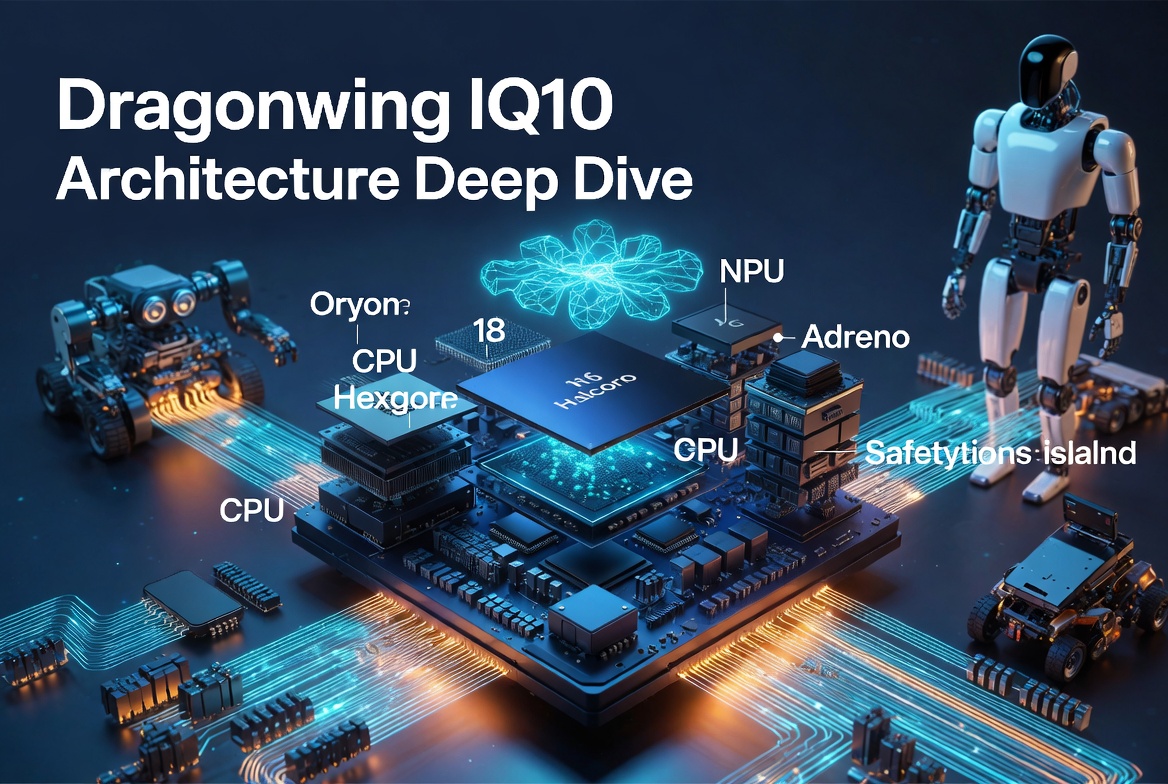
Three MAX96724 deserializer chips, mapped to three CSI ports, pull twelve GMSL2 cameras straight into the silicon. That single line buried in the IQ10 spec sheet is the whole argument Qualcomm is making, and it took me a second read to clock why it matters more than the 700 TOPS number everyone led with.
Building a robot today means bolting a compute board to a sensor bridge board to a motor-controller board to a safety PLC, then praying the latency budget survives. Qualcomm’s pitch with the Dragonwing IQ10 is that it deletes most of those boards. The cameras, LiDAR, EtherCAT, CAN-FD, and the safety logic all land inside one box. That’s a less sexy story than a teraflops headline, but it’s the one that decides whether a humanoid ships in 2027 or stays a demo reel.
The chip got its CES 2026 reveal in January (Edit 06/2026 : Cristiano Amon put the full reference design on stage at his Computex keynote on June 1). Early-access units are being seeded to partners right now, this month, with global availability targeted for September. So we’re in the awkward in-between where the spec sheet is public, but almost nobody outside the early-access ring has run real workloads on it yet.
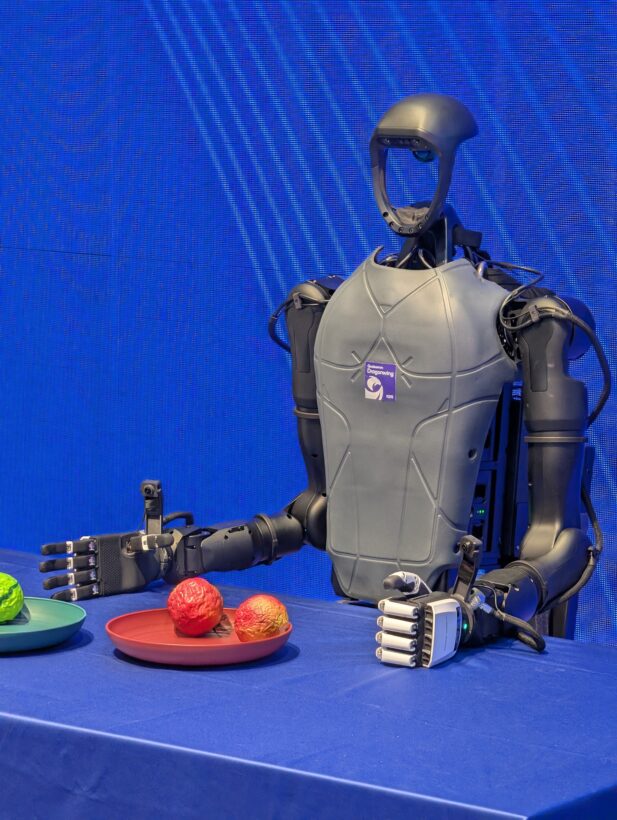
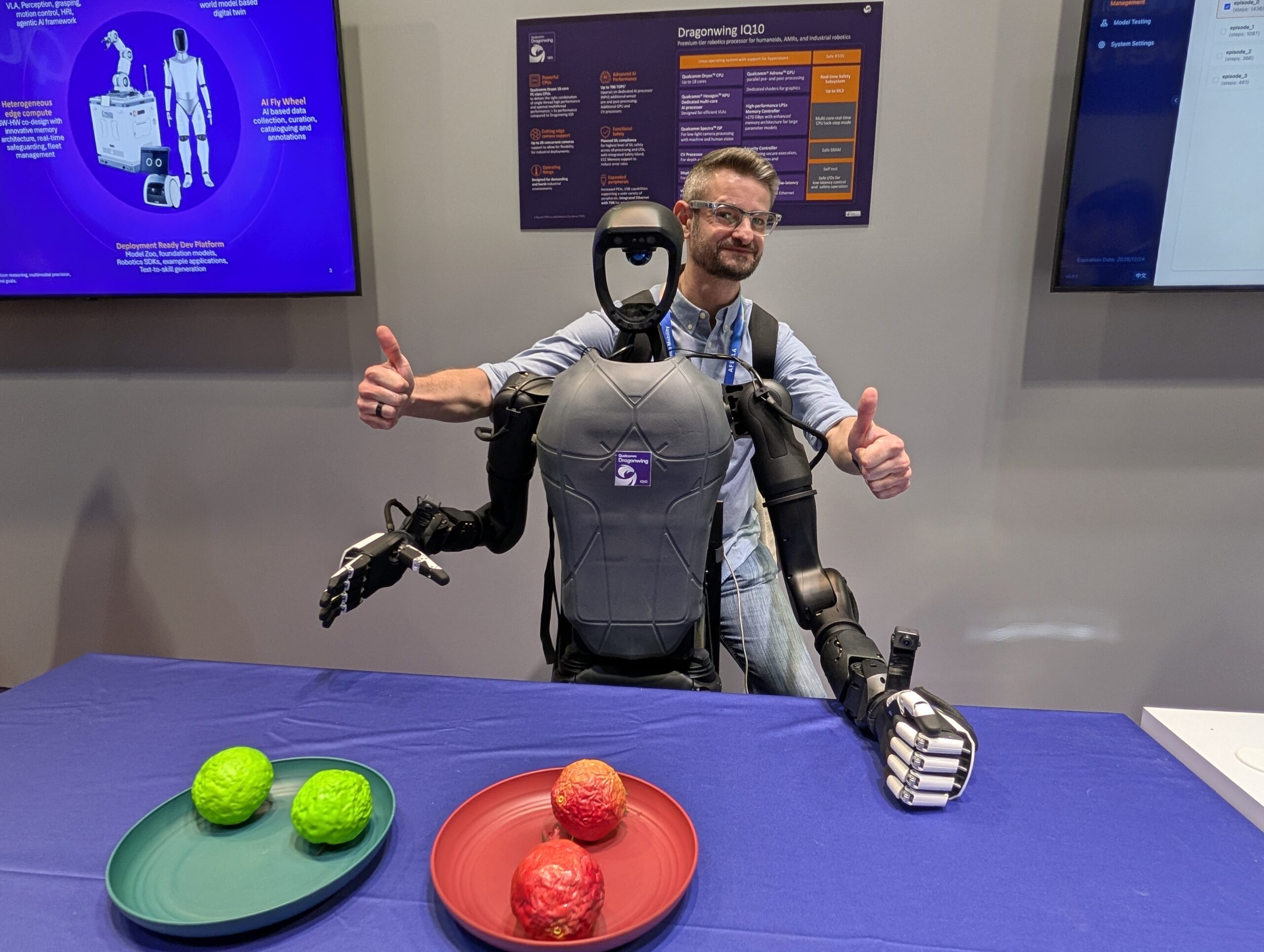
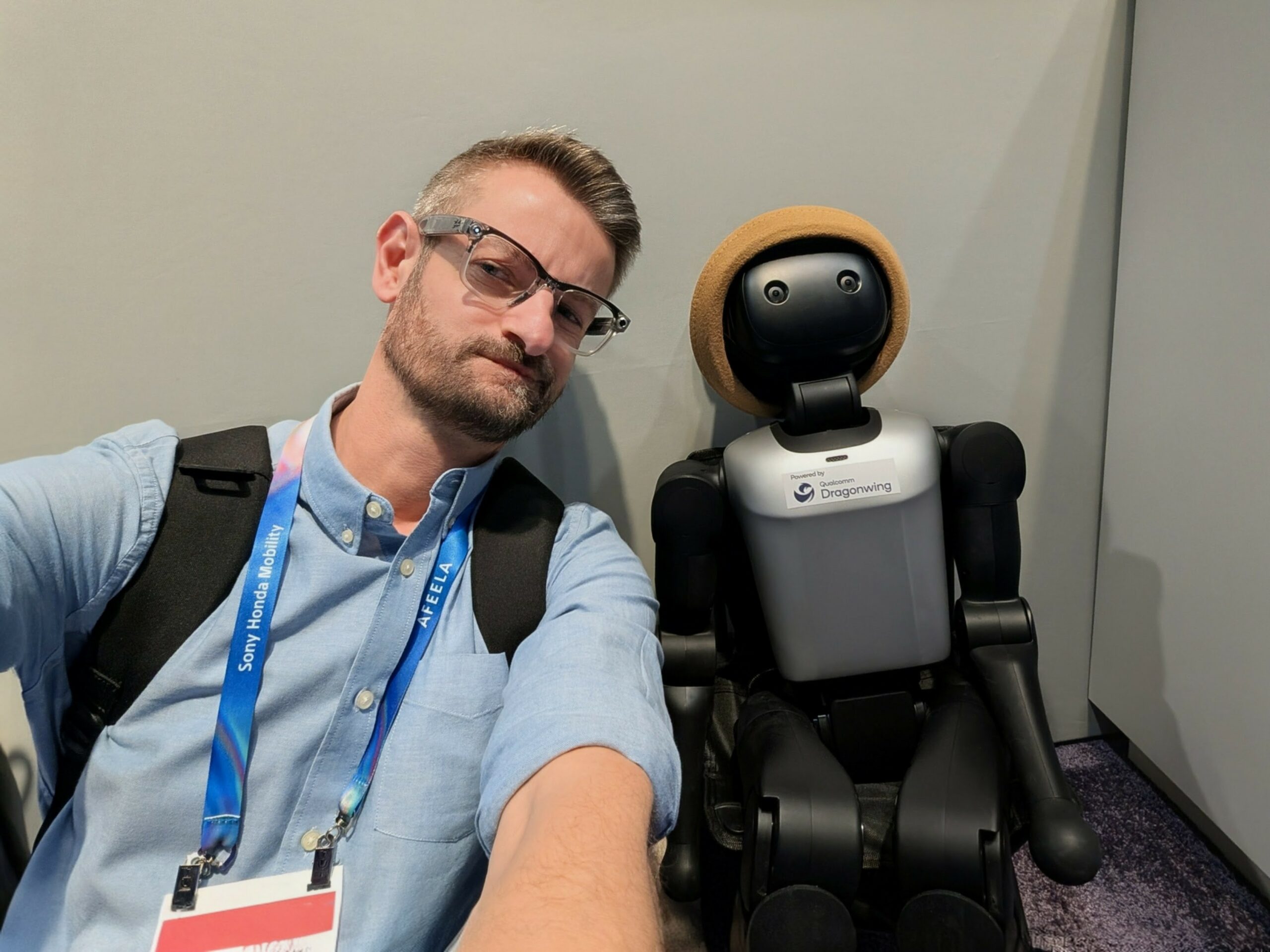
The silicon is a robot wearing an X Elite
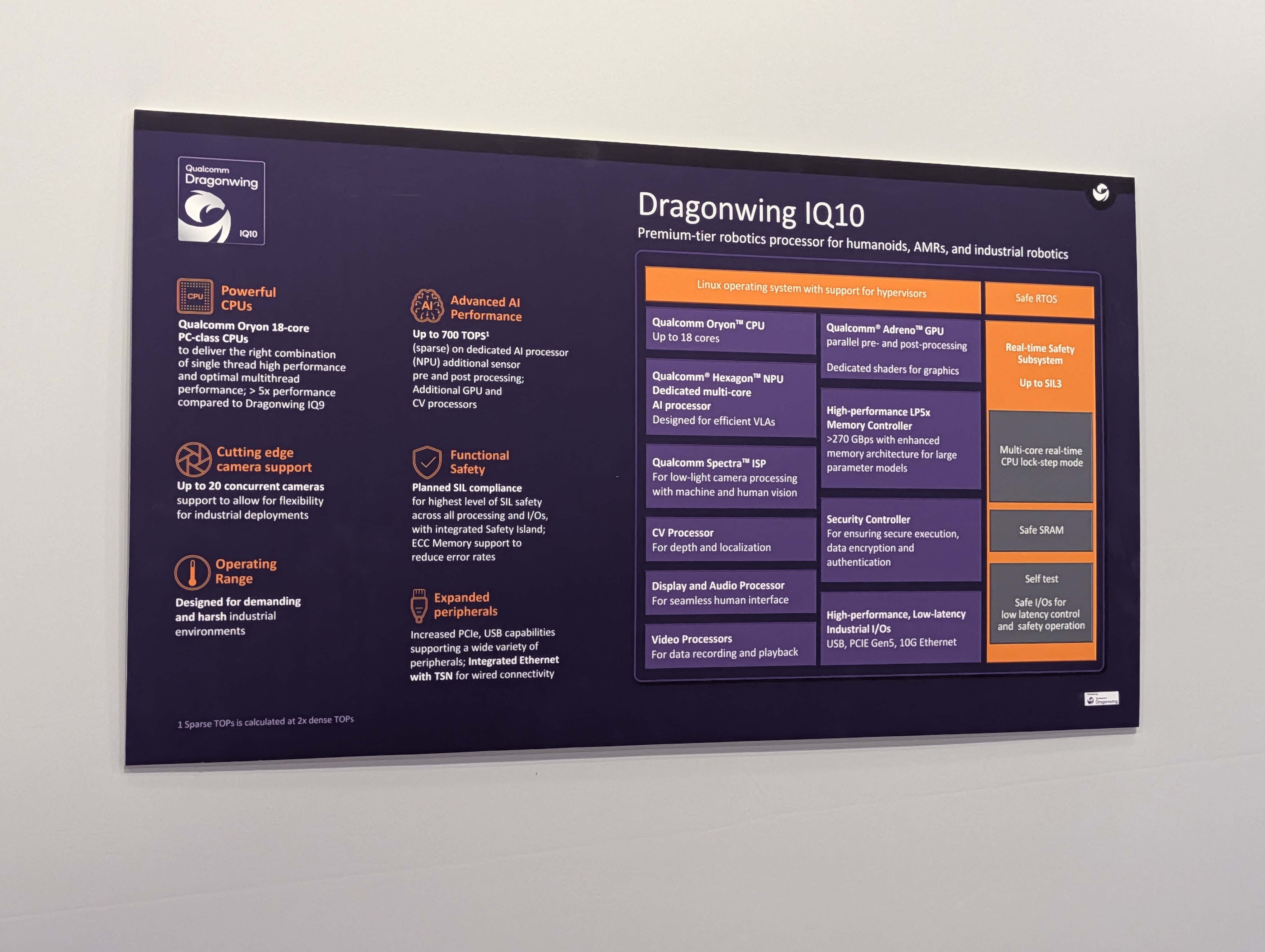
Strip the marketing, and the IQ10’s brain is the same 18-core Qualcomm Oryon SoC that powers the Snapdragon X Elite laptop platform. SemiAccurate said the quiet part out loud: this is the consumer X Elite silicon, dropped into an industrial enclosure rated from -40 to 70 °C, running Ubuntu instead of Windows. That Oryon core has quietly become Qualcomm’s everything-chip, and the IQ10 is the clearest proof, yet that one CPU design now spans laptops, desktops, and the inside of a humanoid’s chest.
Those eighteen cores aren’t doing the AI heavy lifting. They run the ROS 2 stack, the task planning, and the classic control loops that never mapped cleanly onto a neural engine. The 700 TOPS headline comes from the multicore Hexagon NPU, with the Adreno GPU and CPU vector units topped in. And that number deserves a hard squint. SemiAccurate noted Qualcomm gets to 700 by adding up the CPU, GPU, and NPU top-line figures, sparse, best case. Call it roughly half that for honest dense INT8 work, and remember the board only reaches around 2,000 TOPS if you bolt on external compute modules. The on-device 700 is real, and it’s a lot. It just isn’t the clean apples-to-apples slab the slide implies.
What that compute buys you is the end of the cloud round-trip for perception and planning. A humanoid navigating a space built for humans lives or dies on its sensorimotor loop, and shipping camera frames to a datacenter and waiting for an answer was never going to work for a machine about to put its foot down. Running Vision-Language-Action models locally is the entire point. This is the same on-device gravity I traced from Movidius to Dragonwing, pushed to its physical-AI extreme.
Where it actually separates from a generic SoC
Memory is 64 GB of in-package LPDDR5x with ECC, paired with 512 GB of UFS 4.0 and a PCIe Gen5 NVMe slot if you need more. ECC matters here in a way it never does on a phone: a bit-flip in a robot’s perception buffer is not a crashed app, it’s a 70-kilogram machine misjudging where your leg is.
Then there’s the safety island, which is what really sets the IQ10 apart from a repurposed IoT chip. It’s a dedicated, hardware-isolated subsystem that keeps the critical routines, braking vectors, and obstacle avoidance, executing even if the main OS throws a software exception. Industrial robots have to meet standards like ISO 13849 and IEC 61508, and historically, that meant adding an external safety PLC or a redundant microcontroller to your design. Folding that island into the SoC is how Qualcomm wants to shave months off the certification process. One honest gap I’ll flag: Qualcomm hasn’t publicly stamped a specific certified safety-integrity level on the IQ10 that I’ve seen, so treat the safety-tier talk as a design target the silicon is built to reach, not a certificate already in hand.
The deterministic plumbing rounds it out: two 10GBase-T ports plus a 2.5GBase-T, four EtherCAT ports via an Intel I226 controller, eight CAN-FD channels, TSN, PCIe Gen5, Wi-Fi 7, and an optional 5G module. Eight CAN-FD channels split across domains is the kind of detail that doesn’t trend on launch day, but is exactly what a motion-control engineer needs to synchronize a dozen actuators without jitter.
The Thor question
Qualcomm did not build this to win a teraflops drag race, which is fortunate, because on raw peak, it loses. NVIDIA’s Jetson Thor (T5000) quotes 2,070 FP4 TFLOPS against the IQ10’s 700 TOPS, and people will slap those side by side and call it a blowout. They’re different precisions doing different math, closer to comparing a sprinter’s top speed to a delivery truck’s payload. Thor has the bigger raw ceiling. The IQ10 answers with integration, power efficiency, and a safety island that Thor only matches on its pricier IGX variant.
The real gap is software, and it isn’t close. NVIDIA’s Isaac stack and the CUDA gravity well around it form a decade-deep moat, and every robotics lab already speaks that dialect. Qualcomm shows up with Ubuntu, ROS 2, and the Qualcomm AI Hub for fleet management, a credible stack but a young one. The shape of it is simple enough: NVIDIA owns the humanoid mindshare today, Qualcomm is trying to own the volume underneath it.
| Spec | Dragonwing IQ10 | Jetson Thor (T5000) |
|---|---|---|
| AI peak | ~700 TOPS (sparse) | 2,070 FP4 TFLOPS |
| CPU | 18-core Qualcomm Oryon | 14-core Arm Neoverse-V3AE |
| Memory | 64 GB LPDDR5x, ECC | 128 GB LPDDR5x |
| Sensor I/O | 12x GMSL2 native, multi-modal | Strong, often via bridge boards |
| Safety | Integrated safety island | On IGX variant |
| Software | Ubuntu, ROS 2, AI Hub (young) | Isaac, CUDA (mature) |
The board everyone builds on
Step back and the IQ10 is less a chip launch than a positioning move. Qualcomm isn’t selling robots; it’s selling the board everyone else builds them on, and an all-in-one design with the sensors already wired in is a sharp answer to the integration mess. I called this the full-stack edge thesis back in January: buy and bundle your way into being the default platform before anyone else’s reference design locks in the design wins. It’s also the mirror image of what’s happening up in the datacenter, where the chip itself is coming apart into modular chiplets, the same unbundling pressure playing out at the opposite end of the compute spectrum.
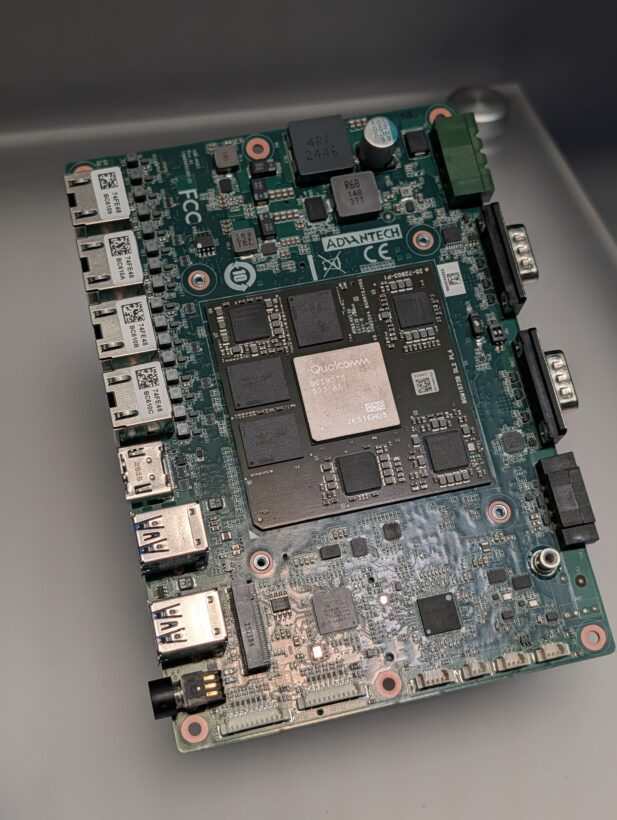
The early-access list reads like a channel strategy rather than a press release. NEURA Robotics, Advantech, NEXCOM, Thundercomm, Radxa, ten partners in total, spanning robot makers, integrators, and module vendors. Thundercomm’s TurboX IRB10 dev board inherits the architecture natively, so you can get prototypes moving without every team having to rebuild the same plumbing. At the humanoid tier, Qualcomm’s broader Dragonwing roadmap already appears in machines from Booster and VinMotion (whose Motion 2 runs on the older IQ9), with a collaboration with Figure and ongoing discussions with Kuka. Reference designs live or die on whether those names actually ship, and September is the date that matters.
There’s an irony here I can’t let go of. The IQ10 runs Ubuntu cleanly, and Qualcomm is proud of it. Meanwhile, the company still goes out of its way to block Linux on the very same Oryon silicon when it’s sitting in a consumer laptop, leaning on a Windows-on-Arm experience that’s been a patch-quilt for years. SemiAccurate has been hammering this, and the IQ10 basically concedes the point: Linux could run fine on Snapdragon X, and always has.
Pricing? Not disclosed. Whether the ROS 2 tooling and fleet management carry licensing fees on top of the board? Also unanswered. For a platform whose entire pitch is lowering the cost of getting to production, leaving the price blank is a conspicuous hole. And September is a promise, not a shipment. If it slips, ten partners slip with it.
I’m not getting into the power-budget math for legged robots here, what 700 TOPS actually costs you in watts when a humanoid is balancing on one foot, because that deserves its own post once real units are in real hands.
So, where does that leave the IQ10? If your bottleneck is the integration slog, the sensors and safety, and real-time control, and a software stack you’d rather not assemble from parts, this is the most complete single-box answer shipping right now, and the on-device AI is more than enough. The one thing it won’t touch is Thor’s raw inference ceiling paired with a decade of CUDA-native tooling your team already knows, so if that’s the hill you’re on, stay on it. Qualcomm is betting the 2030s belong to whoever makes robots boring to build, not whoever posts the biggest TOPS number. I think that’s the right bet. I’m just not sure Qualcomm’s software gets there before NVIDIA’s hardware lead stops mattering.
Edit May 2026: Jetson follow-up post published here