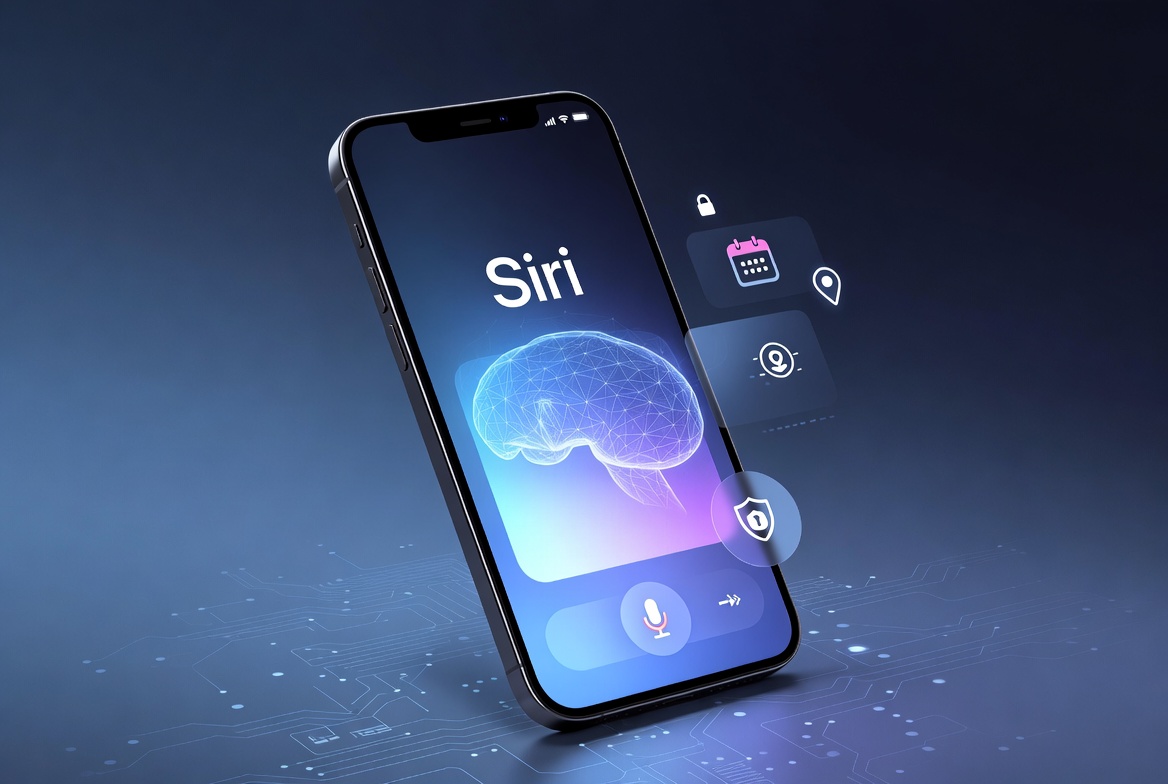
Apple’s WWDC 2026 introduced meaningful Siri improvements, including functional multi-step conversational requests, document summarization, and on-device inference powered by M5 and A19 Neural Engines. Expanded Apple Intelligence APIs allow third-party developers to integrate these capabilities, though historical patterns suggest adoption may be slow.
The on-device architecture preserves privacy advantages over Google Assistant and Copilot but limits Siri’s ability to match cloud-scale reasoning found in Gemini or Claude. For users primarily within Apple’s ecosystem, the update narrows the gap; for cross-platform or complex reasoning tasks, Siri remains less competitive.
Apple spent a significant chunk of WWDC 2026 on Siri, and it’s noticeably better. Multi-step conversational requests now work in a way they didn’t before. “Book a hotel near the conference venue, check the weather, add it to my calendar” actually chains without breaking. Summarizing documents and emails is genuinely useful. The on-device 16-core Neural Engines in the M5 and A19 chips mean inference happens locally rather than being routed to Apple’s cloud. And the expanded Apple Intelligence APIs mean third-party apps can now integrate the same summarization and language capabilities, if developers bother to adopt them.
That last part is the one I’m not assuming. Apple’s track record on AI/ML developer API uptake is mixed at best. SiriKit launched in 2016 and took years to see meaningful adoption outside Apple’s own apps. Shortcuts eventually got real users, but not quickly. The Apple Intelligence hooks are more capable than either of those, but “more capable” and “widely adopted” are different outcomes. If the adoption happens, the compounding effect could close the capability gap faster than the base Siri improvements suggest. If it doesn’t, Siri gets meaningfully better in Apple’s own apps and stays the same everywhere else.
The on-device processing architecture is both the principled call and the constraint. Private Cloud Compute handles queries too complex for the device, without routing them through standard cloud infrastructure, thereby maintaining a privacy standard that Google Assistant and Copilot cannot match. The Fable 5 shutdown made this argument newly concrete: inference that runs on your M5 chip cannot be revoked by a Commerce Department export control. Apple doesn’t frame it that way, but the functional difference is real. The trade-off is that on-device inference can’t access the scale of cloud compute that powers Gemini’s million-token context window, so Siri still loses badly on tasks that require deep reasoning or large context. That’s not a WWDC problem; it’s an architectural choice Apple made years ago.
For the billion-plus people inside the Apple ecosystem who primarily use Apple’s own apps, this update probably closes the gap enough. For anyone running cross-platform workflows or needing the kind of reasoning that Claude or Gemini handle well, Siri is still not competitive. WWDC 2026 moved the needle. It didn’t change the fundamental product category.
Related: the longer view on Apple’s silicon-versus-AI split in Apple from the Android side, great silicon and a stuck AI (2022 to 2026).