Microsoft Build 2026, held June 2-3 in San Francisco, introduced an agent-first platform combining new hardware and software. Key announcements included the Surface RTX Spark Dev Box, a desktop offering 1 petaflop of AI compute and 128GB unified memory for local AI workloads, and a new in-house MAI model family reducing reliance on OpenAI.
The event also detailed GitHub Copilot’s evolution into an autonomous coding agent, expanded Windows agent orchestration capabilities, and Project Solara, a security framework for governing AI agents. Together, these releases represent a coherent developer stack designed to shift AI from answering questions to autonomously performing tasks.
Microsoft Build 2026 ran June 2 and 3 at Fort Mason in San Francisco, and it was one of those developer conferences where the hardware and software announcements reinforce each other so cleanly that the overall message lands with unusual force. The headline hardware: the Surface RTX Spark Dev Box, a compact desktop that puts 1 petaflop of AI compute and 128GB of unified memory on a developer’s desk at a price point designed to compete with cloud GPU subscription costs. The headline software: an agent-first platform spanning Windows, GitHub Copilot, Azure AI Foundry, and a new family of in-house MAI models that signals Microsoft is done being primarily an OpenAI reseller. The through-line: the agentic era, where AI stops answering questions and starts doing work.
CEO Satya Nadella framed the entire conference around three pillars: an open AI model ecosystem, a unified agent runtime, and a new application model built around AI-first experiences. “We are moving from AI that assists you to AI that acts on your behalf,” he said. That framing is not new for a Microsoft keynote, but Build 2026 was the first event where the hardware, the developer tools, and the model portfolio were all actually aligned behind it simultaneously.
The Surface RTX Spark Dev Box
The Surface RTX Spark Dev Box was announced on June 2, the morning after Microsoft unveiled the Surface Laptop Ultra at Computex. The two devices are positioned as a deliberate pair: the Laptop Ultra for portable development, the Dev Box for sustained desk-based AI workloads. Together they represent what Microsoft is calling the next step for the Surface brand: purpose-built hardware for the people building what comes next.
At the heart of the Dev Box is the NVIDIA RTX Spark superchip, the same GB10/N1X silicon that powers the Surface Laptop Ultra. The chip combines 20 Arm-based Grace CPU cores, a Blackwell GPU with 6,144 CUDA cores, and 128GB of unified LPDDR5X memory, of which 112GB can be dedicated to GPU workloads. Total AI compute is rated at 1 petaflop of FP4 performance. A developer can load, run, and interact with AI models exceeding 120 billion parameters with up to 1 million token context without sending a single API call to the cloud.
The thermal design is where the Dev Box diverges meaningfully from the Laptop Ultra. The Dev Box operates at a 100W sustained thermal envelope, meaning it can run long-duration training jobs, agentic AI pipelines, and local model fine-tuning at full chip performance without the power management compromises inherent to a portable chassis. These are workloads that previously required either expensive cloud GPU rentals or a full workstation with a discrete GPU.
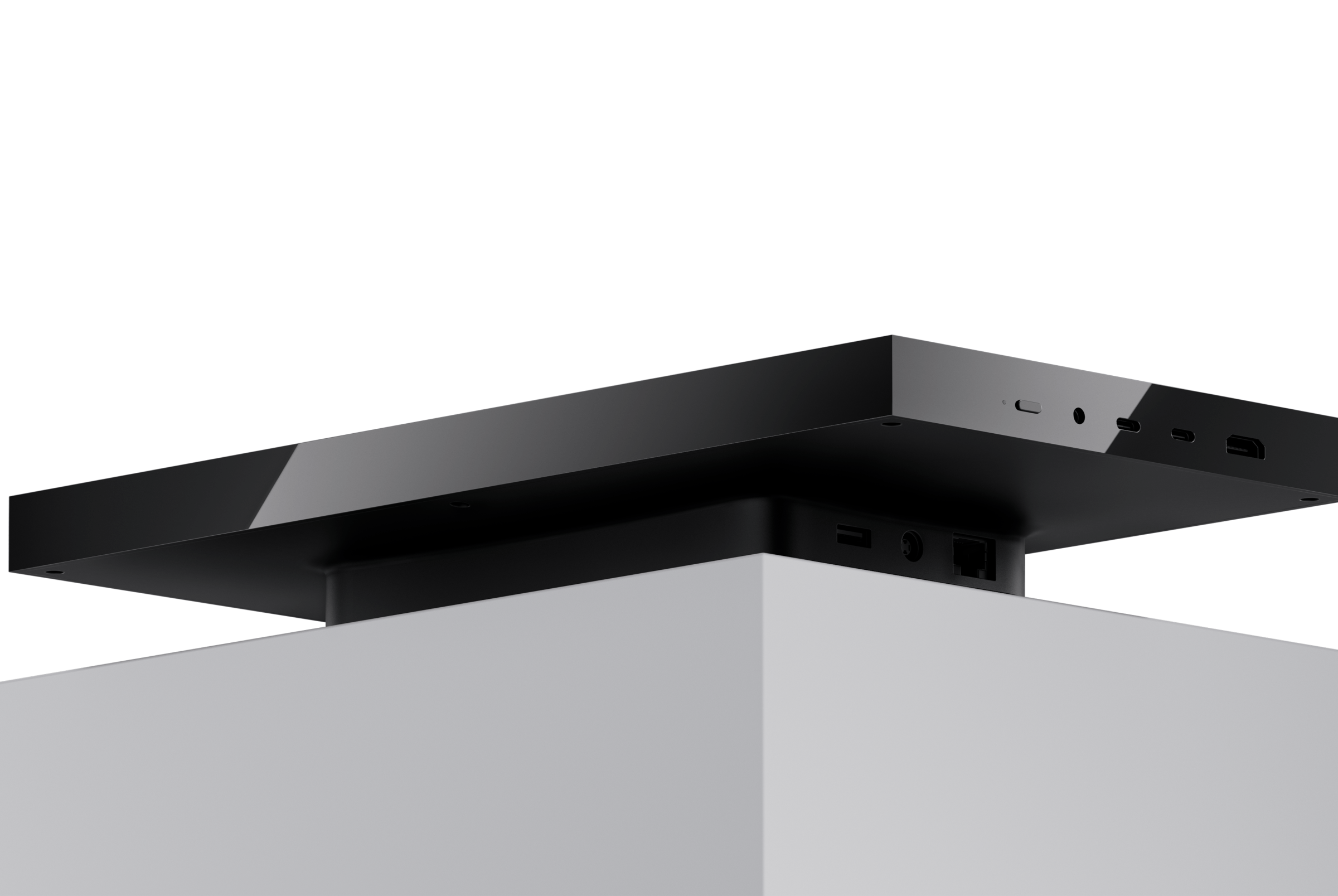
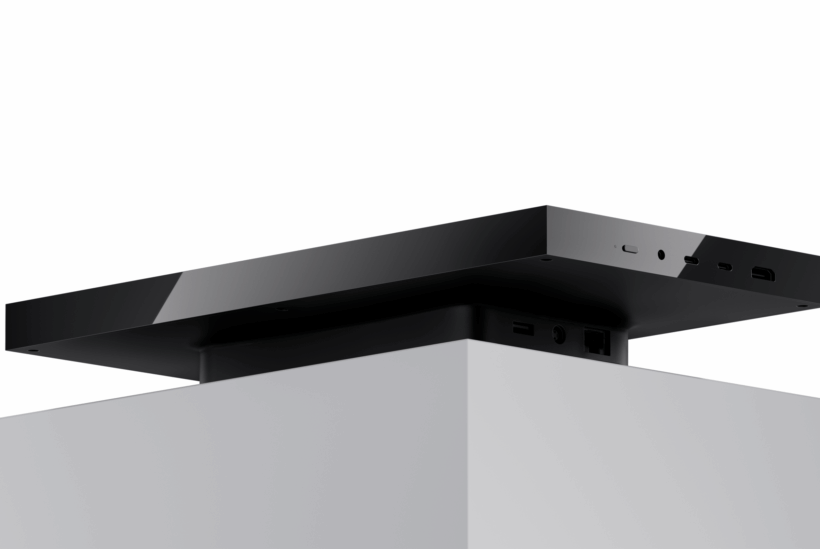
The chassis is a premium anodized aluminum small-form-factor design with 1,000 air vents in a grid pattern, passively cooled and silent during sustained workloads. IO includes two USB-C ports, a USB-A port, HDMI, Ethernet, and a headphone jack. The software stack ships pre-configured: Visual Studio Code, GitHub Copilot, WSL2 with native GPU passthrough, full CUDA support, Windows Copilot Runtime, WindowsML with TensorRT, and a toolkit for model conversion, fine-tuning, and evaluation.
Versus the Mac Studio
The competitive framing against Apple’s Mac Studio is explicit. The Mac Studio with M4 Max reaches 128GB of unified memory in its top configuration, matching the Dev Box’s memory spec. But the CUDA ecosystem argument is Microsoft’s primary differentiator, and it is a real one. The overwhelming majority of AI training and inference frameworks, including PyTorch, TensorRT, llama.cpp, and Hugging Face’s entire tooling suite, are built and tested first against NVIDIA’s CUDA stack. A developer on the Dev Box runs the same code in the same environment as the cloud GPU clusters they will eventually scale to. On a Mac, that parity requires additional translation layers or framework-specific workarounds.
Pricing is unconfirmed. Given the sustained performance envelope and developer-focused software stack, the Dev Box is likely to land in the $2,000 to $3,500 range when it ships later in 2026, positioning it directly against the Mac Studio M4 Max at $1,999 and above.
The Three-Tier Microsoft AI Hardware Stack
The Dev Box is the middle tier of a three-device AI hardware strategy. The Surface Laptop Ultra handles portable development. The Dev Box handles mid-range sustained local AI workloads. The DGX Station for Windows, powered by NVIDIA’s GB300 Grace Blackwell Ultra, handles frontier model development at up to 1 trillion parameter scale, expected Q4 2026. This stack mirrors what NVIDIA itself laid out with the DGX Spark and DGX Station, with Microsoft adding the portable Laptop Ultra below the Dev Box to create a complete developer hardware portfolio from bag to desk to lab.
The MAI Model Family: Microsoft’s OpenAI Independence
In April 2026, restrictions in the Microsoft-OpenAI partnership were lifted, giving Microsoft the right to serve its own models in its products rather than defaulting to OpenAI. Build 2026 is the first full public exercise of that right.
Microsoft announced a complete family of in-house MAI models spanning every major AI task category. MAI-Thinking-1 is the company’s first dedicated reasoning model. MAI-Code-1 is a coding model trained inside GitHub Copilot’s production tool harnesses: it achieves 85.8 percent on Microsoft’s adversarial coding benchmark, approximately 51 percent on SWE-Bench Pro, and uses 60 percent fewer tokens than comparable models on complex tasks. It is already live in the Copilot model picker across all tiers. MAI-Image-2.5 targets image editing. MAI-Transcribe-1.5 handles speech-to-text across 43 languages. MAI-Voice-2 adds voices across 15-plus additional languages.
The strategic significance of the MAI family is supply chain independence. For years, Microsoft’s AI credibility in products was entirely dependent on OpenAI. The MAI models give Microsoft the ability to serve AI features in Copilot, Azure, GitHub, and Windows from its own infrastructure, with its own cost structure, without relying on a third-party partner for every inference call.
GitHub Copilot: From Assistant to Autonomous Agent
The standalone GitHub Copilot desktop app is now in preview, designed for full agentic workflows from a native desktop experience. GitHub CEO Thomas Dohmke demonstrated Copilot Workspace Agents: a developer describes a feature in natural language, Copilot scopes the work, creates an implementation plan, writes code across multiple files, runs tests, and opens a pull request, autonomously, with human review gates at each stage. “We’re not replacing developers; we’re removing the friction,” Dohmke said.
Copilot now supports agentic code reviews, automatic security vulnerability remediation, and generating entire CI/CD pipelines from a README. Microsoft IQ, now generally available across GitHub Copilot, Foundry, and Copilot Studios, provides the context layer feeding agents real workplace knowledge, structured business data, and fast web grounding. Frontier Tuning, in private preview, allows agents to learn how a specific business operates within its compliance boundaries.
Project Rayfin, also in preview, addresses the prototype-to-production gap: a managed backend-as-a-service built on Microsoft Fabric that gives developers a deployable infrastructure target without rebuilding from scratch.
Windows as an Agent Platform
The Copilot sidebar can now orchestrate multi-step tasks across applications, chaining agents for file search, data analysis, and communication in response to natural language. Local MAI-1B handles many requests offline, preserving privacy for sensitive workplace queries. Windows Development Configurations reached general availability at Build 2026, allowing developers to define and reproduce consistent development environments as code.
Copilot Platform is now available on Linux and macOS via an Edge-powered runtime, meaning enterprise agentic workflows can span Windows servers, Linux containers, and Mac developer machines. This is a pragmatic acknowledgment that enterprise development environments are heterogeneous and will remain so.
Project Solara: Security for Agents
Project Solara is Microsoft’s security framework for AI agents: sandboxed execution environments, defined permission boundaries, audit logging of agent actions, and compliance controls for enterprise governance. As Nadella said, the agentic era requires “securing, governing, and observing AI agents, because they can’t be trusted” to operate without oversight. With the Dev Box running agents directly on local file systems and applications without a cloud API security layer in between, this framework is not optional infrastructure. It is the thing that makes the rest of it deployable in regulated enterprise environments.
What Build 2026 Actually Means
Build 2026 is the conference where Microsoft’s agentic AI ambitions became concrete rather than aspirational. The RTX Spark Dev Box hardware, the MAI model family, the GitHub Copilot autonomous agent capabilities, and the Windows agent platform create a coherent developer stack that did not exist a year ago. Each piece has been in development independently; Build 2026 is the moment they were shown working together.
The economic argument is worth taking seriously. Cloud AI inference costs have become a material budget line for every enterprise deploying generative AI at scale. A developer who runs a 120B-parameter model locally on a $2,500 Dev Box, paying a one-time capital cost rather than a per-token operational cost for every experiment and iteration, changes the economics of AI-assisted development for the large middle ground of work that does not require frontier model performance on every call.
The open questions are familiar: will the hardware deliver sustained performance at 100W under real developer workloads? Will the agent capabilities work reliably enough that developers trust them with consequential tasks? Will the MAI models prove competitive with OpenAI and Anthropic in the quality dimensions that matter for code generation and reasoning? Build 2026 showed the architecture. The answers arrive when developers put these tools into daily use later this year.
What is already clear: Microsoft has built a more complete and more coherent AI developer platform than it had twelve months ago, and it has hardware to go with it.
Sources: Microsoft Devices Blog, Tom’s Hardware, Windows Central, VentureBeat, Tom’s Guide, Thurrott, Gizbot, WindowsNews AI, Basic Tutorials, BigGo Finance, WCCFtech, ChatForest. Reported June 3, 2026.