June 13, 2026. Nothing’s design philosophy is stated in the company’s founding mission: “When technology is sufficiently advanced, it should fade into the background and feel like nothing.” That sentence contains a design program. Fade into the background. Not invisible in the literal sense, because Nothing’s products are among the most visually distinctive on the market. Invisible in the sense of requiring no effort to use, generating no anxiety about operation, and creating no friction between the person and the task. The philosophy is about interaction, not aesthetics. The aesthetics are how Nothing communicates its philosophy before you pick up the phone.
Five years of product testing have tested that philosophy against the realities of hardware manufacturing and consumer expectations. This is my attempt to track where the philosophy has held, where it has evolved, and where it remains an aspiration rather than an achievement.
Transparency as a material argument
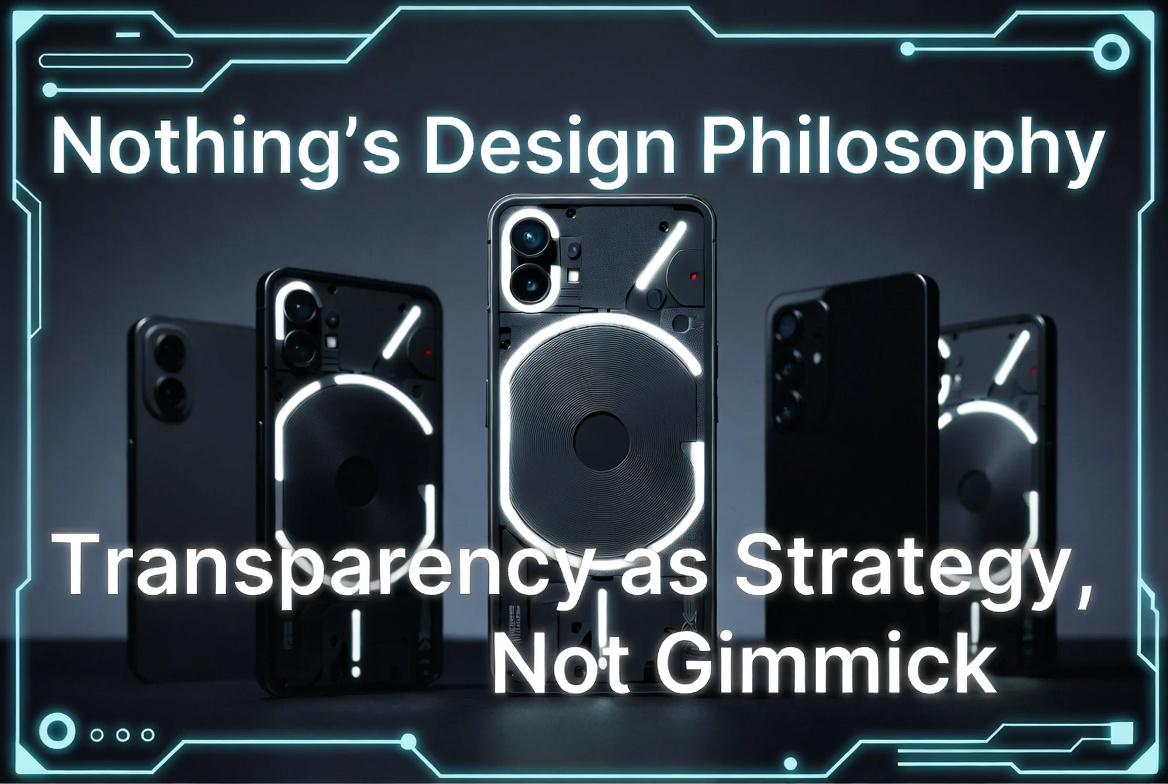
The transparent back on the ear (1) was the founding material statement. Showing the internal components of a consumer electronics device is, in 2021 and still today, an unusual choice. The consumer electronics industry spent two decades concealing engineering behind smooth shells, treating the inside of a product as something to be hidden. Apple’s aluminum unibody iPhone, which defined premium smartphone aesthetics for a decade, is the apex of this philosophy: the engineering is invisible, and the surface communicates refinement through material quality alone.
Nothing’s counter-argument is that if the engineering is good enough, it is its own aesthetic. The transparent stem of the ear (1) works as design because the component arrangement inside is deliberate: wires run in intentional paths, the driver housing is color-coded, the internal architecture is considered as a visual composition rather than just as an electrical system. The Teenage Engineering influence is direct and still visible in every Nothing product released since.
The Glyph Interface: notification philosophy as product feature
The Glyph Interface on the Phone (1) addresses a specific problem Nothing diagnosed in smartphone culture: notification systems are designed to interrupt you. Banners, sounds, vibrations, screen flashes. Every notification demands your attention immediately. Nothing’s argument is that most notifications do not deserve immediate attention, and that a phone should be able to tell you something is happening without requiring you to pick it up. The Glyph makes that possible: the phone lies face down, the back lights up, you know something is happening, and you choose whether to respond.
The Glyph Matrix on the Phone (3), with 489 LEDs in a circular disc that can display the time and run developer-built mini-applications, is the logical evolution from a notification system to an ambient information surface. The back of the phone is now a programmable display. It is the Teenage Engineering aesthetic at its logical conclusion, and it is the clearest expression of the original philosophy that any Nothing product has achieved so far.
Where the philosophy still falls short
Essential Space is still not the ambient intelligence layer the philosophy implies. A truly invisible AI assistant would require less setup, less deliberate interaction, and fewer filing decisions to reach the organizational depth that makes it actually useful. The current implementation requires learning, which is friction, which is the opposite of what the philosophy targets. Nobody knows this. The roadmap for Essential Space is pointed toward the version that requires no learning, and the Phone (3a) and Phone (3) implementations are the iterations along the way.
The camera gap is real. Natural color rendering as a deliberate philosophy is also a description of a computational photography gap that more capable processing would close. The Phone (3) narrowed it. It has not eliminated it. “Feel like nothing” applies to the interaction. It does not yet fully apply to the camera output compared to what Apple and Google are producing.
The community model, which I have covered throughout this series, is itself a design decision. When 13,000 people own equity in the company that makes your phone, you have designed a distribution system that does not appear in any hardware specification. Nothing chose its investors the same way it chose its materials: deliberately, with a theory about how the choice would express the company’s values. The philosophy has proven more durable than the critics expected in 2021. Whether it proves durable enough to sustain a public company is the next test.
Part of my ongoing coverage of Nothing at m1k.tech, tracking the company from founding to global expansion.