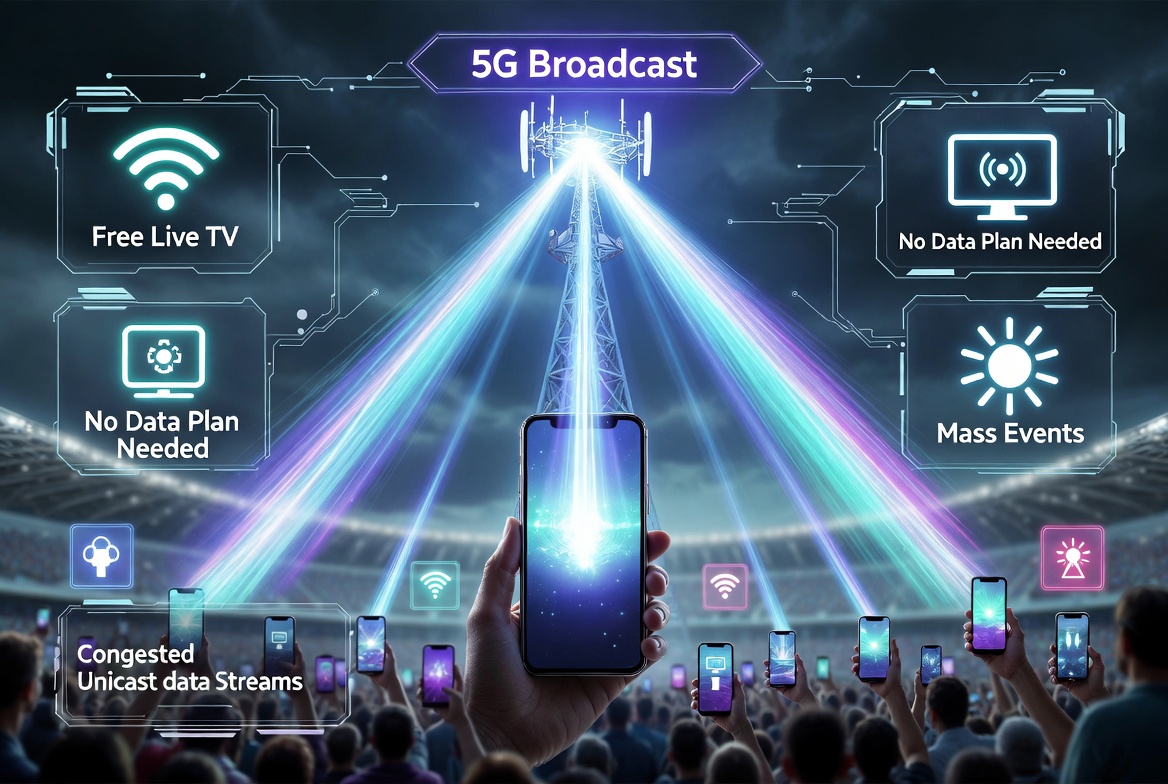
During the Paris Olympics in the summer of 2024, TDF and France Télévisions pointed a television tower at a few hundred phones and pushed the same live feed to all of them at once. The mobile network carried none of it. No SIM was checked, no data plan was touched, and it would not have mattered if it had been a few hundred thousand phones instead of a few hundred. One transmission, every device in range, zero congestion. That is the whole pitch for 5G Broadcast in a single sentence, and it is the kind of idea that sounds obvious right up until you remember the mobile industry has been fumbling it for a decade.
Here is the problem it solves, and it is a real one. When ten million people stream the same football match over a normal mobile network, the network builds ten million separate streams. Every viewer gets their own unicast pipe, the cell towers saturate, and the picture turns to mush at exactly the moment everyone wants to watch. Broadcasting has known the fix since the 1930s: send the signal once and let every receiver in the coverage area pull it down. 5G Broadcast drags that ancient, efficient idea into the phone in your pocket.
What it is, because the name is doing a lot of lying
The name suggests this rides on 5G. It mostly does not. The flavor that TDF, RAI and the rest of the European broadcasters are deploying is built on LTE, the 4G physical layer, dressed up and standardized by 3GPP across a few releases. It started life as enTV (enhanced TV) in Release 14 around 2017, became a proper standalone broadcast mode in Release 16, and in Release 18, finalized in early 2024, finally got the UHF band 470 to 698 MHz added, which is the spectrum television has used for generations. There is a true 5G-native version too, NR-MBS from Release 17, but that one lives inside the cellular network and behaves differently. When a broadcaster says “5G Broadcast,” they almost always mean the LTE-based, tower-driven standard. Perso, I think the naming has caused half the confusion in this whole space.
The part that makes it interesting is what it strips out. This is downlink only. The tower talks, the phone listens, and there is no return path, no handshake back to the tower at all. That enables Receive-Only Mode, which means a device with no SIM and no mobile account at all can still pull the signal out of the air. A twenty-euro burner phone can receive it. So can a tablet that never had a SIM tray, or a handset whose account died months ago. And because it runs from existing high-power, high-tower broadcast sites with a cyclic prefix stretched out to around 200 microseconds, a single transmitter blankets a huge area, and you can run a single-frequency network where neighboring towers reinforce instead of interfere. This is broadcast engineering, not cellular engineering. It is why the broadcasters, not the carriers, are the ones pushing it.
The upside is almost embarrassingly good on paper
Spectral efficiency is the headline nobody outside the industry cares about but everybody should. One 5G Broadcast transmission serves an unlimited number of viewers using the same sliver of spectrum whether three people or three million are watching. For a mobile operator drowning in video, which is most of their traffic, the appeal is offload: punt the popular live content onto a broadcast layer and stop paying to unicast the same Champions League match to every handset in the city. For the user, the content does not count against a data cap because it never crossed the mobile network. For a public broadcaster, it is the holy grail of getting free-to-air television back onto the device people really watch on, the phone, after a decade of losing that ground to streaming apps and YouTube.
Then there is the resilience angle, which I keep coming back to because it is the one that justifies public money on its own. A broadcast tower with Receive-Only Mode is a one-to-many emergency channel that works when the cellular network is melting down or knocked out entirely. When the cell network collapses under load, which is the first thing that happens in a flood or a blackout or a stadium crush, a downlink-only broadcast layer that any phone can hear without authentication is exactly the kind of infrastructure you want when everything else fails. Estonia has been testing 5G Broadcast specifically tied to emergency alerting. That use case alone is why the EBU keeps the broadcasters in the room.
Battery is a quieter win. Pulling a single broadcast stream is far gentler on a phone than holding up a saturated unicast session with constant retransmissions, so a stadium full of people watching the replay on 5G Broadcast drains slower than the same crowd hammering the mobile network. Small thing. Adds up.
Now the part that has killed this idea before
None of the upside matters if you cannot buy a phone that receives it, and right now you cannot. Every European trial, Paris included, ran on Qualcomm reference designs and modified Xiaomi handsets, not retail devices off a shelf. This is the exact wall that buried eMBMS, also sold as LTE Broadcast, the predecessor that shipped in Qualcomm modems for years and went almost nowhere because carriers never switched it on and handset makers never surfaced it. The chicken and egg is brutal: chipmakers will not bake in and validate a feature with no service to receive, broadcasters will not fund transmitters with no devices to reach, and round it goes. The whole reason the EBU and Broadcast Networks Europe published a common 5G Broadcast receiver profile in late 2024, with Qualcomm’s help, was to break that loop by handing chipset and phone makers one harmonized spec to build against instead of twenty national variants. It is the single most important non-glamorous thing happening in this technology, and whether it works is still an open question.
The business model is the other soft spot, and franchement nobody has a clean answer. Who pays the tower operator to run the broadcast layer? The carrier saving on offload? The broadcaster buying reach? The state funding emergency resilience? Everybody benefits a little and nobody obviously owns the bill, which is a classic recipe for a technology that demos beautifully every two years at the Olympics and never quite launches. The spectrum politics underneath it are worse: UHF is contested ground, and the mobile industry has spent years trying to claw it away from broadcasters for more unicast capacity. 5G Broadcast is partly a broadcaster argument for keeping that spectrum, which makes it as much a political play as a technical one.
The carrier angle, which is more interesting than the carriers admit
For an operator, the obvious move is hybrid: deliver the long tail of personalized content over normal unicast, and flip the few truly massive live events onto a broadcast carrier, with the phone handing off between the two without the user noticing. The NR-MBS variant from Release 17 is designed exactly for that in-network switching, dynamically moving a service between point-to-point and point-to-multipoint depending on how many people in a cell want it. That is the version a carrier controls end to end, versus the LTE-based standalone version a broadcaster runs from a TV tower.
Beyond live TV, the same downlink-only pipe can push software updates to a million cars at once, feed map and road-sign data to vehicles, blast IoT firmware, or run a datacasting business delivering files to fleets of devices that all need the same payload. That last one is where new B2B revenue could really live, and it is the part the slide decks underplay because “broadcast TV to phones” tells better than “bulk file delivery to embedded modems.” The automotive case is real enough that it keeps showing up in the trial roadmaps.
Who is building this
The European cast is small and consistent. Qualcomm supplies the chipsets and reference phones and has been the constant across nearly every trial. Rohde & Schwarz builds the transmitters. Ateme handles the encoding. Above them sit the broadcasters and the tower operators who own the actual towers: TDF in France, Media Broadcast in Germany, ORS in Austria, EITowers in Italy, Cellnex in Spain, with the EBU and BNE coordinating so the whole continent does not fragment into incompatible islands.
France is one of the front-runners. TDF and France Télévisions ran that large-scale Paris 2024 demo on hundreds of devices, TDF has spent 2025 on hybrid service models and signal optimization, and the operator has floated a potential commercial rollout around 2028. You can read TDF’s own framing of it on their 5G Broadcast page. Italy is arguably further along on the ground: RAI, working with the EBU, has been running pre-commercial large-scale trials since early 2025 and is using the Milano Cortina Winter Olympics this February to stress-test reception and robustness across Rome and Turin. Germany has Vantage Towers and Media Broadcast eyeing commercial timelines in the 2026 to 2027 window. The pattern across all of it is coordinated, standards-led, and patient, which is either reassuring or maddening depending on how long you have been waiting.
Europe versus the United States, where the story flips completely
This is the part I find fascinating, because the two regions took opposite roads and both are stuck in instructive ways.
Europe went with the boring, LTE-based, broadcaster-controlled 5G Broadcast and is quietly grinding it toward market through tower operators and the EBU. The United States bet everything on ATSC 3.0, branded NextGen TV, a far more ambitious IP-based standard with its own physical layer, a future-proofing bootstrap signal, 4K, HDR, and real datacasting built in. On raw capability ATSC 3.0 is the better engineering. On the ground it is a mess. The transition is voluntary, so there is no mandate forcing it through. Stations are stuck simulcasting the old ATSC 1.0 signal alongside the new one, which eats the capacity that was supposed to make 3.0 worth it. TV makers resent the tuner cost and the royalty fights, so Samsung put 3.0 tuners in 8K sets and skipped the cheaper 4K models. And the DRM and encryption layer, policed by the A3SA, has consumer groups accusing broadcasters of acting as gatekeepers over public airwaves. NextGen TV has launched in more than 80 markets and reaches over 70 percent of the population on paper, with 14 million capable sets sold through 2024, but adoption is dragging and the NAB is begging the FCC for a hard cutoff date that keeps slipping toward 2028 and beyond.
Into that frustration walks 5G Broadcast as the insurgent. A company called HC2 Broadcasting, which owns around sixty low-power stations, petitioned the FCC back in April 2025 to run 5G TV instead of ATSC 3.0 in the 470 to 698 MHz band, pitching a future where a cheap phone with no subscription tunes live television and emergency alerts straight out of the air. At NAB 2026 in April, Castanet showed a live 5G Broadcast signal running interleaved inside an ATSC 3.0 transmission, a working system on the show floor, not a slide. The established broadcast alliances, NAB and the ATBA, are pushing back hard, framing it as a replacement attempt dressed up as coexistence, and the ATSC itself has a technical group trying to fold 5G Broadcast waveforms into 3.0 so the two can share a transmission rather than fight. The fault line is open and a little ugly, and it comes down to whether broadcasters have just handed the mobile industry the argument that their spectrum belongs in someone else’s ecosystem.
So the irony writes itself. America invented the technically superior standard and is drowning in its own patents, mandates, and DRM politics. Europe took the unglamorous LTE-based one and is putting it on phones at the Olympics. I would not have called that ten years ago.
I am leaving the airborne side of this alone here, the drone-carried private 5G cells that France Télévisions, RAI and the BBC have been flying for live production, because that is a different beast entirely, uplink contribution rather than downlink distribution, and it deserves its own post.
Where I land
The technology works. Paris proved it, Milano Cortina will prove it again, and every demo lands because the underlying idea, send once and reach everyone, is simply correct. That was never the question. The question is whether a phone you can walk into a shop and buy will ever ship with 5G Broadcast switched on, and on that, the industry’s track record is a decade of switching the predecessor off. The receiver profile is the real test, not the next Olympic showcase. If commercial Snapdragon-class phones start carrying validated 5G Broadcast reception off the back of that profile, this becomes infrastructure. If they do not, this stays what eMBMS was: a brilliant capability sitting dormant in a billion modems because nobody could agree on who pays to turn it on. I want to believe the emergency-resilience case is strong enough to force it through where pure media economics never could. Ask me again after Milano Cortina, and after I see whether a single carrier or a single phone maker does anything that costs them money.