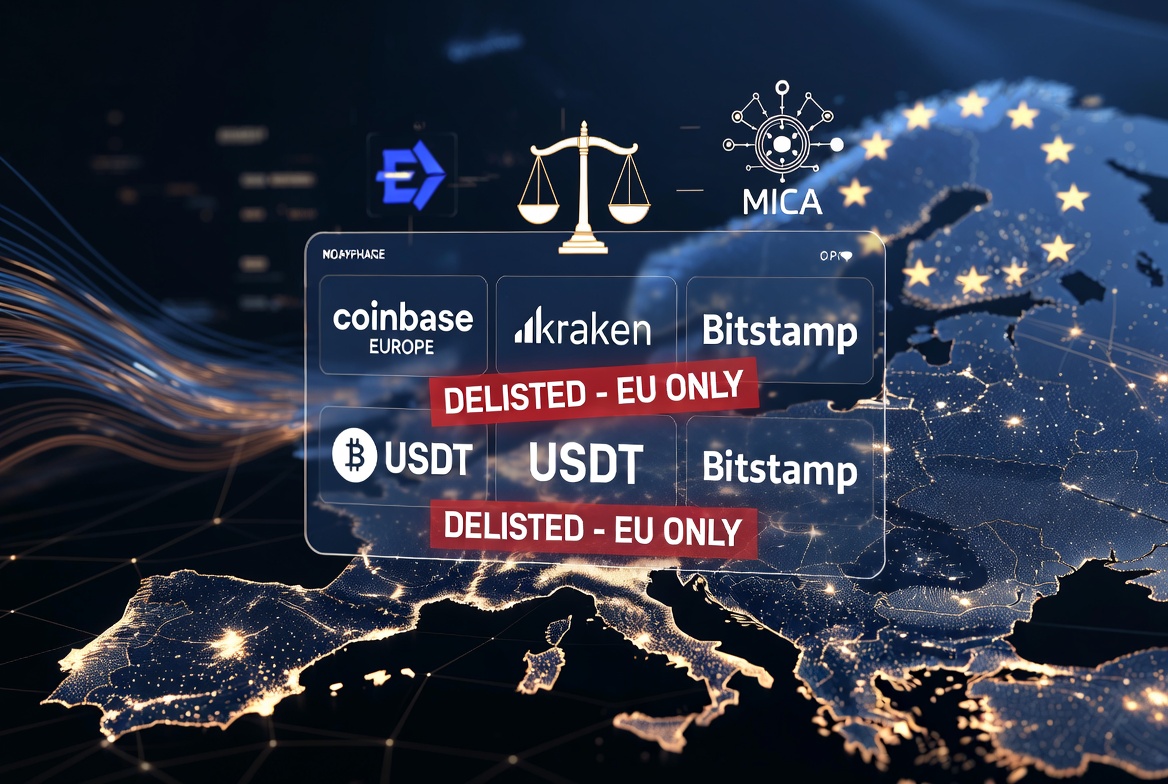
Regulation (EU) 2023/1114, known as MiCA, is the EU’s first comprehensive statutory framework for crypto-assets. It classifies tokens into three categories, imposes licensing requirements on crypto service providers, and sets strict reserve and audit standards for stablecoins, with full applicability reached by December 30, 2024.
The regulation’s real-world impact is visible in Tether’s USDT being delisted from major EU exchanges for non-compliance, while Circle’s USDC gained a competitive advantage by securing EMT authorization. With no equivalent federal framework in the United States, MiCA has emerged as a de facto global compliance benchmark, extending its influence beyond European borders.
USDT vanished from Coinbase Europe, Bitstamp, and Kraken order books for EU customers ahead of a single deadline in June 2024. The largest stablecoin on earth, the default settlement pair on nearly every exchange, gone from European retail because it declined to play by a rulebook the EU had just switched on. That is what Regulation (EU) 2023/1114 does when it bites, and the industry has spent the eighteen months since learning exactly where the teeth are.
The EU has a habit of writing rules the rest of the world ends up copying. GDPR rewired how every large tech company handles personal data, European or not. The General Product Safety Regulation quietly became the floor for consumer electronics sold anywhere. MiCA, the Markets in Crypto-Assets regulation, is the same play aimed at crypto: the first comprehensive statutory framework for digital assets, dropped onto a market representing roughly 20% of global GDP, with the gravitational pull left to do the rest.
This is not a light-touch disclosure regime. It is a full-stack financial services law aimed at an industry that spent fifteen years operating largely outside such frameworks, and the friction shows up in delisted stablecoins, rushed licensing scrambles, and companies quietly re-plumbing their European entities. The Commission proposed it in September 2020, Parliament adopted it in April 2023, and it hit the Official Journal on June 9, 2023. It came alive in stages. The stablecoin rules, covering Asset-Referenced Tokens and Electronic Money Tokens, became applicable on June 30, 2024. The full framework governing Crypto-Asset Service Providers went live on December 30, 2024. Firms already operating under national regimes get a grandfathering window to keep going while they chase MiCA authorization, but that window slams shut on July 1, 2026, and any CASP without authorization after that date has to leave the EU.
Underneath the timeline sits a three-way split of the entire crypto universe, and which box a token lands in decides how much law falls on its head. Asset-Referenced Tokens are stablecoins pegged to a basket, multiple currencies, commodities, or other crypto-assets. Think a token backed by EUR, USD, and gold at once. They carry the heaviest burden precisely because that multi-asset backing makes reserve management and stabilization genuinely harder. Electronic Money Tokens are the simpler animal: a stablecoin pegged 1:1 to a single fiat currency, a euro coin or a dollar coin. MiCA treats an EMT as functionally the same as electronic money under the existing E-Money Directive, so the issuer has to be an authorized credit institution or hold an e-money license, keep fully liquid reserves matching the outstanding supply, and redeem at par on demand. Everything else, the utility tokens and altcoins and governance tokens, drops into a residual bucket with a lighter but real regime: publish a whitepaper, register the issuing entity inside the EU, follow marketing standards.
Three things sit outside the fence entirely. Security tokens that qualify as financial instruments under MiFID II stay under MiFID II. NFTs escape on the theory that they are unique and non-fungible, though the regulation itself admits fractionalized NFTs or large series of functionally identical NFTs can get pulled back in. Central bank digital currencies live under the separate digital euro framework. And fully decentralized DeFi, where no issuer or service provider can be pointed at, is carved out with boundaries the drafters left deliberately fuzzy, to be poked at in a Commission review and report due by 2025.
Any outfit offering custody, exchange, trading, transfer, portfolio management, advice, or underwriting to EU customers is a Crypto-Asset Service Provider, and since December 30, 2024, authorization for those firms stopped being optional. You register in one member state, and that single license passports you across all 27. It mirrors how banks and investment firms already operate under MiFID II, and it is one of MiCA’s honest structural wins over the old patchwork of national VASP registrations. The own-funds floor scales with what you do: €50,000 for advice or order handling, €125,000 for running a trading platform or exchange, €150,000 for custody. Those are minimums, and regulators can and do demand more once they see the operational scale.
Capital is the easy part. A CASP also has to prove fit-and-proper management, with directors and major shareholders run through background and competence checks, document its governance, stand up cybersecurity and business-continuity policies, report material incidents to its national authority, ringfence client assets from firm assets with no commingling, run a formal complaints process, and publish conflict-of-interest policies. AML and KYC ride in on the existing EU framework, which MiCA reinforces rather than rewrites, and the Travel Rule attaches: originator and beneficiary information has to accompany any crypto transfer above €1,000.
For a token issuer the central chore is the whitepaper. Before any public EU offering, the issuer publishes a document describing itself and the project, the rights and obligations tied to the token, the underlying tech and its risks, the use of proceeds, and any significant holders, then files it with the national regulator before the offering opens. Offerings raising under €1 million over twelve months are exempt, which spares small projects from compliance costs that would swallow them whole. Marketing has to match the whitepaper and be labeled as marketing.
Stablecoin issuers get a supervisory ceiling on top of all that. Once an ART or EMT crosses into “significant” territory, meaning more than 10 million holders, a €5 billion market cap, or €500 million in average daily volume, oversight jumps straight from the national authority to the European Banking Authority. The EBA then tightens capital and liquidity demands and can cap transaction volumes if it decides a stablecoin threatens monetary policy transmission. This is not a paper power. The EBA has already published detailed technical standards on reserve composition, custody of reserve assets, and stress testing.
MiCA was supposed to kill the fragmented national VASP regimes, and the joke is that the transition briefly rebuilt exactly that fragmentation, because member states handed out grandfathering windows of wildly different lengths. France, Malta, Luxembourg, and Estonia gave the full 18 months, so nationally registered firms there can coast until July 1, 2026. Germany and Austria offered roughly 12, dragging their real deadlines back to around the end of 2025. The Netherlands and Poland cut theirs hard, with the Dutch regulator telling firms to get MiCA authorization or stop operating by mid-2025. So a CASP holding only a Dutch registration was staring at a deadline a full year earlier than a rival sitting on a French or Maltese one. The result was a visible race to Luxembourg and Malta, both of which built reputations as fast authorization hubs, the CSSF and MFSA processing applications at a clip. Coinbase took its CASP authorization from the CSSF and now runs EU services through Coinbase Luxembourg S.A. OKX went through Malta. Crypto.com licensed via Cyprus. None of this is arbitrage in the old sense, since every MiCA authorization carries identical legal weight and identical passporting rights, but the home state you pick decides which regulator watches you forever after, and firms are clearly choosing the relationship they want to live in.
Nothing shows MiCA’s real-world bite like what it did to Tether. USDT is the biggest stablecoin there is by market cap and by volume, the settlement and trading-pair asset underpinning basically every major exchange on the planet. Under the EMT rules, any single-fiat stablecoin offered to EU retail has to come from a MiCA-authorized entity holding fully liquid, segregated, audited reserves matching supply, with unconditional redemption at par. Tether hasn’t applied. The company has publicly called MiCA’s reserve and audit demands operationally punishing and structurally at odds with how it actually runs reserves, which lean on US Treasury bills and other instruments that are liquid enough but not shaped to MiCA’s specific composition standards. Its reserve attestations, done by BDO Italia, also fall short of the full audit standard MiCA wants from a significant EMT issuer. So before the June 30, 2024 deadline, Coinbase Europe, Bitstamp, and Kraken delisted or restricted USDT pairs for EU customers. Those weren’t abstract business calls. They were the only legal response to a flat prohibition on serving non-compliant stablecoins to EU retail.
Circle read the room earlier. USDC is now registered as an EMT under MiCA through an EU-authorized entity, which makes it the dominant compliant dollar stablecoin in Europe. The competitive gap that opens is not subtle: USDC can be listed freely on EU platforms and USDT cannot, and in a market where stablecoin dominance is mostly a function of which pairs an exchange offers, MiCA handed Circle a regulatory moat that Tether has simply declined to fight for. As of early 2026 Tether has announced no plans to seek authorization. It still reaches EU institutional and peer-to-peer users through channels that don’t need CASP intermediation, but its retail footprint in Europe has been cut to the bone.
The exclusions leak worse than the inclusions bind. The DeFi language exempts services provided “in a fully decentralized manner without any intermediary,” and then never defines “fully decentralized” across 150 pages. Almost every DeFi protocol carries some centralized residue, a dev team, a multisig admin key, a foundation steering upgrade governance, or a token distribution that quietly concentrates voting power. Whether any of that is enough to drag a protocol back inside MiCA is an open question the Commission owes an answer to in that 2025 report, and until legislation follows, enforcement stays interpretive and uneven across member states. Some projects are restructuring their governance right now purely to shore up a decentralization claim they can defend.
The NFT carve-out has the same soft edge. It covers tokens that are “unique and not fungible with other crypto-assets,” and the regulation goes out of its way to say that slapping a unique identifier on a token doesn’t automatically make it an NFT for MiCA purposes. Ten thousand algorithmically generated profile pictures running identical smart-contract mechanics and trading freely on secondary markets can be functionally fungible no matter how distinct each image looks. Fractionalized NFTs, where a single NFT is split into fungible shares, almost certainly land inside MiCA as ARTs or as other crypto-assets. That line gets drawn in court.
The deeper point of MiCA isn’t only what it demands of crypto firms in Europe. It’s what it signals about who gets to write the terms everyone else builds to. The United States, as of early 2026, still has no comprehensive federal crypto framework. The SEC and CFTC keep fighting over turf. Congress keeps proposing legislation that keeps not passing. Into that vacuum, MiCA has become the de facto global compliance benchmark, because a firm designing a product for worldwide distribution around MiCA has, by construction, already solved reserve requirements, whitepaper disclosure, AML/KYC, client asset segregation, and governance, and that stack is stricter than anything another major jurisdiction currently asks for. So EU standards get exported to non-EU firms chasing EU market access, and from there to those firms’ global operations, because maintaining one compliance stack beats maintaining twenty. The Brussels Effect, now running in digital finance.
For stablecoins the effect is sharper still. MiCA’s reserve and audit rules mean any stablecoin wanting EU retail distribution has to sit on a fully audited, liquid reserve held in EU-supervised custody. Call it digital monetary sovereignty: the settlement layer for European crypto answers to EU prudential oversight instead of resting on attestations from a Cayman-incorporated company signed off by a small Italian auditor. You can read that as sober financial regulation or as protectionist digital policy depending on what you already believe about Brussels, but the structural result doesn’t care which you pick. The dominant stablecoins in the European market will be EU-supervised entities.
The framework is still moving. The Commission’s DeFi report, the EBA’s continuing work on reserve technical standards, ESMA’s technical standards for CASP operations, and the looming question of whether crypto lending and staking need rules of their own will all generate more regulatory material over the next few years. But the one seam I’d watch is that undefined “fully decentralized” line, and whether it holds up the first time a serious protocol with a multisig key and a foundation dares a regulator to call it centralized. That fight is where MiCA either proves it can regulate crypto as it actually exists or admits it only ever regulated the parts that agreed to be found.
Primary source: Regulation (EU) 2023/1114, Official Journal of the European Union L 150, 9 June 2023, available via EUR-Lex at eur-lex.europa.eu.