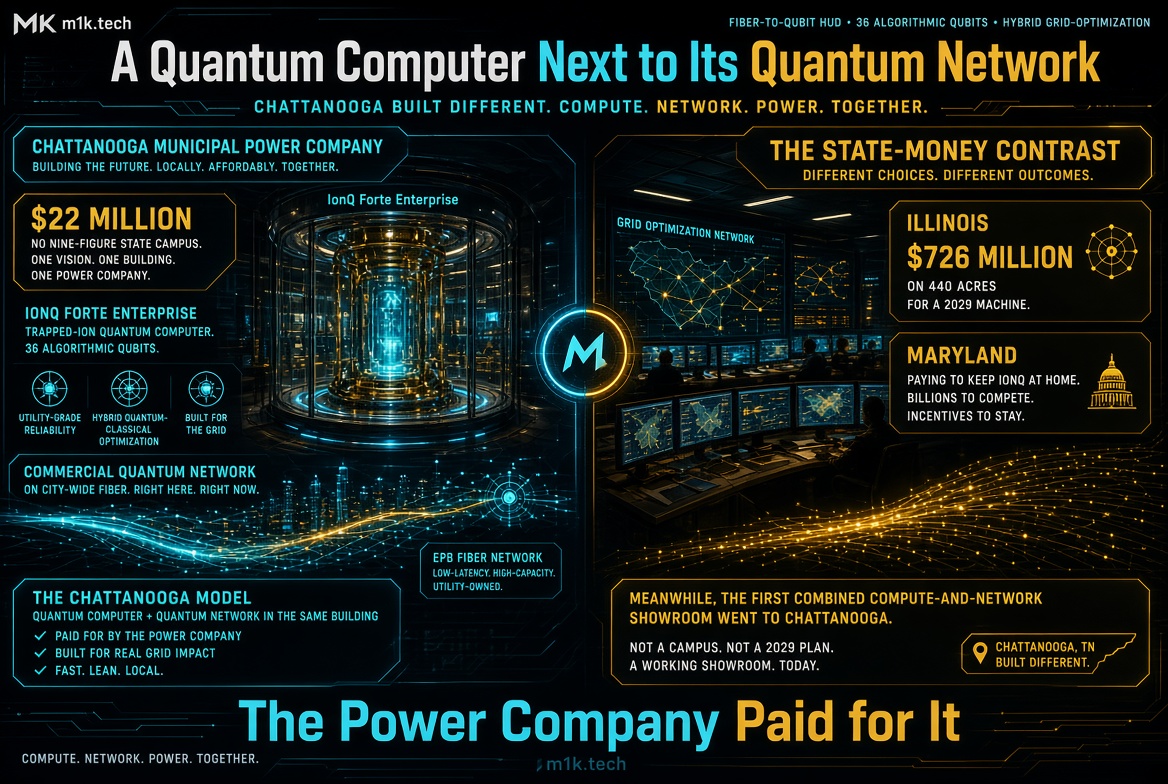
The first people allowed to run code on Chattanooga’s new quantum computer aren’t paying customers. They’re eight graduate researchers on a $4 million NIST grant, and the job EPB handed them is squeezing a bit more efficiency out of the city’s own power circuits. On September 18, EPB switched on an IonQ Forte Enterprise at the EPB Quantum Center, in the same facility as the EPB Quantum Network it has sold commercially since 2023. That makes the Chattanooga quantum computing hub the first place in the US offering commercial quantum computing and commercial quantum networking under one roof. Paid service opens in early October; the University of Tennessee at Chattanooga goes first, and Vanderbilt is lining up its first project behind it.
Back in August I wrote about Chicago’s quantum park breaking ground on 440 acres of slag, and I ducked one question on purpose: whether Illinois had outmaneuvered Maryland, Colorado and New Mexico for the quantum lead. I called that a different post. This is that post, except the entrant I didn’t see coming isn’t a state at all. It’s a municipally owned electric company in southeast Tennessee.
The instinct is the one I recognize from Chicago: build the infrastructure first and let the industry find it, but the plumbing underneath is completely different. EPB strung 100% fiber across its service area in 2010 because its automated grid needed it, sold the leftover capacity as the first community-wide gigabit internet in the country, and now runs up to 25 Gig on the same glass. The quantum network rides that fiber. The quantum computer sits next to it. Nobody in Nashville wrote a nine-figure appropriation for any of this.
The deal itself is small by quantum-campus standards. IonQ announced it in April 2025 at $22 million, covering the Forte Enterprise sale and a permanent IonQ office in Chattanooga focused on grid-optimization algorithms. EPB bought half the machine’s compute capacity. The other half stays with IonQ, which pitched the Tennessee system as extra capacity for its own cloud and Amazon Braket customers. So “funded by a municipal utility” is mostly right, with an asterisk: a public power company co-owns the time on a machine that also serves a Maryland-headquartered vendor’s global cloud. The vertical integration runs deeper than the headline, too. Qubitekk built the EPB Quantum Network, and IonQ bought Qubitekk. The network vendor and the computer vendor in that building are the same company.
Here’s the local-regulation twist I find a little funny. Tennessee law has long kept municipal electric utilities from selling broadband outside their electric footprint. EPB fought that in 2015, got the FCC to preempt the state, then lost when the Sixth Circuit threw out the FCC’s order in 2016. The statute that fenced in EPB’s internet business is part of why the utility keeps finding new things to do with the fiber it’s allowed to run. Being a public utility also shapes the order of operations: EPB answers to ratepayers, which is why its own grid fellows get the machine before any university does, and why the risk, if this goes sideways, sits on a utility balance sheet rather than a legislature’s.
Now put that next to what the states are doing. The Quantum Insider’s tracker counts 28 states with quantum programs across 125 funding lines as of Q3 2026, and the money is badly lopsided. Illinois sits on top with $726.3 million allocated, almost all of it flowing through the campus: the $500 million from 2024, PsiQuantum as anchor tenant, and a thirty-year Cook County property-tax break that I estimated at roughly $175 million in forgone revenue. That is a bet on a fault-tolerant machine whose million-qubit target has already slid to 2028 or 2029. New York comes second at $366.5 million, spending on physical infrastructure while it froze new data centers in the same month.
Maryland is the one that stings. It has $301.9 million allocated toward Governor Moore’s Capital of Quantum push, a $1 billion target by 2030, and it put $10 million of state money behind IonQ’s new 100,000-square-foot headquarters in College Park, which is supposed to double IonQ’s Maryland workforce to at least 250. Maryland paid to keep IonQ at home, and IonQ’s first combined computing-and-networking showroom went to Chattanooga anyway. I don’t think anyone in Annapolis is losing sleep over it, since Microsoft’s quantum research center opens there this fall, but it tells you something about where vendors put hardware when a customer already has live fiber.
The Mountain West went a different route. New Mexico shows $166.8 million allocated plus another $255 million committed but not yet out the door, and it went from zero quantum companies to five (Quantinuum, QuEra, Qunnect, Maybell and Mesa Quantum) in under two years, helped by a $25 million state venture studio. Colorado, through the Elevate Quantum tech hub it shares with New Mexico, leaned on the tax code instead of buildings: a 100% refundable credit for capital put into a shared quantum facility, and another that covers losses on registered loans to quantum companies. Of all the state playbooks, that’s the one I like most, because it pays out only if somebody actually shows up and builds.
Tennessee’s state line is $65 million, and the tracker files it under workforce, which matches what’s happening locally. Hamilton County Schools is piloting the state’s K-12 quantum program, and an Energy and Quantum Industries Academy is supposed to take around 400 high schoolers a year starting in 2028. The research money is showing up through the universities instead. UTC plans to add 135 to 240 faculty, staff, and students; Vanderbilt is anchoring a Chattanooga campus for its Institute for Quantum Innovation at around 250 people; and IonQ is putting $15 million into a Tennessee Quantum Communications Research Center with about two dozen jobs. Oak Ridge is an hour and a half up the road and already inside the building: EPB, IonQ, ORNL and NVIDIA installed a classical supercomputer in the quantum center for a hybrid grid-optimization project.
That hybrid box is where I’d put my money, and it’s where my skepticism lives too. A Forte Enterprise is a trapped-ion machine IonQ markets at 36 algorithmic qubits. It’s a good system. It is nowhere near fault-tolerant, and nobody has shown that grid optimization at utility scale runs better on hardware like this than on a well-tuned classical solver. I wrote in August about how badly quantum results hold up when someone tries to reproduce them, and “we optimized a feeder circuit” is exactly the kind of claim I’ll want to see benchmarked against the supercomputer sitting a few racks away. The honest version of this R&D program is the hybrid one, and to EPB’s credit, that’s the one it’s actually funding.
The “combined” in combined hub also deserves a squint. Nothing in the launch says the Forte’s qubits are talking to the network’s photons yet. For now it means the same building and the same sales desk, which is still useful, but distributed quantum computing over fiber is a later chapter. Chattanooga doesn’t own the networking story alone either. Chicago’s exchange runs its own fiber testbed, and Brookhaven and Stony Brook just sent entangled photons 21 kilometers through open air on Long Island. What Chattanooga has that they don’t is a price sheet.
I’m not getting into the community-benefits question here. I did that for Chicago, and Chattanooga’s version looks gentler because nobody is capping a brownfield. The economic projection needs a grain of salt all the same: EPB and the mayor are quoting up to $1.1 billion in gains by 2035, which is the kind of number every quantum groundbreaking seems legally required to produce.
What keeps nagging at me is the scale mismatch. The whole EPB deal was $22 million, roughly an eighth of the property tax Cook County is giving up on the Chicago campus, and it bought a machine people can rent next month. Illinois bought a campus for a machine that may arrive in 2029. I’m a Chicago guy, and I want the South Works bet to pay off, but if I were a state economic-development office drafting my first quantum strategy this fall, I’d call Chattanooga before I called a real-estate fund.
Sources: EPB launch release (Sept 18, 2026); IonQ Q1 2025 results, $22M EPB deal; The Quantum Insider state quantum funding tracker; Maryland Capital of Quantum announcement; New Mexico EDD quantum ecosystem award; SSTI on Colorado HB24-1325 quantum tax credits.