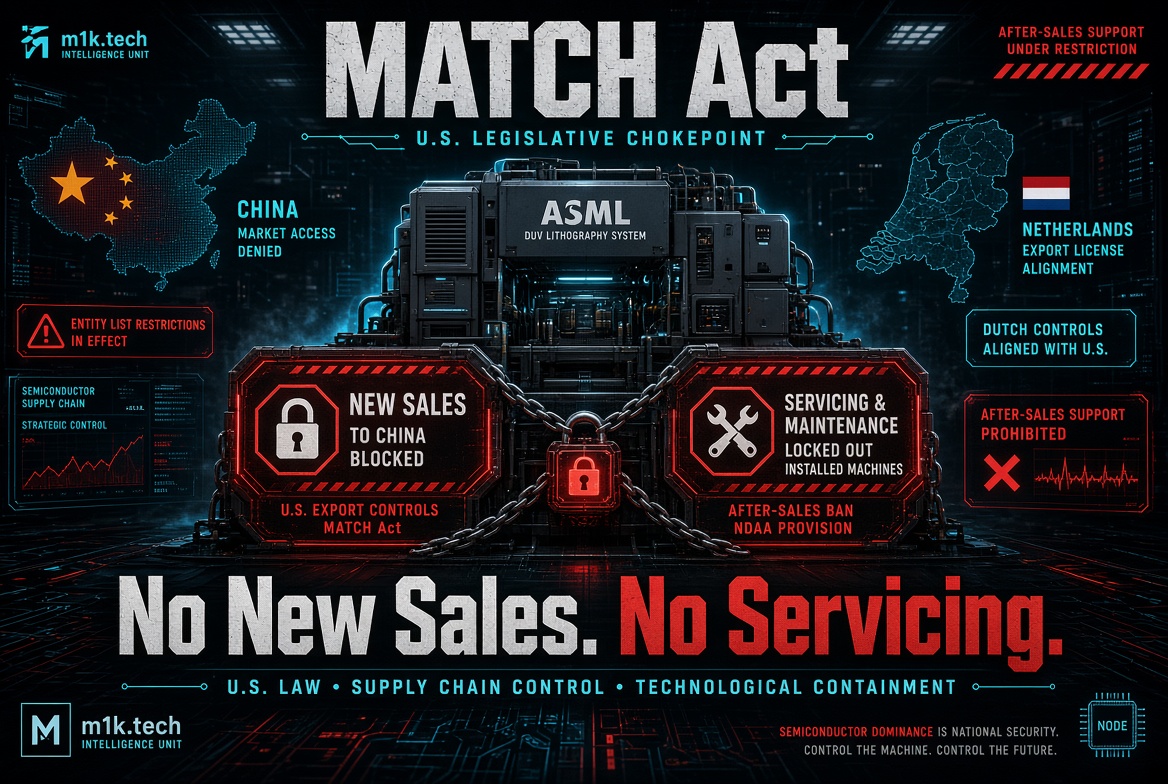
Congress is close to handing ASML a choice it doesn’t want: stop selling to China, or stop being allowed to touch the machines it already sold there. The bill carrying that ultimatum is the MATCH Act, the Multilateral Alignment of Technology Controls on Hardware Act, and it’s riding into law inside the Senate’s National Defense Authorization Act for fiscal 2026. Getting stapled to the NDAA is about as close to a guaranteed floor vote as a standalone bill gets in Washington, since Congress has passed that budget every year for six decades running.
I wrote about this exact door back in 2022, when EUV first got sealed off from China and DUV was still open. I said then that governments don’t find a chokepoint this clean and leave it alone; they use it and go looking for the next thing to restrict. DUV was always next. What I didn’t expect was Washington reaching for legislation instead of another round of licensing memos, and reaching past new sales into maintenance on hardware that already left the building.
That’s the part that actually stings. ASML can currently still sell older DUV lithography systems to Chinese customers under Dutch rules, since EUV and the highest-end DUV variants are already blocked. NL Times reported this week, citing Dutch outlet NU.nl, that the bill would kill that DUV carveout entirely and go further: ASML wouldn’t be allowed to maintain the DUV tools Chinese fabs already paid for and installed. A stepper that breaks stays broken. A part that wears out stays worn. If the Netherlands won’t enforce the ban, the bill lets Washington sanction the Dutch directly, and that’s the leverage that matters, because the Hague has caved to exactly this kind of pressure before. ASML depends on American suppliers for its own production, and American threats to that supply chain have already talked the Dutch government into tighter export rules once.
Introduced back in April by Senators Pete Ricketts and Andy Kim, one Republican and one Democrat, the bill’s stated target isn’t ASML specifically. It’s the gap between how strict US equipment controls already are and how loosely allied nations, mainly the Netherlands and Japan, enforce their own versions of the same restrictions. That asymmetry is a real problem for Washington on its own terms: American toolmakers lose sales to a stricter standard than their Dutch and Japanese competitors face, and Chinese buyers exploit the gap anyway. Framed that way, the MATCH Act reads less like a new attack on ASML and more like Washington deciding that if its own companies have to play by the tight rules, everyone selling into the same market does too. NU.nl’s framing, that American firms would still be allowed to sell their most advanced etching tools to China under the bill, is true, but only because US controls were already the strictest baseline in the room. The bill isn’t loosening anything on the American side. It’s dragging the Dutch and Japanese baselines up to meet it.
Dutch officials are reportedly lobbying hard in Washington to get the MATCH Act stripped out before the NDAA passes, and their odds look thin. Both parties back it; it’s paired with the AI Overwatch Act and the Chip Security Act as part of a broader supply chain security package, and nothing about that combination smells like a bill Congress walks back under foreign pressure. My guess, and it’s only a guess, is the Netherlands complies quietly, the same way it did last time. The Hague has never actually said no to Washington on this file, not once, not when it counted.
The bitter irony is that a servicing ban is exactly the kind of pressure that backfires fastest. I wrote in July about China’s homegrown immersion DUV tool, the one with five machines on order this year and twenty next, headed for SMIC, Hua Hong, and CXMT. That program exists because dependency on ASML already looked uncomfortable to Beijing before this bill showed up. Cut off maintenance on machines Chinese fabs already own, and you don’t just push new sales toward the domestic alternative; you force existing fleets to either run on borrowed time or get cannibalized for parts by whoever reverse-engineers ASML’s service manuals first. Either way, the incentive to make that homegrown stepper reliable just went up, not down. Twenty machines a year stops sounding like a rounding error once you remember they’re training a domestic maintenance bench on hardware Chinese fabs can no longer get ASML engineers to touch.
None of this is about EUV. EUV has been untouchable for years and stays that way no matter what happens with the NDAA markup. This is about the workhorse tier, the immersion DUV systems that actually run volume for legacy logic, power management, sensors, the unglamorous silicon every AI server rack still needs by the thousands, the same tier that already sits inside a wider control mesh reaching into Malaysian transshipment logistics and Korean memory sales. I’ve called ASML the chokepoint the whole industry runs through because one company sits underneath every leading-edge node on earth. What the MATCH Act reveals is that the chokepoint cuts both ways: Washington can squeeze ASML precisely because ASML needs American parts as badly as China needs ASML’s machines. Nobody in this triangle has clean hands, and nobody in it has full control either.
What I’m not covering here is what a real servicing ban does to the machines already sitting in Chinese fabs if it actually lands, because that’s a parts-availability and supply chain story that needs its own reporting, not a paragraph tacked onto a policy piece. Watch the NDAA manager’s amendment, not the press releases out of either capital. That’s where this actually gets decided.
Sources
- NL Times, U.S. preparing to force Netherlands to ban ASML from selling to China, August 20, 2026
- Crypto Briefing, MATCH Act poised for inclusion in Senate NDAA as US tightens chip export controls, August 16, 2026