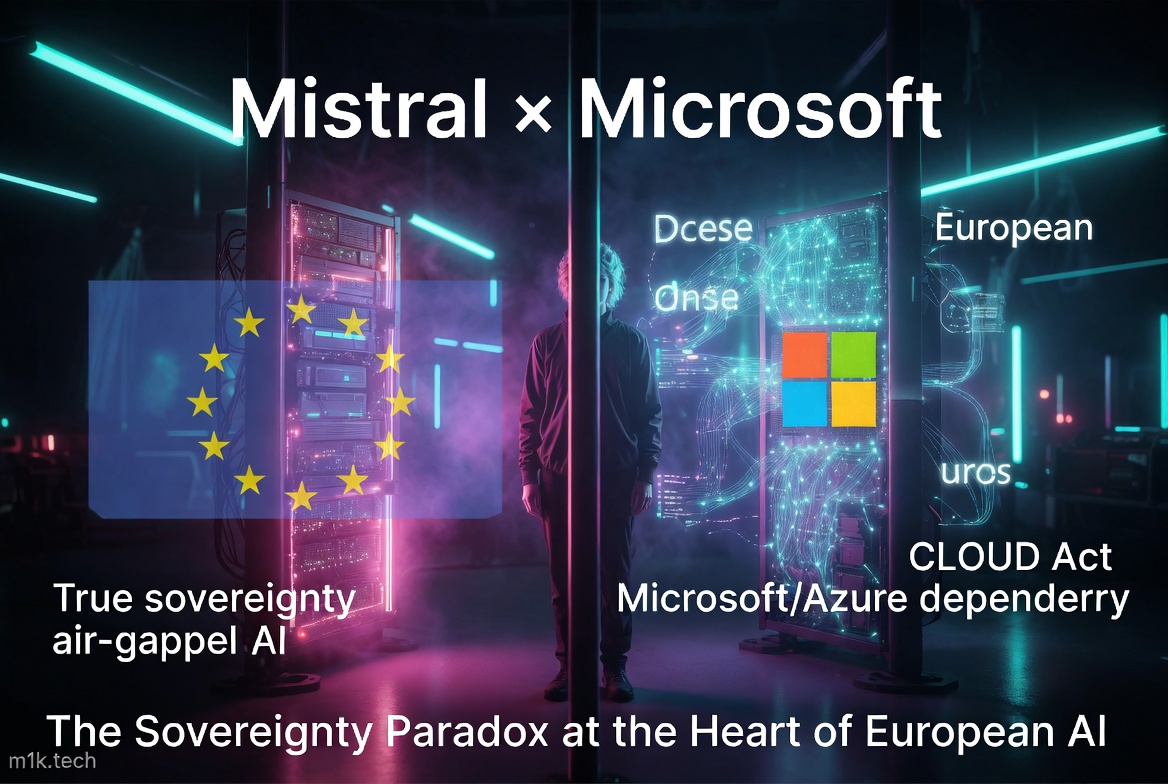
Three ex-Meta researchers walked out of Paris in early 2023 with a company in their heads and Meta’s LLaMA architecture in their fingertips. Arthur Mensch, Guillaume Lample, and Timothée Lacroix founded Mistral AI on a bet that the reigning orthodoxy in large language models, closed APIs served by American hyperscalers at ruinous scale, was neither technically inevitable nor politically survivable for Europe. Under two years later they had raised more than €1.1 billion, hit a valuation near $6 billion, and signed a deepened partnership with Microsoft that validates the technical vision and detonates the political one at the same time. Their supporters have a phrase for what is at stake: les enjeux de souveraineté sont colossaux. The sovereignty stakes are colossal. The question is whether the Microsoft deal resolves them or just wraps them in nicer paper.
Mensch co-authored the Chinchilla scaling laws paper at Google DeepMind, the 2022 work (arxiv.org/abs/2203.15556) showing that most large models of that era were badly undertrained for their parameter count, and that a smaller model fed more tokens beats a larger model fed fewer. Lample and Lacroix were central to LLaMA at Meta. So the founding thesis was never "build the biggest model." It was "build the most efficiently trained one, and put the weights in the open." That pedigree explains almost every technical choice that followed.
Mistral 7B, out in September 2023 under Apache 2.0, was the proof. At 7.3 billion parameters it beat Llama 2 13B on most standard benchmarks and traded blows with Llama 2 34B on reasoning. Two mechanisms did the heavy lifting, and they recur through the entire model family, so they are worth slowing down on. Grouped Query Attention shrinks the key-value cache during inference. Standard multi-head attention keeps separate K and V projections for every attention head; GQA lets several query heads share one K/V head, which collapses the KV cache size without a matching drop in quality. That KV cache is usually the binding memory constraint the moment you serve long-context requests or batch many users at once, so this is not a benchmark nicety. It decides how many people you can serve per GPU.
Sliding Window Attention attacks the other scaling wall. Full attention makes every token look at every other token, so memory and compute grow as O(n²) with sequence length. SWA restricts each token to a local window of size w and brings that down to O(n×w). Information from past the window still propagates, because each stacked layer widens the effective receptive field, so long-range coherence survives without paying the full quadratic bill. In practice Mistral 7B handled an 8,192-token context at a moment when comparably sized models usually topped out at 4,096.
Mixtral 8x7B changed the bet entirely in December 2023. It runs a Sparse Mixture of Experts: eight expert feed-forward networks per transformer layer, but a learned router fires only two of them per token per forward pass. Total parameter count sits around 46.7 billion, yet only about 12.9 billion are active for any given token. Inference costs roughly what a 13B dense model costs while the effective capacity, the breadth of knowledge spread across all eight experts, reaches toward something far larger. Mixtral matched or beat GPT-3.5 on most benchmarks, stayed competitive with Llama 2 70B, shipped under Apache 2.0, and became one of the most fine-tuned base models in the open ecosystem.
That sparsity is the whole point for sovereign deployment. Active parameter count drives inference compute, so a sparse MoE model delivers more quality per inference dollar than a dense model that scores the same on paper. A government agency or a hospital running inference on-premises against a fixed GPU budget does not experience that as an efficiency metric. It is the line between a deployment that pencils out and one that never ships.
What came after pushed the family in several directions at once. Mixtral 8x22B (April 2024) scaled the MoE design to roughly 141 billion total parameters with 39 billion active, a 65,536-token window, and native function calling across five European languages. Mistral Large 2 (July 2024) is a 123-billion-parameter dense model with a 128K window, pitched as a GPT-4-class competitor and served both via API and on Azure. Codestral (May 2024) is a 22-billion-parameter code model trained on more than 80 programming languages with a 32K window. The multimodal line opened with Pixtral 12B (September 2024, Apache 2.0) and grew into Pixtral Large (November 2024, 124 billion parameters). Mistral Small 3 arrived in January 2025 at 24 billion parameters under Apache 2.0, claiming best-in-class performance for its size.
One quiet detail carries more weight than it looks like. Mistral’s byte-pair tokenizer uses a 32,000-token vocabulary tuned for European languages, and tokenization efficiency feeds straight into both cost and quality. A tokenizer trained mostly on English over-segments French, German, and Italian words, burning context window on nothing and dulling the model’s grip on those languages. Fewer tokens per sentence means cheaper API calls and faster generation, and it means the French text actually reads like French. For the market Mistral is chasing, that is not trivia.
The Microsoft relationship opened formally on February 26, 2024. Mistral models landed on Azure AI Studio, later rebranded Azure AI Foundry, and Microsoft joined Mistral’s €385 million Series A alongside Andreessen Horowitz, Salesforce, BNP Paribas, and General Catalyst. Microsoft’s stake went undisclosed. Mistral Large shipped as a serverless pay-per-token endpoint plus managed compute for customers wanting dedicated GPUs, slotting in next to Meta’s Llama, Cohere’s Command, and eventually Anthropic’s Claude in the catalog, all of it living in the shadow of OpenAI’s models given Microsoft’s roughly $13 billion poured into OpenAI across 2019, 2021, and 2023.
The 2025 expansion goes much further. Mistral is building out AI compute capacity in Europe, a serious capital commitment in specific data centers, and Microsoft has agreed to lease part of it. That inverts the usual arrangement: Microsoft’s own workloads will run on European infrastructure that Mistral controls rather than exclusively on Azure’s data centers. Customers with data residency requirements care about that, and the commercial commitment helps Mistral justify the capex in the first place.
Deployment flexibility now stretches from Azure serverless inference through hybrid and on-premises setups all the way to fully disconnected, air-gapped environments. A fully disconnected deployment puts Mistral’s weights and inference runtime on customer-controlled hardware with zero external connectivity, running inside the customer’s security perimeter with no calls home. OpenAI’s GPT-4 and Anthropic’s Claude cannot do this, because they are API-delivered services and the weights simply are not available for customer deployment. Open-weight models can, and this is the exact configuration that defense agencies, intelligence services, nuclear operators, and classified government systems treat as a non-negotiable precondition for touching AI at all.
The chain runs from Azure-hosted serverless (standard API, Microsoft-managed, pay-per-token) down through Azure-hosted managed compute (dedicated customer-isolated GPU clusters), then Azure Arc (Microsoft’s management plane reaching into customer on-prem hardware), and finally fully disconnected weights on customer iron with no external connectivity. Every step trades away Microsoft’s convenience and management overhead for customer control and data isolation. The bottom rung is where sovereignty stops being a slogan and becomes something you can point a security auditor at.
France has done technological sovereignty as industrial policy for decades. Minitel came before the public internet, Ariane gave Europe its own way to space, Airbus was built as a deliberate counterweight to Boeing. The state’s relationship with Mistral is cut from the same cloth: Bpifrance, the public investment bank, is a shareholder, Macron has personally pushed Mistral at Davos, and France fought during EU AI Act negotiations for lighter obligations on open-weight providers, a carve-out widely understood as shielding Mistral from compliance costs that fall harder on closed-model API vendors.
The threat all of this answers is concrete. The US CLOUD Act (2018) lets American law enforcement compel US-headquartered companies to hand over data stored anywhere on earth, Europe included. A European hospital keeping patient records on AWS, or a French defense ministry using Azure-hosted AI, is potentially exposed to US legal process no matter where the servers physically sit. GDPR creates obligations that collide head-on with CLOUD Act demands, which leaves American cloud providers in a legally impossible spot and European customers genuinely exposed.
Open weights are Mistral’s technical answer. Download them, run inference on your own hardware, and there is no American company in the loop, no CLOUD Act reach, no service that can be repriced or pulled out from under you. The Apache 2.0 license means the weights can never be recalled; they are irrevocably public. This is real sovereignty, the kind closed-model API providers structurally cannot sell.
And here the paradox turns sharp. Mistral’s primary commercial distribution channel is Microsoft Azure. Microsoft is an American company bound by the CLOUD Act, has put roughly $13 billion into OpenAI, Mistral’s most direct frontier competitor, and the one deployment option that actually cashes the sovereignty check, fully disconnected, is precisely the one that earns Microsoft the least revenue and locks in neither party. Most enterprise customers will never run air-gapped. They will take the Azure serverless API because it is convenient, already wired into their infrastructure, and demands no GPU capex. For them the sovereignty pitch collapses to "a European company trained this, and you could run it yourself if you wanted to." Whether that counts as sovereignty is a political judgment, not a technical one.
French politicians and commentators have named this tension out loud, and the worry is not academic. Microsoft’s OpenAI playbook is on the record: invest in 2019, deepen integration through 2021, then the $10 billion commitment in 2023 that handed Microsoft roughly 49% of OpenAI’s capped-profit entity and made Azure its exclusive cloud. Investment, then integration, then de facto control, obvious in hindsight even if no single step forced the next. Any Microsoft acquisition of Mistral would trip EU merger review, French scrutiny under the strategic-asset décret Montebourg framework that lets Paris block foreign takeovers in strategic sectors, and loud political opposition at the top of the French government. The open-weight releases muddy the math further, because the Apache 2.0 weights already sitting on millions of servers cannot be clawed back and community forks would outlive any change of ownership. But future model development, the commercial API, the Le Chat consumer product, and the enterprise relationships would all pass under acquirer control. The released weights are a floor on the damage, not a ceiling on the risk. Which is likely why the expanded partnership looks like Microsoft’s optimal move: capture the commercial integration and revenue-sharing of a deep partnership, commit to Mistral’s European compute for political cover and genuine investment, and park the acquisition question until either the politics soften or Mistral’s finances make the terms cheaper. That reading is not cynical so much as the rational equilibrium given what both sides are boxed in by.
Microsoft’s willingness to back several competing AI providers at once looks like incoherence until you follow the compute. OpenAI is the anchor at roughly $13 billion, about 49% of the capped-profit entity, Azure as exclusive cloud, and deep integration across Copilot, GitHub Copilot, and Microsoft 365, with GPT-4o, o1, o3, DALL-E 3, and Whisper as the flagship Azure models. Mistral is the hedge and the European play, an undisclosed Series A stake plus the expanded compute and deployment commitment. Microsoft also effectively absorbed Inflection AI’s team in 2024 through a structure built to dodge EU merger review, with co-founder Mustafa Suleyman becoming CEO of Microsoft AI and Inflection’s Pi technology internalized. One correction worth making, since it circulates constantly: Microsoft has no significant stake in Anthropic. Anthropic’s cloud partner is AWS, which has committed up to $4 billion (plus another $2.75 billion in March 2024), and Google has put in over $2 billion; Claude sits on Azure AI Foundry only as a third-party listing. The Anthropic-AWS bond is the structural twin of OpenAI-Microsoft, not a Microsoft investment. And Microsoft builds its own Phi series, with Phi-4 (14 billion parameters) posting strong reasoning for its size and overlapping directly with Mistral Small 3’s turf.
The thread tying all of that together is Azure compute consumption. Every AI workload runs on Azure infrastructure regardless of which model it uses, so Microsoft wins whether the customer picks GPT-4o, Mistral Large, Llama 3, or Phi-4, as long as the bill lands on Azure. The model layer is a means to the compute-revenue end. Which is exactly where Mistral’s dependency bites: Microsoft’s sales force will actively push Mistral models to Azure customers, and Microsoft will also never once prioritize Mistral’s success over Azure’s platform position.
Any honest read of Mistral’s standing has to split the European regulated market from the global frontier, because the company looks like two different companies depending on which you measure. Globally it is not a top-three player by usage, revenue, or raw benchmarks. GPT-4o and the o-series lead on capability and developer mindshare, Claude 3.5 Sonnet is the reference point for coding and enterprise documents, Gemini 1.5 Pro and the 2.0 series own long-context and multimodal, and Mistral Large 2 is competitive without leading. In the open-weight segment, Meta’s Llama 3.1 and 3.3, with models up to 405 billion parameters, dominate Hugging Face downloads by a wide margin.
DeepSeek-R1, released by the Chinese lab in January 2025, turned the screw harder. DeepSeek-V3 and R1 hit frontier-quality benchmarks at dramatically lower reported training cost and shipped open-weight, and R1 specifically brought o1-style chain-of-thought reasoning that Mistral still has no public answer to. When a Chinese lab produces a better open-weight model more cheaply, the efficiency story Mistral has told since Mistral 7B needs a new chapter. The chapter its supporters offer is European compliance and sovereignty, a real differentiator but a political moat, not a technical one.
In Europe the picture flips. Mistral holds direct relationships with French ministries, EU institutions, and major European enterprises; BNP Paribas and CMA CGM are both investors and customers; the European Parliament has piloted Mistral-based tools; Airbus has been reported as a customer. GDPR-native data handling, better French-language tokenization and training, active AI Act engagement, and the open-weight deployment option stack into a bundle American rivals cannot easily copy. Aleph Alpha shows the alternative outcome. Germany’s would-be sovereign champion raised around €500 million, then pivoted in 2024 from model development to enterprise "AI systems," widely read as conceding it could not hold frontier pace on model quality alone. The pure technical race is brutal, and the European survivors will win on regulatory positioning and government relationships rather than benchmark supremacy.
Mistral hedges against Azure dependence by being everywhere else too, with models on AWS Bedrock, Google Cloud Vertex AI, and Hugging Face, plus the direct api.mistral.ai and Le Chat channels that skip hyperscalers entirely. That breadth preserves negotiating leverage and keeps the Microsoft relationship from quietly becoming an acquisition by commercial dependency.
The Apache 2.0 decision is simultaneously Mistral’s strongest marketing asset and its biggest business risk. The license is fully permissive: commercial use without royalties, modification and redistribution allowed, no copyleft, no usage cap. It is more open than Meta’s Llama license, which restricts commercial use above 700 million monthly active users, a limit that touches a handful of firms globally but broadcasts a different philosophy. The strategic logic is adoption maximization. Anyone can download, fine-tune, deploy, and build without asking or paying, which is why Mistral 7B has piled up tens of millions of Hugging Face downloads (behind the Llama 3 variants) and spawned the ecosystem of derivatives and tooling that creates network effects around the base models.
The catch is that Apache 2.0 releases cannot be monetized directly. Revenue comes from the closed commercial models, Mistral Large and Mistral Medium and the API platform, plus enterprise contracts, so the open weights are ecosystem-building rather than income. The more capable those open releases get, the more they eat the commercial API business, which Mistral manages by keeping the frontier models like Mistral Large 2 and Pixtral Large closed while releasing efficient mid-tier models open. Those already-public weights also constrain the acquisition scenario in a concrete way: buying Mistral would hand Microsoft nothing over Mistral 7B or Mixtral 8x7B, because those weights live on millions of servers and community forks would keep developing them regardless. It does not kill acquisition value, since the team, the training infrastructure, the commercial relationships, and the future pipeline all remain, but it caps what the open weights are worth to a buyer.
What stays proprietary is the training data composition, training code, fine-tuning methodology, and the frontier commercial weights. Like every major lab, Mistral has not fully disclosed its training data, describing it only as "web data, books, and code," which is both standard and evasive. That vagueness cuts at the sovereignty claim: if a large share of the corpus is American English web content, "European AI" is partly rhetorical at the data layer even when the company, team, and infrastructure are European. It also feeds copyright exposure, with cases like the New York Times suit against OpenAI leaving the whole industry’s training-data liability unsettled. The Microsoft arrangement, as described publicly, is a distribution agreement rather than an IP transfer: Microsoft gets rights to host and distribute on Azure, Mistral keeps the weights and IP, and the equity buys a financial stake without IP rights. The details of any deeper technical collaboration, fine-tuning on Azure, joint enterprise variants, are not public, and that is where the sovereignty concern has legitimate technical footing, because deep integration can manufacture de facto IP dependencies without any formal transfer, and the boundary between "distribution partnership" and "joint development" erodes as the relationship grows.
Air-gapped deployment is not a fringe feature for a few paranoid buyers. It is the key to a large and growing market that closed-model providers structurally cannot enter. France’s DGSE, Germany’s BND, NATO militaries, and contractors like Thales, Airbus Defence, and Rheinmetall process classified material that cannot leave controlled environments under any circumstance, and their use cases are concrete and valuable: summarizing enormous classified corpora, synthesizing intelligence, optimizing logistics, generating code for defense systems. These agencies hold serious IT budgets and are hunting for AI. They cannot touch GPT-4 or Claude, and they can run Mistral on their own hardware. EDF and other nuclear operators face categorical bans on external cloud for operational systems. Hospitals under the forthcoming European Health Data Space regulation face strict data localization. Central banks, financial regulators, tax authorities, and judicial systems all land in the same bucket for the same reasons.
The money behind that bucket is not small. EU public sector IT spending runs past €100 billion a year, European defense AI is climbing fast in the post-2022 environment with NATO members pushed toward 2% GDP commitments and AI flagged as a priority capability, European healthcare AI is projected to reach €45 billion by 2030, and financial services is already the largest enterprise AI spender globally. The moat here is structural, not technical: OpenAI and Anthropic made business-model choices that make air-gapping impossible, since their models are services, not artifacts. Meta’s Llama is the real open-weight rival for these deployments, and Llama 3.1 405B is a serious competitor on raw capability. What separates Mistral from Llama in the sovereign market is European provenance for EU procurement preferences, multilingual tuning that genuinely favors European languages, the compliance documentation and commercial support governments demand, and the specific deployment tooling Mistral and Microsoft are building together.
Compute is the first hard question three to five years out. Training frontier models means massive clusters of NVIDIA H100 and H200 systems, tens of thousands of dollars per unit, globally supply-constrained, and scarcer in Europe than in the US. The European compute buildout and Microsoft’s lease commitment address this, but the capital needed to stay at the frontier keeps ballooning. The €600 million Series B with Nvidia as an investor brings both money and a signal of chip access, yet the next run aimed at a GPT-5 or Gemini 3 competitor will demand resources that strain even well-funded startups.
Reasoning is the nearest-term gap. The o1-style approach, where a model spins out extended internal reasoning before answering, has become table stakes for frontier positioning, DeepSeek-R1 proved it works in open weights, and Mistral has shipped no competitive reasoning model as of early 2025. Enterprise buyers evaluating frontier options will see that hole immediately. Multimodal is softer: Pixtral Large at 124 billion parameters is a genuine vision-language model, but Mistral trails OpenAI, Google, and Anthropic on breadth, especially audio and video. For regulated industries built around text and document processing, that matters far less than it would in consumer.
Talent retention is the structural one. French AI researchers are globally mobile, and Mistral’s equity story, strong by European standards, competes against OpenAI, Google DeepMind, and Anthropic packages tied to companies worth hundreds of billions. The founders staying put is the loudest retention signal, but building a deep senior bench in Paris demands sustained compensation that European startups have historically failed to hold.
Geopolitics, oddly, is the strongest tailwind. The post-2022 security climate, rising CLOUD Act awareness, the AI Act rolling out, and the broader autonomy push all lift the value of what Mistral sells. The DeepSeek moment sharpened American fear of Chinese AI and, in the same stroke, European fear of American infrastructure dependency, and Mistral sits to profit from both anxieties as long as its technical credibility keeps pace with its sovereignty story. Read that way, the Microsoft partnership is a calculated bet by both parties. Mistral gets global distribution, sales-force muscle, Azure integration that smooths adoption for the majority who will never air-gap anything, and a financial commitment to European compute. Microsoft gets a European champion in its catalog, political cover in Brussels, a hedge against OpenAI risk, and Azure revenue from Mistral workloads no matter where the relationship ends up. The paradox of a European AI company routed mainly through an American hyperscaler is not resolved by any of this. It is managed, with the open weights and air-gapped option as the floor the sovereignty argument cannot fall through.
That floor is what I actually doubt. Most customers will click the convenient Azure endpoint and never once exercise the air-gapped option that makes the sovereignty claim true, and the gap between what Mistral can offer and what buyers will bother to use gets settled in the procurement decisions of European defense ministries, hospitals, and central banks, not in any press release.