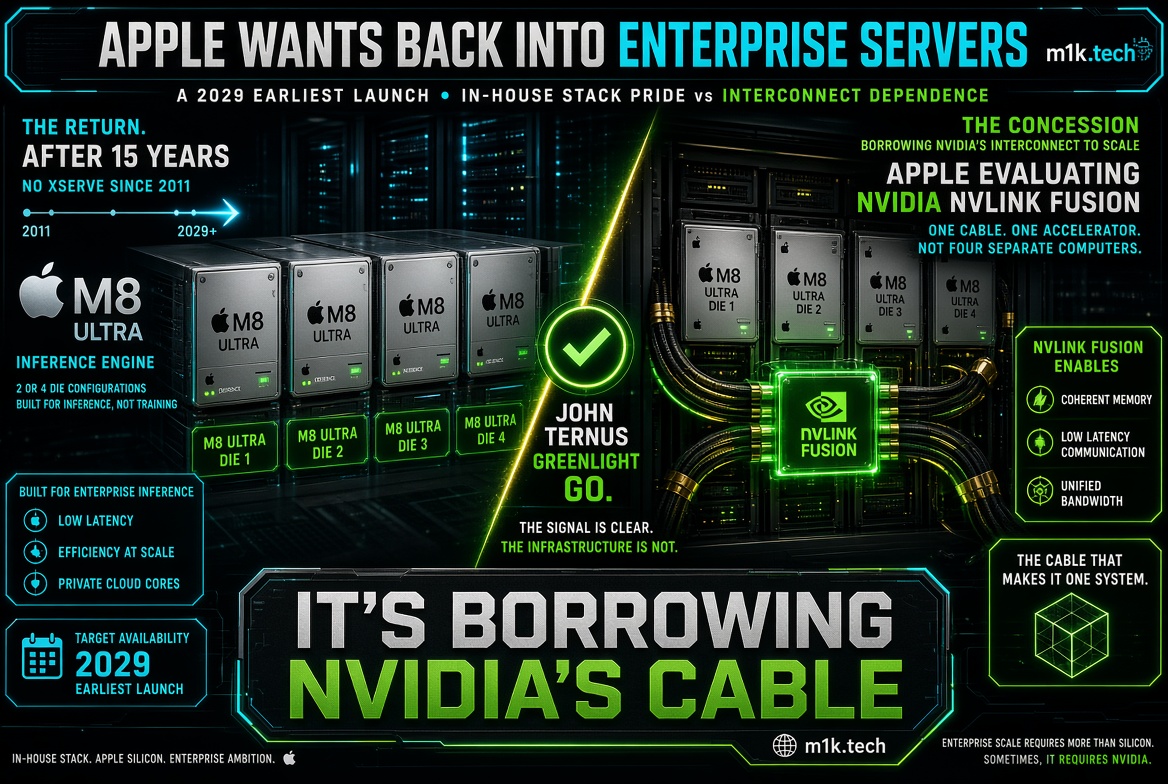
Apple has been out of the enterprise server business for fifteen years, ever since it discontinued the Xserve rack in early 2011 and effectively told IT departments to go elsewhere. The project The Information describes this week wants back in, and what stopped me mid-scroll wasn’t the chip itself; it was that Apple is reportedly willing to build the new server around Nvidia’s interconnect technology to get there.
The plan, per people familiar with the project, ships in two configurations: two M8 Ultra chips wired together, or four. Both versions target inference rather than training, running already trained models rather than building new ones, which tracks with where Apple’s chip architecture has always had its real advantage. The interesting decision is how Apple gets multiple M8 Ultra dies talking to each other fast enough to act like one accelerator instead of four separate computers. Nvidia has already opened NVLink Fusion up to outside silicon, the same interconnect MediaTek picked over the open UALink standard when Nvidia put $3.5 billion into MediaTek convertible bonds, and Apple is apparently evaluating it as the connective tissue for its own chips. A company that has spent two decades building every layer of its stack in-house, silicon and software both, going to a competitor’s networking standard to make its own hardware viable is not a small concession. It might be the only realistic one.
None of this ships soon. The Information’s own timeline puts a launch no earlier than 2029, and the project could still be scrapped, or built without Nvidia’s technology at all if Apple decides the dependency isn’t worth it. What’s kept it alive so far is John Ternus, who took over as Apple’s CEO from Tim Cook on September 1 after fifteen years running the company, and who reportedly greenlit the project about a year earlier while he was still heading hardware engineering. That timeline matters more than it looks. The person who now runs the entire company was already betting on enterprise AI infrastructure before he had the authority to make it happen company-wide.
I don’t think Apple wakes up one morning as a serious Nvidia or AMD competitor in AI training clusters. That’s not the pitch here, and it was never realistic given how far behind Apple starts. What’s actually plausible is something narrower and rather Apple-shaped: AI labs are already buying Mac Minis and Mac Studios in bulk to run computer-use agents, and Apple’s own Mac revenue jumped almost 29 percent last quarter to $10.4 billion on demand nobody was fully modeling a year ago. Apple’s $30 billion Broadcom deal locked in its custom silicon supply chain through 2031 before any of this server ambition became public, which in hindsight reads less like a coincidence and more like Apple quietly building the manufacturing runway for exactly this kind of bet. And Apple is already running DRAM from a sanctioned Chinese supplier through parts of its supply chain, so the company clearly isn’t squeamish about unconventional sourcing when the memory math doesn’t work any other way.
Three years is a long time in this industry, long enough that Nvidia’s own interconnect roadmap could look completely different by the time Apple ships anything, if it ships anything at all. But a company famous for controlling every part of its own stack quietly asking to plug into somebody else’s cable says more about the state of the AI hardware market in 2026 than most product launches manage.
Sources
- The Information, Apple Considers Return to Server Market, Talked to Nvidia About Using Its Network Tech, September 16, 2026
- The Decoder, Apple Is Reportedly Building an Enterprise AI Server With Its Own M8 Ultra Chips, September 16, 2026
- TrendForce, Apple Reportedly Eyes 2029 Enterprise Server Return With M8 Ultra, Nvidia NVLink, September 17, 2026
- Al Jazeera, John Ternus Succeeds Tim Cook as Apple CEO After 15 Years, September 1, 2026