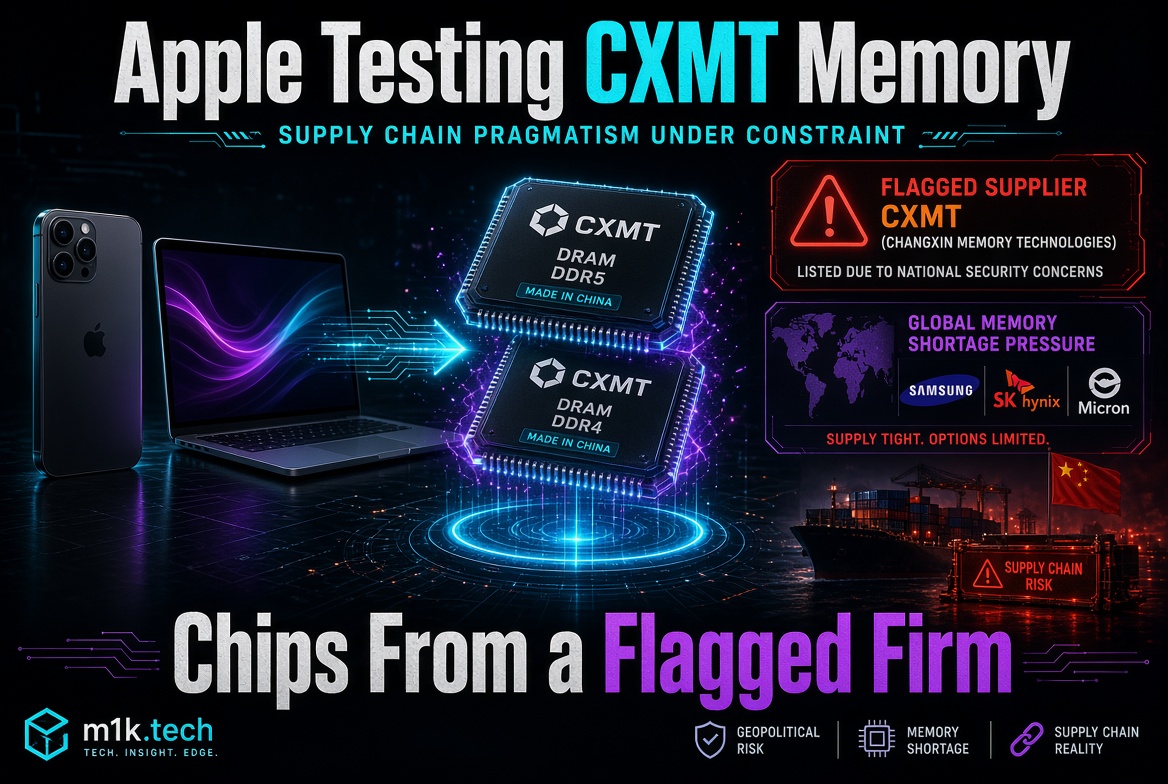
Apple built its reputation over the past decade as the company that doesn’t touch unproven or Chinese-flagged suppliers. So when the Wall Street Journal reported Monday that Apple is testing DRAM chips from ChangXin Memory Technologies for iPhones and MacBooks sold in China, I had to reread it twice. CXMT isn’t just an unproven supplier. It’s the company the Trump administration has specifically flagged as having ties to China’s military, the same category of scrutiny that turned Huawei radioactive in Western supply chains.
This isn’t Apple getting cozy with Beijing for its own sake. It’s Apple running out of better options. The memory shortage that’s been chewing through the entire industry since spring finally reached the one company that usually gets to skip the line by outbidding everyone else for supply. I’ve been tracking CXMT’s ramp for weeks now, watching it push toward LPDDR6 mass production out of its Beijing expansion, and the subtext of that coverage was always the same: this is the company that benefits most when Samsung, SK Hynix, and Micron can’t make enough DRAM to go around. Apple testing its chips is that thesis playing out in real time, at the top of the food chain.
The scope matters here. This is reportedly about devices sold in China, not a wholesale swap of Apple’s global memory supply chain, and that distinction is doing a lot of work. It lets Apple frame this as a China-market localization move rather than a strategic bet on CXMT as a long-term supplier, which matters enormously if US regulators start asking questions. And they will ask questions, because a military-flagged Chinese chipmaker showing up anywhere in Apple’s bill of materials, even for a regional SKU, is the kind of headline that gets a company summoned to testify about something.
What actually strikes me as strange is how unglamorous the reason is. This isn’t Apple making a geopolitical statement or hedging against future export controls, the same regional-hedging instinct that’s got China building its own lithography tools rather than waiting on ASML. It’s a company that got squeezed by the exact price spiral it helped inflate. Apple’s own AI ambitions, and everyone else’s, are part of what’s driving DRAM prices high enough that even Apple is shopping outside its comfort zone. I already watched the CMF Phone 3 Pro get canceled outright because Nothing couldn’t make the RAM math work on a budget phone. Apple has more leverage than a budget Android brand, obviously, but leverage against a global shortage only stretches so far before even the biggest buyer in the room starts looking at suppliers it would have dismissed a year ago.
I don’t think this ends with CXMT chips inside a global iPhone bill of materials anytime soon. The regulatory exposure is too real, and Apple’s brand is built on precisely the kind of trust that a Pentagon-flagged supplier undermines fastest. But testing is not nothing. Testing is Apple’s supply chain team building leverage, both against its existing DRAM vendors and against Washington itself, by proving there’s an alternative even if it’s one Apple would rather not use. The AI memory shortage has already claimed a budget phone. Watching it push Apple toward a supplier the US government considers a military risk tells me the shortage has more room to get uncomfortable before it gets better.
Sources
- Gizmodo, “Apple Reportedly Testing Controversial Chinese Chips as Memory Supply Crunch Intensifies,” Aug 10, 2026: gizmodo.com
- Fox Business, “Apple testing Chinese-made CXMT memory chips in iPhones, MacBooks amid global shortage,” Aug 10, 2026: foxbusiness.com