Qualcomm booked $959 million in automotive revenue for the quarter ending March 2025, and that one line is where years of we-are-more-than-smartphones investor talk finally became a balance sheet instead of a slide. Set it beside the Snapdragon X line taking better than 10% of premium US Windows laptops and you get a company that rebuilt its revenue spine while almost nobody outside the earnings calls was paying attention. Then July 14 happened twice. Malaysia issued its first AI-chip export directive, and Nvidia got cleared to sell the H20 back into China, on the same day. The reason those two belong in the same piece is what they reveal about where Qualcomm sits on the export-control map, which is essentially off it. Its exposure to the whole export-controls apparatus is close to zero, and that is the most underrated thing about the company right now.
The Snapdragon X Elite is the first chip where Qualcomm stopped borrowing Arm’s cores and built its own. Oryon came out of the 2021 NUVIA acquisition, a startup packed with ex-Apple silicon people, and it shows: twelve performance cores, no efficiency cluster, on TSMC N4P, with a 45-TOPS Hexagon NPU. The 45 figure is the one that mattered at launch, because Microsoft drew its Copilot+ line at 40 TOPS and Snapdragon stepped over it while Intel’s Meteor Lake at 11 TOPS and AMD’s Hawk Point at 16 were stuck waiting on an architecture refresh to even qualify.
Premium here means Windows laptops over a grand, a segment that has been an Intel-AMD x86 duopoly for forty years, so any Arm share above single digits there is not a pilot program. It means OEMs paying for Arm-native driver stacks, custom thermal designs, the whole manufacturing tooling chain, none of which Dell or HP funds for a platform they expect to die. Microsoft built it into the Surface Pro 11 and Surface Laptop 7, Dell shipped the XPS 13 9345, and HP, Lenovo, Samsung, and Asus all put machines on shelves. That is supply-chain conviction, not a hedge.
x86 software still runs through Microsoft’s Prism emulation layer, and you pay a tax for it, somewhere around 60 to 80% of native speed on compute-bound work, though the fat memory bandwidth claws a chunk of that back when the bottleneck is bandwidth instead. The native app list has filled in where it counts, Office and Chrome and Photoshop and the rest, but professional creative and engineering tools still have gaps. For the buyer chasing battery life and on-device AI, the tax is apparently acceptable, and that is what the share number is really telling you.
The NPU lead, though, is gone. Intel’s Lunar Lake does 47 TOPS now and AMD’s Ryzen AI 300 hits 50, so the raw-inference bragging rights have evaporated. Qualcomm’s edge has moved to less glamorous ground: memory bandwidth, idle and light-load battery life the always-on heterogeneous design does very well, plus a 5G modem most OEMs solder down and then ship without the antenna to use it. I am a declared Snapdragon Insider, so take this with the appropriate salt, but the honest read is that the platform won on battery, lost on emulation, and that uneven scorecard has held all year.
The $959 million is up about 59% year over year, from roughly $603 million, which brings automotive to close to a tenth of chip revenue, up from a rounding error a couple of years ago. Annualize it and you are looking at a $4 billion run rate. Automotive money behaves a specific way, slow and then suddenly real, because design cycles run three to five years from win to revenue. The cash landing now is cashing in wins booked back in 2020 to 2022.
The platform underneath is Snapdragon Ride, scaling from cheap lane-keep assist up to the Ride Flex SoC that hits 700-plus TOPS in a multi-chip config with ASIL-D safety capability. The win worth watching is BMW’s Neue Klasse, because BMW moved to a centralized zonal electrical architecture, and in that world the ADAS supplier is not selling a camera processor anymore. It is selling the car’s central nervous system. That revenue lands somewhere around 2026 to 2028, well behind the wins already on the books.
Qualcomm does not win the top of the autonomy stack, and it is not trying to. Nvidia’s DRIVE Thor lists 2,000 TOPS and has Mercedes, Volvo, and BYD signed up. Qualcomm’s pitch is consolidation instead, one Ride Flex folding the ADAS, the cockpit, and the connectivity onto a single die, which is a cost-and-integration story that a TOPS spec sheet completely flattens. Mobileye still ships perception-only parts into Ford and VW, and the volume in L2+ and early L3 is exactly where integration and power budget beat brute force. That is the lane Qualcomm picked, and it picked right.
Now the part that is actually new. On July 14, Malaysia’s trade ministry issued Directive No. 1/2025, the first time a Southeast Asian government has written a rule aimed squarely at AI-chip export compliance. It hangs off existing law, the Strategic Trade Act of 2010, which already lets the ministry demand permits for strategic goods and carries stiff penalties, fines in the millions of ringgit and prison time. What the directive does is stretch that machinery over advanced semiconductors that were not explicitly on the strategic-items list before. Export permits for covered chips leaving the country, end-user declarations coming in, re-export notice for anything merely passing through, and a 30-day advance notification before any of it moves.
The reason a transit rule in Kuala Lumpur lands hard is what the US framework did right before it. The Biden administration’s AI Diffusion Rule, finalized in January 2025, sorted the world into three buckets: unrestricted allies, a controlled middle of roughly 120 countries living under a compute cap of about 50,000 high-end GPUs each with a validated-end-user escape hatch, and embargoed adversaries. The Trump administration scrapped the whole tiered structure in mid-May, days before it took effect, and fell back to bilateral deals and entity-list controls. The caps on that middle tier vanished. Enforcement reverted to US end-user verification, which lives or dies on the exporter’s own due diligence rather than the destination country’s plumbing. And Malaysia is not a minor destination. It runs something like 13% of global chip packaging and testing, hosts dozens of semiconductor multinationals, and Intel’s Penang campus is one of its largest assembly-and-test sites anywhere. The fear in Washington is diversion: a chip shipped legitimately to a Penang packaging house and quietly re-exported to a buyer it was never meant to reach.
The line being policed is US export classification 3A090. A chip gets caught once its total processing performance crosses 4,800 on the BIS scale, or 1,600 if its performance density is high enough, and the data-center training parts clear that bar without trying: the H100, the H200, AMD’s MI300X. A Snapdragon X NPU at 45 TOPS is not within two orders of magnitude of it, and nothing in the Ride automotive line is either. Malaysia wrote its directive to mirror the same 3A090 category codes, which tells you it is coordinated with US policy whether anyone says so on the record.
For the packaging houses running these lines, the directive is friction more than catastrophe: end-user checks on outbound shipments, re-export paperwork that did not exist for non-strategic goods, inventory in bonded zones that has to be re-audited. The annual compliance bill runs from a few hundred thousand to about a million dollars depending on how much export-control infrastructure a firm already has, and the big multinationals eat a smaller incremental hit because they already keep the lawyers and the software on staff. The cost is not really the risk. Contagion is the risk, because the moment one node in the regional cluster tightens, Singapore and Thailand and Vietnam start looking like the soft spots and the pressure to match Malaysia builds fast.
On that same July 14, Jensen Huang signaled that the H20, the deliberately throttled China-market Hopper part, was getting cleared to sell into China again. It is the same GH100 die as the H100, loaded with fast memory but tuned down to a sliver of the compute, built specifically to duck the export thresholds, then caught when the rules tightened, then banned, now back. I pulled that teardown apart already, and went into the reversal mechanics separately. So on the exact day Malaysia tightens the screws on high-end chips, Washington loosens them on a China part. Those only look like opposite directions until you notice they are not aimed at the same silicon. The H20 cannot train a frontier model; the H100 and MI300X class that Malaysia’s rule bites on can. Let China have the constrained chip, keep the cordon tight around the real one, and have Kuala Lumpur reinforce that cordon from the side. Read the actual threshold instead of the headline and there is no contradiction here at all, just one policy working both directions on purpose.
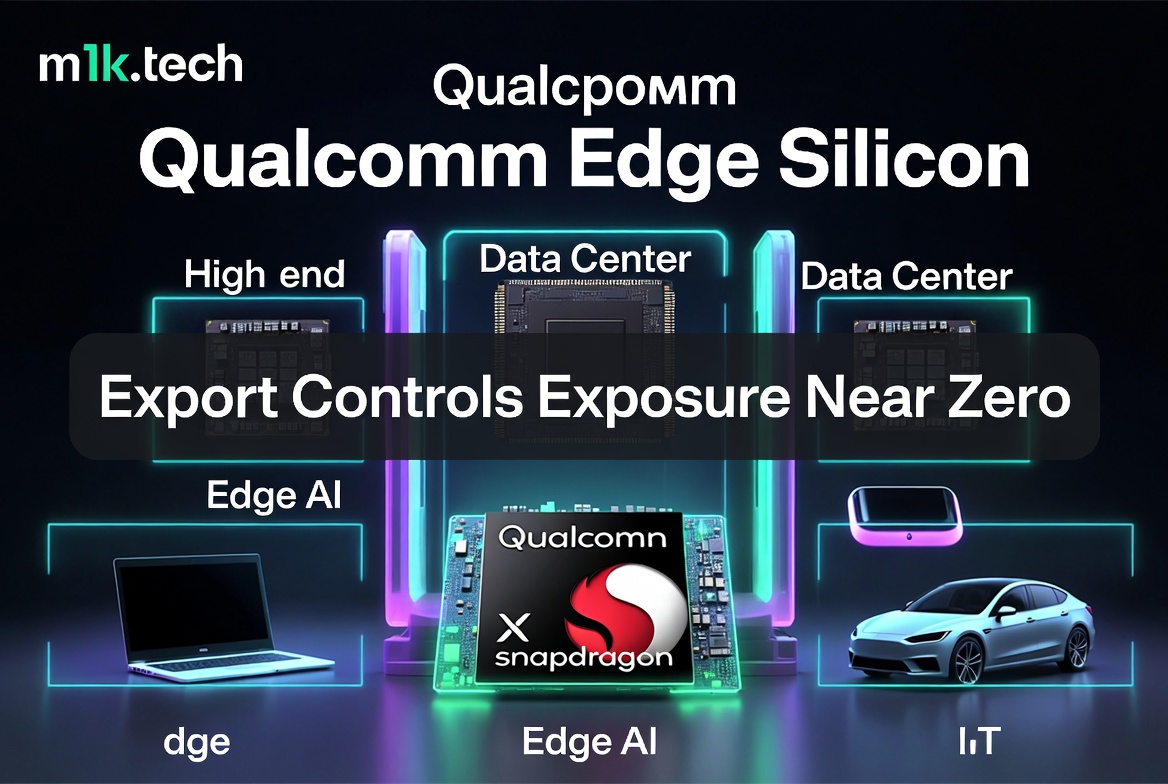
Which is the whole point about Qualcomm. Snapdragon X at 45 TOPS sits two orders of magnitude under the 3A090 trigger, the Ride chips are nowhere near it, and the entire export-control architecture was built to choke off data-center training and large-scale inference. Edge AI on a laptop or a dashboard runs at a scale the regime was never designed to reach, which is exactly where Qualcomm’s real bet lives. So as the data-center supply chain disappears under licensing and declarations and re-export filings, the slice of the market Qualcomm actually competes in stays regulatory-light. That advantage never shows up in a single quarter. It shows up over years, as a cost its high-TOPS rivals carry and it does not.
Going into the July 30 earnings call, three things hold up: the premium-PC share, the automotive run rate, the export-control insulation. What I cannot call yet is whether the Prism tax and the thin professional-app shelf cap how far the laptop story can climb. The geopolitics keep getting scarier, the chips are slower than the keynote says, and Qualcomm somehow landed in the one corner of the market where neither problem reaches it. I keep wanting to call that brilliant strategy. Most of it is just having bet on edge silicon years before anyone knew the regulators would spend the back half of the decade walling off everything stacked above it.