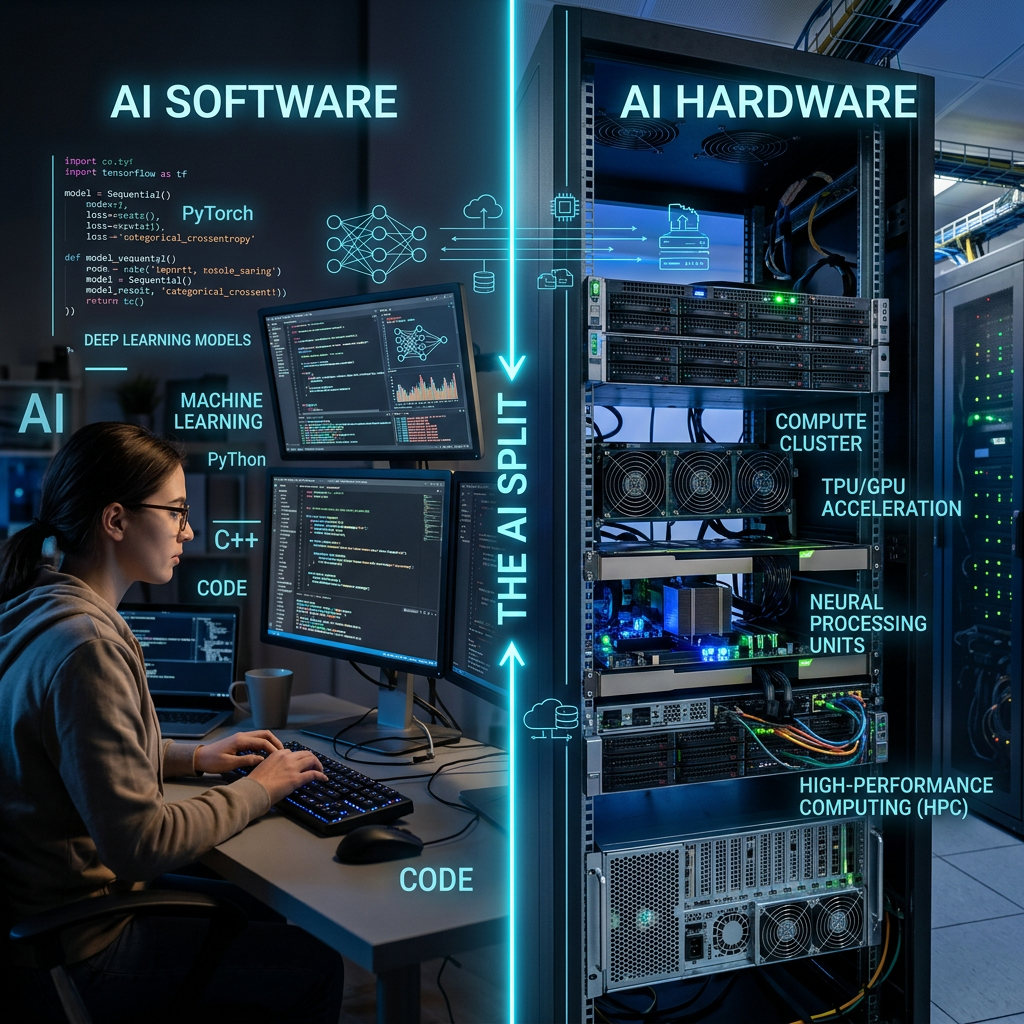
Two AI stories landed this month that look unrelated but map the same split I keep seeing across the industry. Google DeepMind published research on mathematical reasoning that puts AI at a silver-medal level on problems from the International Mathematical Olympiad. Intel, meanwhile, is pushing its Ponte Vecchio GPU accelerator into data centers to compete with Nvidia on AI training workloads. One company is betting on smarter models. The other is betting on faster hardware. Both are right, and the interesting question is where they converge.
DeepMind’s mathematical reasoning push
DeepMind’s work combines large language models with symbolic reasoning systems, notably the Lean theorem prover. This hybrid approach enables the system to parse complex equations and apply rigorous logical steps rather than relying solely on pattern matching from training data. The systems, AlphaProof and AlphaGeometry 2, demonstrated performance at the level of a silver medalist at the International Mathematical Olympiad, solving advanced competition-level problems. That is a meaningful milestone because formal mathematical reasoning has historically been one of the areas where pure LLMs have struggled most.
If this hybrid approach continues to improve, it opens the door to scientific computing, engineering simulation, automated theorem proving, and financial modeling, domains where getting the logic wrong is not an option. Google’s Thompson Center investment in Chicago signals the same thesis from the infrastructure side: the company is building both the AI research and the physical footprint to deploy it.
Intel Ponte Vecchio and the data center fight
Ponte Vecchio is Intel’s answer to Nvidia’s dominance in AI and HPC accelerators. Built on a chiplet architecture with up to 128 Xe-HPC cores and HBM2e memory, it is designed for the same training and inference workloads that the A100 and H100 have dominated. The chip powers the Aurora exascale supercomputer at Argonne National Laboratory, which gives it a marquee deployment but not yet the volume sales that Nvidia enjoys.
The competitive reality is straightforward: Intel entered the AI accelerator market later than Nvidia, and the CUDA software ecosystem remains a powerful moat that raw hardware specifications alone have not yet breached at scale. Ponte Vecchio is a credible chip, particularly strong in HPC workloads. Whether it can meaningfully shift production AI workloads away from Nvidia clusters is the question that 2023 will answer.
The software-hardware split
The pattern that matters is the divergence. DeepMind is investing in algorithmic sophistication, making models smarter per parameter through better reasoning architectures. Intel is investing in compute density and efficiency, making hardware faster per watt. The companies building production AI systems will need both, and the winners will be those who combine smarter models with more efficient silicon.
The Qualcomm keynote at CES 2013 was the first time I saw a chip company pitch itself as a full platform rather than a component supplier. That same logic now applies across the AI stack: the chip alone is not the product, the integrated platform is. Qualcomm understood this a decade ago with Snapdragon. The AI industry is reaching the same conclusion: purpose-built chips need purpose-built reasoning systems on top of them, and vice versa.
We are already seeing this with Qualcomm’s Snapdragon AR2, a chip built specifically for AR glasses rather than repurposed from a phone SoC. The same specialization logic applies to AI accelerators: general-purpose GPUs powered the first wave. The next wave will be purpose-built reasoning systems running on purpose-built silicon, and the organizations that own both sides of that equation will have a structural advantage the rest of the industry cannot easily replicate.