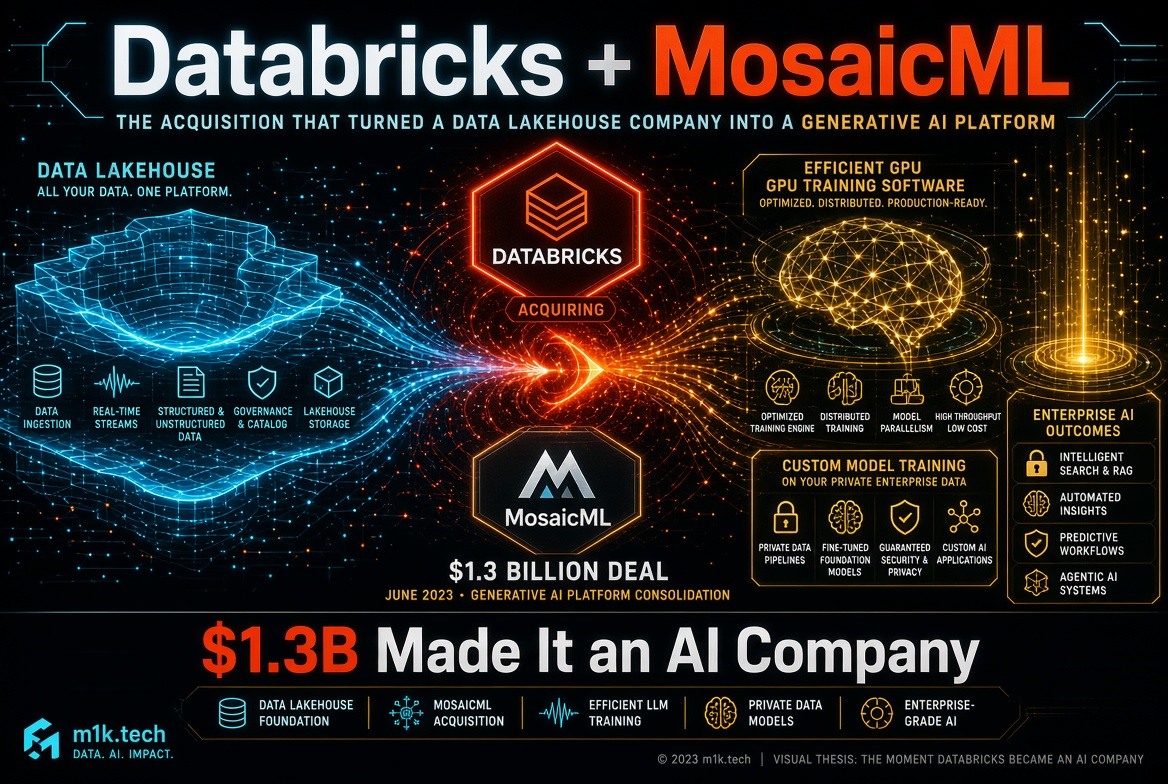
Databricks has announced it is acquiring MosaicML for roughly $ 1.3 billion. It is the largest acquisition in the company’s history, and it marks Databricks’ full commitment to the generative AI era. ChatGPT launched at the end of 2022 and set off the biggest wave of AI excitement the industry has ever seen. Within months, Databricks is spending more than a billion dollars to make sure it is a builder in that wave rather than a bystander. To understand why a data-platform company would pay that much for a relatively young startup, you have to understand what MosaicML actually does.
What MosaicML Is For
MosaicML builds tools that make training large AI models, the kind of models behind ChatGPT and its rivals, dramatically cheaper and easier. This needs unpacking, because the cost of training these models is why the acquisition makes sense.
A large language model learns by processing enormous amounts of text on huge banks of expensive specialized chips, mostly NVIDIA GPUs, for weeks at a time. The bill for training a single frontier model can run into millions or even tens of millions of dollars, mostly in computing costs. That expense puts serious AI model-building out of reach for all but the richest tech giants. MosaicML’s entire pitch is to attack that cost. Its software optimizes the training process so the same model can be trained for a fraction of the usual price, using clever engineering to squeeze far more efficiency out of each expensive GPU hour.
A useful analogy: if training an AI model is like a long-haul flight burning enormous amounts of fuel, MosaicML is a set of techniques to make the same journey on a fraction of the fuel. When fuel is your dominant cost, cutting it by half or more changes who can afford to fly at all. MosaicML lets companies that aren’t Google or OpenAI realistically train their own custom AI models on their own data.
Why This Fits Databricks Perfectly
The strategic logic is almost elegant once you see it. Databricks already has what AI models are hungriest for: data. Its entire platform exists to store, clean, and process the massive datasets that companies accumulate. And training an AI model is, at bottom, the act of feeding it a massive, well-prepared dataset. Databricks has the data and the data-preparation tools. MosaicML has the efficient model-training technology. Bolt them together and you get a single platform where a company can take its own proprietary data and, without it ever leaving the platform, train a custom AI model on it cheaply.
That last point, the data never leaving the platform, is the killer feature for enterprises. Most large companies are deeply reluctant to send their confidential data to an outside AI provider. Their data is their competitive advantage and often legally sensitive. The Databricks-plus-MosaicML combination promises what those companies genuinely want: build your own AI, on your own data, inside your own secure environment, without handing your secrets to a third party. That is a compelling answer to the single biggest enterprise objection to the AI boom.
The Generative AI Pivot
The MosaicML deal reframes what Databricks is. For years it has described itself as a data and AI company, but the AI part has mostly meant traditional machine learning, things like predicting customer churn or detecting fraud. After MosaicML, the AI part means generative AI, the headline-grabbing technology of large language models that can write, summarize, code, and converse. Databricks is repositioning as the place where enterprises build and deploy their own generative AI, not just where they run dashboards and predictions.
This is an expensive bet made fast, and that speed matters. In a gold rush, the companies that win are often the ones that move decisively while everyone else is still deciding whether the gold is real. Spending 1.3 billion dollars within roughly six months of ChatGPT’s launch is Databricks declaring that the gold is real and that it intends to sell the most advanced shovels.
What It Means for the Market
The acquisition sharpens the Databricks-versus-Snowflake rivalry in a decisive new dimension. Both have spent years competing on data storage and analytics. Now the battleground shifts to AI, and MosaicML gives Databricks a clear early lead in helping enterprises build custom generative AI models. Snowflake will have to respond, and the competition increasingly becomes about which platform offers the better path to deploying AI on a company’s own data. Databricks has landed a strong first punch.
It also positions Databricks against a new and different set of competitors: the cloud providers’ own AI services and the AI model companies themselves. Amazon, Microsoft, and Google are all building services to help customers create AI applications, and a wave of AI startups is emerging. By owning both the data layer and an efficient model-training capability, Databricks stakes out a defensible middle ground: the neutral platform where your data already lives and where you can now also build your AI, across whichever cloud you use.
The benefit to customers is the democratization of AI model-building, the same democratization theme that runs through Databricks’ whole history. Just as Databricks once made big-data processing accessible to companies without armies of specialists, MosaicML’s technology promises to make custom AI model training accessible to companies that could never have afforded it before. That promise, made real and made early, is what positions Databricks to ride the generative AI wave rather than be swamped by it. After absorbing a valuation cut in 2022, the company has found the wave it intends to ride.