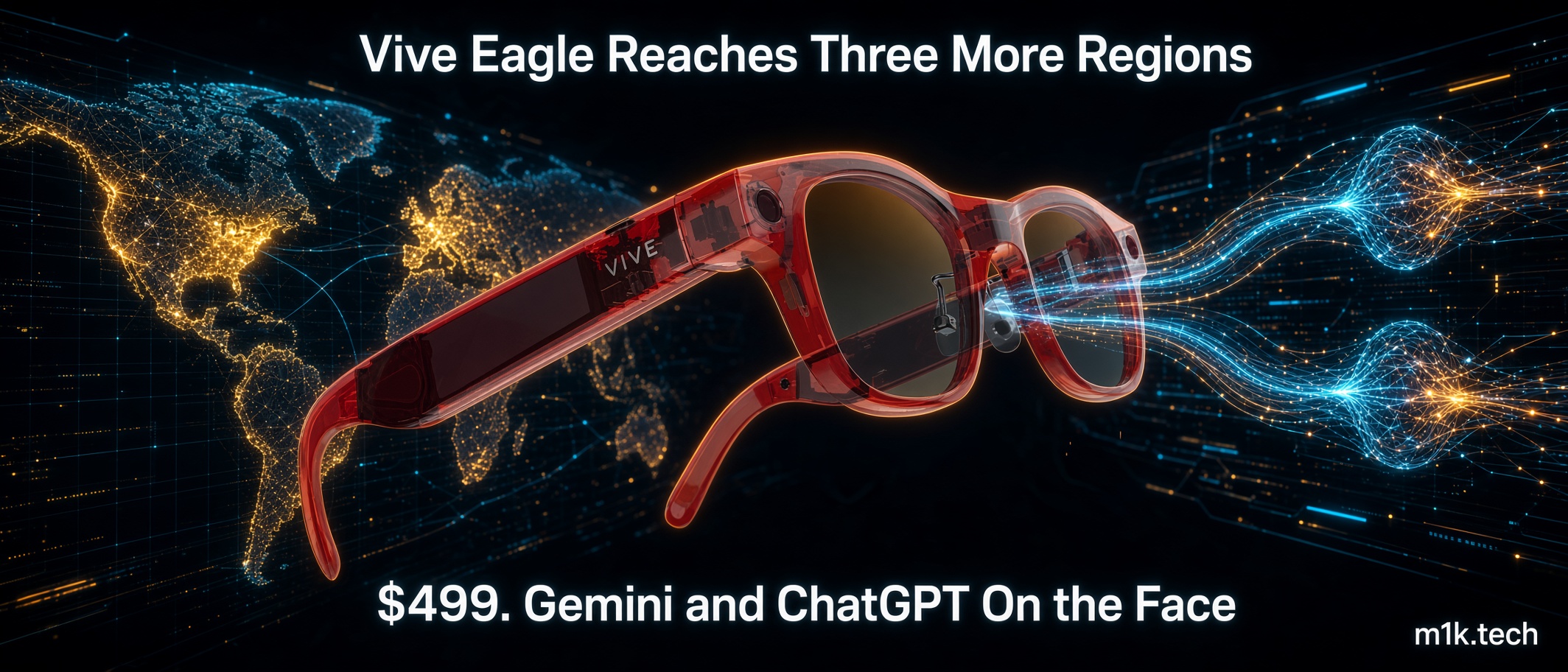
The HTC Vive Eagle started shipping to buyers in the UK and Europe yesterday, a full year after it went on sale in Taipei and two days before Mark Zuckerberg walks on stage in Menlo Park to show whatever pair of glasses Meta has lined up for Connect. HTC could not have picked a louder week to be the quiet option.
The rollout itself isn’t new. HTC announced it at IFA on September 3, US orders shipped immediately, and the wave of “Vive Eagle now available” pieces over the weekend is really the European ship date catching up with the press cycle. Pricing is $499 in the US for the base pair with clear or tinted Zeiss lenses, €469 in Europe and £429 in the UK, with Canada and Australia in the same wave. Photochromic lenses push the US price to $599, and the clip-on Power Boost battery is another $49. The original Taiwan launch in August 2025 went through Taiwan Mobile and the 2020EYEhaus optical chain at NT$15,600, bundled with two years of HTC’s VIVE AI Plus service, and that bundle survived the trip west.
The part I keep staring at is the silicon. The Vive Eagle runs a Qualcomm Snapdragon AR1 Gen 1 with 4GB of RAM and 32GB of storage. That’s the chip Meta put in Ray-Ban Gen 2 back in September 2023, and it’s the same chip Samsung picked for its Android XR eyewear in July. I’ve been around Snapdragon since before it carried that name, and I understand why everybody lands here: the AR1 is a known quantity, the camera pipeline and connectivity stack are mature, and an eyewear ODM can take the reference design and ship. What bothers me is the calendar. Qualcomm announced the AR1+ Gen 1 at AWE on June 10, 2025, with a package 26% smaller, up to 20% less temple height, better power management, dual ISPs, and a third-generation Hexagon NPU that ran Llama 3.2 1B entirely on the glasses in a live demo. The Eagle launched in Taiwan two months later, so its board was frozen long before AR1+ was an option, and I’d forgive that. What I find harder to forgive is spending another year getting the product to the West without touching the board.
That decision leaks into everything else. Without an NPU that can hold a small language model, nothing you’d call AI happens on the frame. Wake word detection and capture live there; every actual question goes out over Bluetooth or Wi-Fi to your phone and then on to Google or OpenAI. Hold that thought, because it comes back when we get to the privacy pitch.
The rest of the spec sheet is the category’s standard kit with a couple of good touches. A 235mAh cell is rated for over 36 hours of standby, up to 4.5 hours of music and over three hours of calls, and the magnetic charger gets you to 50% in 10 minutes and 80% in 23. There’s Wi-Fi 6E, Bluetooth 5.3, IP54, a four-mic array (one directional mic in the bridge, three omnidirectional) and two open-ear stereo speakers in the arms, all in 48.5 to 49 grams depending on frame shape. The 12MP ultra-wide camera in the left hinge shoots 3024 x 4032 stills. HTC’s own spec page lists video at 2176 x 2944 at 30fps, which is where the “3K” line in the marketing comes from, yet Engadget’s review unit was recording 1512 x 2016 vertical clips, with 120fps slow motion at 960 x 1280 and a 10-minute cap per clip. I’d want to know which one is the default before I believed the 3K claim.
| HTC Vive Eagle | Samsung intelligent eyewear | Meta Glasses (entry) | |
|---|---|---|---|
| SoC | Snapdragon AR1 Gen 1 | Snapdragon AR1 Gen 1 | Not stated |
| Camera | 12MP ultra-wide | 12MP Sony IMX681, autofocus | 12MP |
| Weight | 48.5 to 49 g | About 50 g | Not stated |
| Rated battery | 4.5 h music, 3 h calls | Up to 9 h | 8 h |
| Charging case | No (magnetic cable, $49 Power Boost clip) | Yes, about seven extra charges | Yes, up to 40 h extra |
| Assistant | VIVE AI with Gemini or ChatGPT | Gemini, Bixby | Meta AI |
| US price | $499 ($599 photochromic) | Not announced at launch | $299 |
The one structural thing HTC offers that Meta doesn’t is model choice. You pick Gemini or ChatGPT per task through HTC’s own VIVE AI layer, and HTC says requests are de-identified before they reach either company and never used to train its models. Live translation covers 13 languages. There’s a lovely irony sitting in the Gemini half of that menu: in January 2025 Google paid HTC $250 million in cash for part of the Vive engineering team plus a non-exclusive license to HTC’s XR IP, explicitly to speed up Android XR across headsets and glasses. So HTC is now selling glasses that front-end Gemini, eighteen months after handing Google some of the engineers building Google’s own glasses, due in October.
Zeiss is the other partnership doing real work here, with Category 3 UV400 sun lenses, blue-light and photochromic options, and prescription lenses HTC says are easy to fit after purchase. For something you’re supposed to wear all day, that matters more than the NPU generation, and it’s the one area where HTC isn’t behind anyone.
What I can’t get past is the subscription. VIVE AI Plus is free for two years with an eligible purchase, and HTC still hasn’t said what it costs from month 25 or which features stop working without it. On a $499 device whose main differentiator is the AI layer, leaving that blank is a strange choice, and it annoys me more than the old chip does.
Privacy is the whole pitch now, and a good chunk of it is architecture rather than policy language. The capture LED is tied to a light sensor, so covering it stops the recording. The camera won’t record when the glasses aren’t on a face, and if anyone in earshot says “stop recording,” it stops, bystanders included. Notes and transcriptions are AES-256 encrypted and kept on the device, photos and video don’t sync in the background (you join the glasses’ own Wi-Fi network and import by hand), and HTC cites ISO 27001 and 27701 certification. Meta needed two passes to close its own LED loophole, so on paper HTC is ahead.
Then Engadget’s reviewer cut a hook out of the cardboard sleeve the charging cable ships in, hung it a few millimeters in front of the LED, and kept recording. It took him about three minutes. The sensor measures light, not line of sight, so anything that hides the LED from people while letting daylight through defeats it. I laughed, then stopped, because this is precisely the failure critics have been hammering Meta over, and HTC built its Western marketing on being the answer to it. With Meta’s glasses lawsuit now adding bystanders who never bought a pair, “harder to abuse than Meta’s” is a far weaker claim than “can’t be abused,” and HTC’s copy implies the second. Remember the chip, too: every de-identified request still leaves the device, because the AR1 Gen 1 can’t answer anything on its own.
The money side is brutal. Meta held 84% of the display-free smart glasses market in Q1 2026 according to Counterpoint, and its entry glasses start at $299 with an eight-hour rating and a case good for 40 more hours. HTC reported $19 million in revenue for Q2 2026 and an $8.8 million loss. It cannot subsidize hardware the way Menlo Park does, so the $200 premium over Meta’s cheapest pair is the cost of running a small hardware business, not a margin grab. Tomorrow’s keynote could widen that gap, since the reporting points at a camera-free Meta pair codenamed Luna, which lands straight on the privacy ground HTC is trying to claim, the same ground cinemas, courts and Burning Man started fencing off this summer.
Credit where it’s due on the hardware HTC controls. The physical layout, with a power and AI button on the left arm, a capture button on the right and a touchpad along it, beats most glasses I’ve read about that bury everything behind voice. The speakers are tuned for speech, and reviewers describe music as tinny, with the bass either missing or crunchy; open-ear design also means the person next to you hears your calls. Shipping without a charging case in 2026 is an odd omission when both Meta and Samsung include one.
I’m not getting into how GDPR and the AI Act treat a camera on someone’s face in a Paris café. That’s its own post, and it’s the question European buyers unboxing these this week are actually going to run into.
The Vive Eagle is a competent pair of glasses from a company a silicon generation and a year of distribution behind, asking for a $200 premium on the strength of a privacy story that its own packaging can puncture. If Meta shows a cheaper camera-free pair tomorrow, I’m not sure what HTC’s argument is anymore. What I’d actually like to see is an AR1+ refresh that answers a question without phoning Mountain View or San Francisco, because that’s the only privacy claim a cardboard hook can’t beat.
Sources
- HTC, VIVE Eagle specifications
- HTC Newsroom, HTC Announces XR Agreement with Google, 23 January 2025
- Qualcomm, Snapdragon AR1+ Gen 1 Platform
- Engadget, HTC Vive Eagle smart glasses finally come to the west, 3 September 2026
- Engadget, HTC Vive Eagle review: Pricey smart glasses that fail to impress, 15 September 2026
- Digital Trends, HTC VIVE Eagle is ready to fly beyond its home market, September 2026
- Next Reality, HTC Vive Eagle US Price and Specs: Is the $499 Premium Worth It?, 3 August 2026
- VR.org, Meta Connect 2026: Date, Time, What to Expect, September 2026