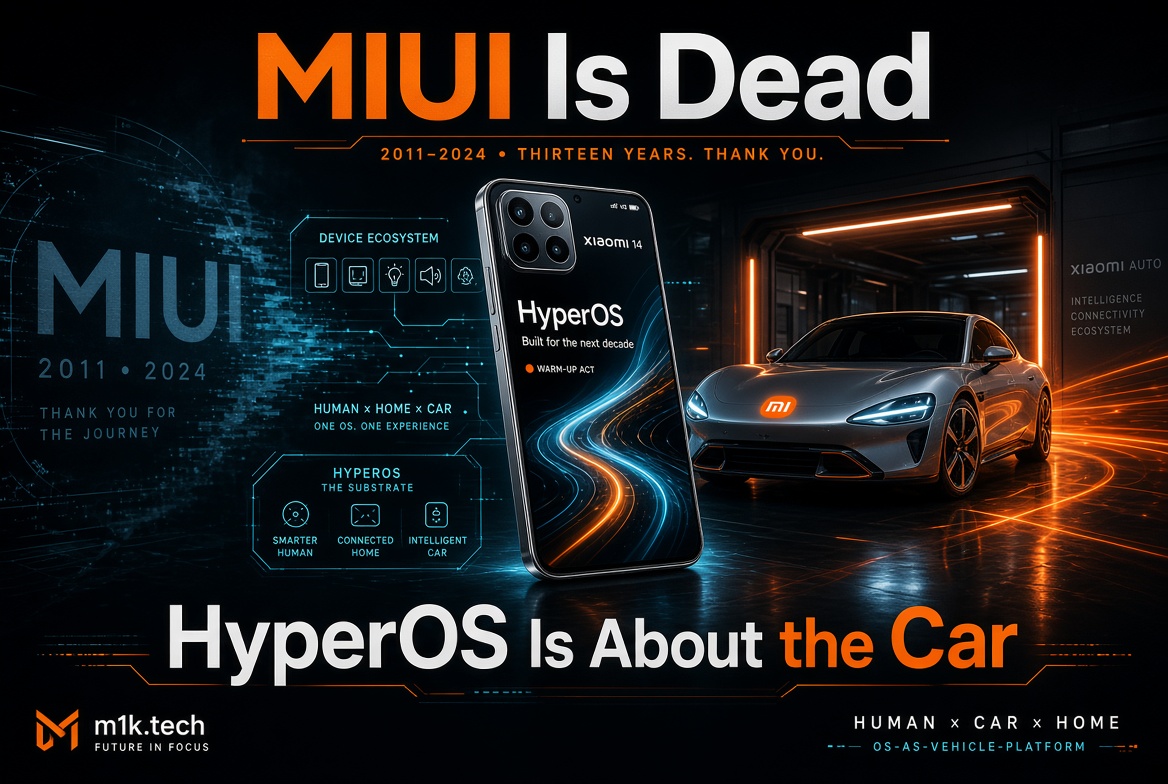
MIUI is dead. Thirteen years after the first ROM that turned a software skin into a community and arguably built the entire company, Xiaomi has retired the name. The replacement is HyperOS, unveiled last week and shipping today on the Xiaomi 14, and the official pitch is the usual lighter, faster, smaller. The actual reason it exists is sitting in a garage.
Technically, HyperOS is still Android underneath, but it folds together MIUI, the Vela system that runs Xiaomi’s IoT gear, and the in-house Mina networking layer into a single architecture meant to run on anything from a phone to a router to a car. Xiaomi says it has been in development since 2017 and now carries the smallest firmware footprint in the industry, and it bolts on a layer called HyperMind that is supposed to act as the brain coordinating the whole device fleet. On a phone that mostly translates to faster animations and a tidier control center, which is not nothing, but it is not the headline either.
The headline is the car. HyperOS only makes sense if you remember that two and a half years ago Lei Jun bet ten billion dollars on building one. An operating system that deliberately spans phone, home, and vehicle is the software substrate for the “Human x Car x Home” slogan Xiaomi keeps repeating, and you do not engineer that unless you are about to ship the third thing in that list. The car still has no price and no firm on-sale date, but the OS that will run it just landed on a phone in my hand. That sequencing is the tell that the car is real and close.
The Xiaomi 14 itself is a tidy little flagship and almost a footnote to its own software. It is among the first phones anywhere to ship Qualcomm’s Snapdragon 8 Gen 3, it keeps the Leica partnership with Summilux-branded glass, and Xiaomi pulled the whole launch forward by more than a month to ride the timing of Qualcomm’s chip reveal. China gets it now; the rest of the world waits until the new year, same as always.
The cynical read, and I have some sympathy for it, is that HyperOS is MIUI 15 wearing a new badge. The leaked betas did not look dramatically different, and on the phone, the resemblance is obvious. But judging HyperOS by how the launcher looks misses what changed. You do not rewrite your kernel architecture to swap a wallpaper. You rewrite it because you need one codebase to drive a fridge, a phone, and a two-ton vehicle off the same foundations, and that is a different kind of project from a yearly skin update.
I will leave the deep dive on HyperMind and the privacy plumbing for another day, because the ecosystem-brain stuff is half real feature and half keynote poetry right now, and I would rather see it run on actual hardware before I grade it.
MIUI built this company, so retiring the name stings more than it functionally matters, and a small part of me is annoyed they did it so quietly. But the timing says everything. Xiaomi did not replace its operating system because phones demanded it. It replaced it because a car needs an OS, and nobody wants their first vehicle booting something called MIUI Auto. The phone just became the warm-up act for whatever rolls out of that garage next.
Related: Five Years Inside the Xiaomi Ecosystem, my history of how Xiaomi built the machine that got it here.