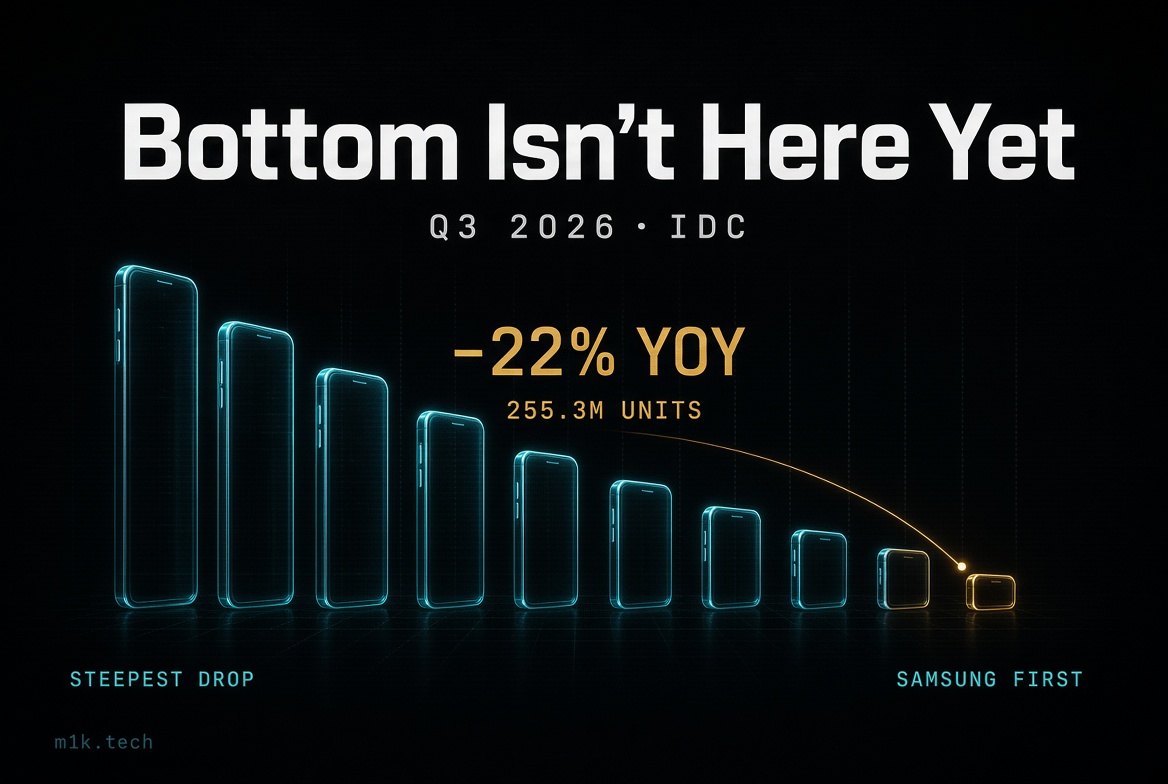
Smartphone shipments fell 22% in the third quarter to 255.3 million units, according to IDC’s preliminary data, the steepest year-on-year drop the firm has recorded in any quarter.
Samsung stayed first with 57.8 million phones and a 22.6% share, and Apple sat 0.5 million units behind at 57.3 million and 22.4%; both gained share. Xiaomi shipped 30.7 million, OPPO 25.6 million, and vivo 19.1 million, and across those three, year-on-year declines ran from 29.2% to 34.5%, with OPPO at the high end.
Half a million units. That is the entire gap at the top.
The cause is the one everybody on this blog has been circling since July: AI datacenter demand has pushed memory costs to levels phone makers can’t absorb, and the makers selling cheaper phones have the least room to hide it. IDC’s own read is that the market hasn’t bottomed out yet, and Omdia’s preliminary numbers point the same way, with a 20% fall versus only 6% the quarter before. When I wrote that the CMF Phone 3 Pro was RAM inflation’s first casualty, I thought of it as one product pulled for one reason. In hindsight, it looks more like an early reading on a gauge that has since gone off the dial. Samsung already put $100 on the Galaxy S26 and warned memory stays tight until 2028, which fits the foldable price rises I covered in July, and memory cost is part of the backdrop to whether Samsung buys the Snapdragon it validated with LPDDR6.
I’d assume the volume loss at Xiaomi, OPPO, and vivo is uncomfortable for Qualcomm too, since those three are big buyers of its mid-range chips, but IDC’s release doesn’t split shipments by chip supplier, so that is my guess, not a number.
IDC’s full-year and Q4 figures come later; I’ll look at those when they land.
Sources
- Fone Arena: Global smartphone shipments drop 22% in Q3 2026 amid memory crisis: IDC, 15 October 2026
- 9to5Mac: IDC: Apple closes in on Samsung as global smartphone shipments see record decline in Q3, 15 October 2026
- Android Headlines: Samsung and Apple Are the Only Brands Gaining Market Share as Smartphone Shipments Crash, 16 October 2026
- Advanced Television: IDC and Omdia Q3 2026 smartphone shipment figures, 16 October 2026