
Google just made Gemini 1.5 Pro generally available in Google Cloud, and the million-token context window is the headline that matters. This is not an incremental LLM update. A model that can ingest an entire codebase, a full legal contract, or hours of video transcript in a single prompt fundamentally changes what enterprise AI can do. Meanwhile, Intel keeps pushing Ponte Vecchio into the Aurora exascale supercomputer deployment while positioning Gaudi accelerators as its real alternative to Nvidia for commercial AI workloads.
What the million-token context window actually enables
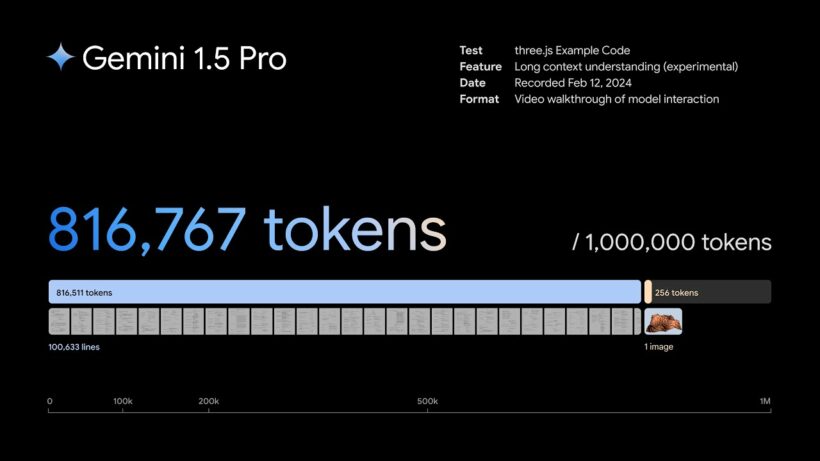
Most LLMs top out at 128K or 200K tokens. Gemini 1.5 Pro offers up to 1–2 million tokens (with the 2M window made widely available after an initial experimental phase), which means you can feed it an entire repository of code, a full-length book, or many hours of audio/video and ask questions about the whole thing. For enterprise customers on Vertex AI, this turns Gemini from a question-answering tool into a genuine analysis engine. A law firm can upload a complete set of contracts and request a conflict check. A development team can paste an entire microservices architecture and ask where the security gaps are. The context window is the constraint that determines what an LLM can reason about, and Google made it an order of magnitude larger than most competitors at launch.
Intel’s AI hardware positioning
Intel is running a two-track hardware strategy. Ponte Vecchio powers HPC deployments like Aurora, where the workload is scientific computing and national-lab-scale simulation. Gaudi 2 and Gaudi 3 target commercial AI training and inference, competing on price-performance against Nvidia’s H100/H200. Intel’s pitch is cost: Gaudi offers competitive throughput at a lower acquisition price, which matters for enterprises that cannot justify Nvidia’s premium.
The challenge remains the same one I noted before: CUDA’s software ecosystem is the moat. Switching from Nvidia to Intel means rewriting inference pipelines, retraining operations teams, and accepting a smaller library of optimized models. Intel is making that switch easier with strong support for PyTorch and TensorFlow, but the friction is real.
The Google Cloud play
Gemini 1.5 Pro on Vertex AI is Google’s answer to Azure’s OpenAI partnership and AWS’s Bedrock marketplace. The differentiators are the long context window and the native integration with Google’s data stack: BigQuery, Cloud Functions, and Looker. For enterprises already on Google Cloud, Gemini is the path of least resistance. For enterprises on AWS or Azure, switching costs are a bigger barrier than model quality.
The cloud AI competition has a direct impact on where European companies land their US operations. The choice of cloud provider increasingly determines the choice of AI model, which in turn determines the choice of underlying hardware. Google, Microsoft, and Amazon are all building vertically integrated AI stacks, and the lock-in gets deeper with every deployment. For European firms evaluating the US market, understanding which stack they are committing to is now as important as understanding the market itself.
The million-token context window is the feature that will define this generation of enterprise LLMs. The hardware race underneath is about who can run that context efficiently. Google controls both sides of Gemini. Intel is fighting for the hardware layer that everyone else needs. And Nvidia, as usual, watches from a position that nobody has yet managed to displace.