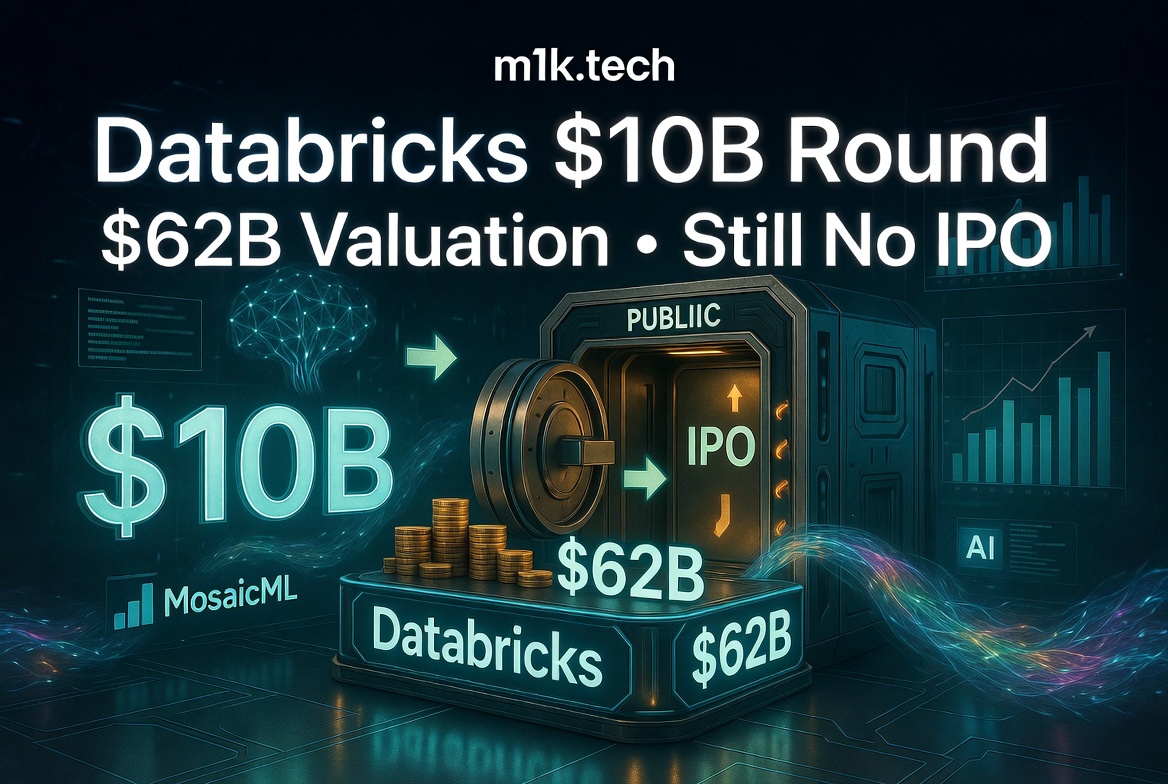
Databricks has closed one of the largest funding rounds in the history of private technology companies: roughly 15.3 billion dollars in total financing, comprising 10 billion dollars in equity and about 5.25 billion dollars in debt, at a valuation of 62 billion dollars. The valuation has jumped from 33 billion in late 2022 to 62 billion, nearly doubling in a little over two years. The MosaicML bet on AI is paying off, the generative AI boom is in full force, and investors are willing to pour staggering sums into the company best positioned to help enterprises build their own AI. The structure of this round, part equity and part debt, is itself worth understanding, because it reveals a lot about how a mature private company thinks about money.
Equity Versus Debt, and Why Use Both
When a company raises money, it generally has two options. It can sell equity, meaning it gives investors ownership stakes in exchange for cash, or it can take on debt, meaning it borrows cash that it promises to pay back with interest. The two have very different consequences, and the choice between them says something about a company’s confidence.
Selling equity dilutes the existing owners. Every new share sold means the founders, employees, and earlier investors own a slightly smaller slice of the company. Debt does not dilute ownership: you borrow the money, you keep your shares, and you owe the lender repayment plus interest. The catch is that debt must be repaid on a schedule, regardless of how the business is doing, whereas equity need not be repaid. Companies typically lean on debt when they are confident in their cash flows and want to avoid diluting ownership. They use equity when they want capital without the obligation to repay.
Databricks raising 10 billion dollars in equity and 5.25 billion dollars in debt is the move of a company that is both growing fast enough to justify selling new shares at a high price and stable enough that lenders are comfortable extending it billions in credit. Using debt to supplement the equity also limits how much ownership the founders and employees have to give up to raise such an enormous sum. It is a sophisticated capital structure, the kind you see from companies approaching the scale and stability of a public corporation, even while choosing to remain private.
What 15 Billion Dollars Is For
The company is explicit about the plan for capital: invest in new AI products, expand its global go-to-market operations (i.e., its international sales and marketing reach), and fund further acquisitions. This is the same playbook from earlier rounds, now executed at vastly greater scale. The AI products investment is about extending the lead the MosaicML acquisition gave it. The go-to-market expansion is about reaching more enterprises in more countries before competitors lock them in. And the acquisition war chest is about continuing to buy capabilities rather than waiting to build them all from scratch.
A round this size also serves an internal purpose: liquidity for employees. Databricks has been private for over a decade, and many of its employees hold stock that they cannot easily sell because there is no public market for it. Huge private rounds typically include mechanisms for longtime employees and early investors to cash out some of their holdings, which matters enormously for retaining talent. If your employees are sitting on millions in paper wealth they can never touch, they get restless. Letting them realize some of that value keeps them committed without forcing the company to go public before it is ready.
Still Choosing to Stay Private
The most striking thing about this round is what it lets Databricks keep avoiding: an IPO. By raising 15 billion dollars privately, the company secures public-company-scale funding while sidestepping the quarterly earnings treadmill, the regulatory burden, and the short-term stock-price pressure that come with being publicly traded. CEO Ali Ghodsi has been consistent that Databricks will go public eventually, but on its own timeline, when it chooses to, not because it needs the money. This round proves the point: when you can raise 15 billion dollars privately, you do not need the public markets for cash. You only go public when the timing suits you.
What It Means for the Market
A 62 billion dollar valuation puts Databricks firmly among the most valuable private companies in the world and confirms that the AI pivot has fundamentally re-rated the business. The market now values Databricks not as a data-analytics company that also does some machine learning, but as a central player in the generative AI infrastructure that every large enterprise is scrambling to adopt. That repositioning, from data company to AI company, is what drives the near-doubling of the valuation.
For the competitive landscape, the sheer size of this war chest changes the calculus against every rival. Snowflake, as a public company, cannot simply raise 15 billion dollars on a whim; it answers to public shareholders and a market price. Databricks can deploy that capital aggressively on AI products and acquisitions without public scrutiny of every quarter’s spending. The cloud giants remain both partners and competitors, but Databricks now has the resources to compete with anyone for the AI-platform opportunity. The benefit to customers is a Databricks investing at enormous scale in exactly the AI capabilities enterprises are desperate for, accelerating the product faster than a more cautious, publicly traded competitor could match. The deep pockets buy speed, and in the current AI race, speed is everything.
And yet, enormous as 62 billion dollars is, the AI boom may not be finished re-rating Databricks. The pressure that has driven the valuation this far shows no sign of easing, and the question now is how much higher the market is willing to go.