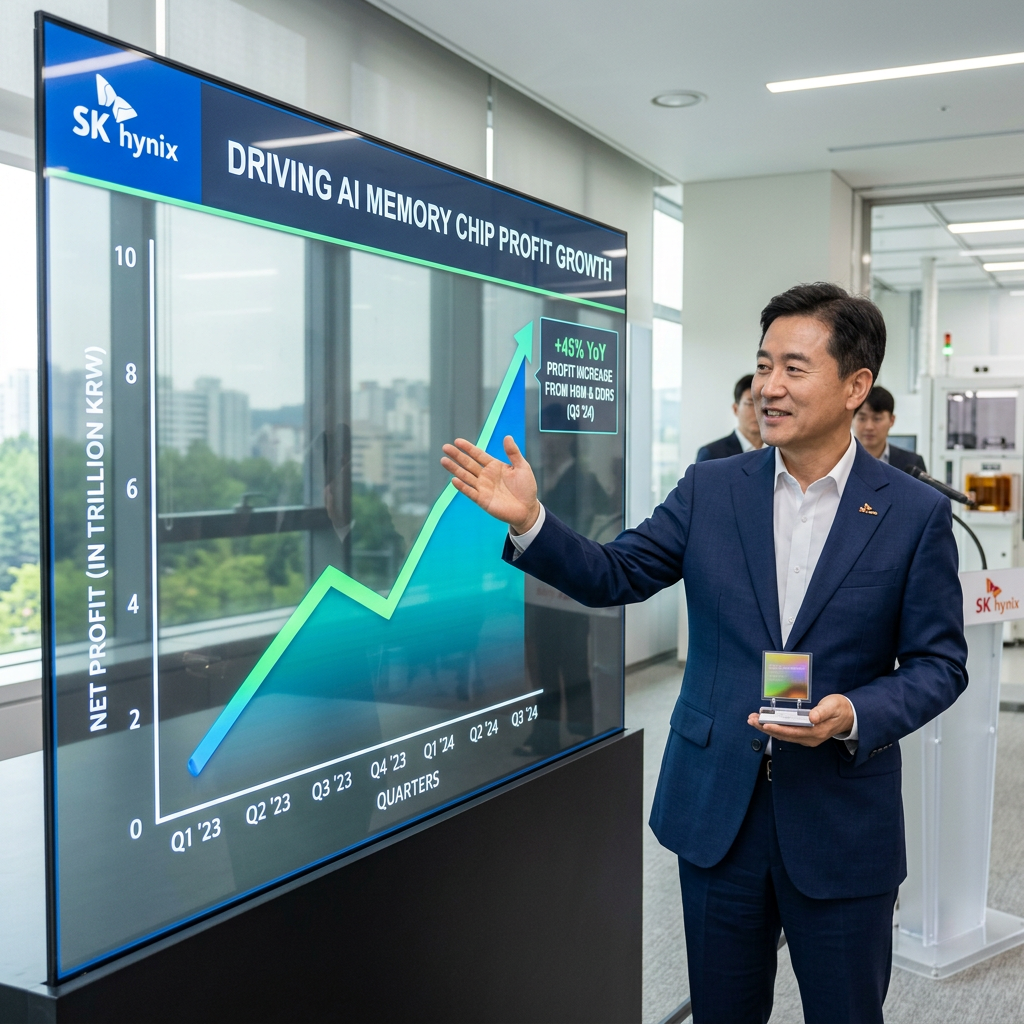
SK Hynix just posted record quarterly and annual profits, and the reason is three letters: HBM. The South Korean memory maker reported strong growth in 2024, with revenues reaching approximately 66 trillion KRW (roughly $48 billion) and significantly higher net profit than the previous year, more than doubling 2023 results in key metrics. The primary driver is High Bandwidth Memory, the stacked DRAM that sits alongside every major Nvidia GPU used for AI training and inference. SK Hynix has been the leading supplier of this memory, and demand continues to outstrip supply.
Why HBM matters more than the GPU itself
Here is the thing most coverage misses: the GPU die is not the only bottleneck in AI compute. Moving data to and from the compute cores fast enough is equally critical. HBM3 and HBM3e solve that by stacking DRAM chips vertically on the same substrate as the GPU (or on an interposer), connected by through-silicon vias that deliver terabytes per second of bandwidth.
- Every H100 ships with 80 GB of HBM3.
- Blackwell GPUs (such as the B200) use significantly more HBM3e memory, typically in the 180–192 GB range across multiple stacks.
SK Hynix supplies the largest share of this memory, which makes it one of the most important companies in the AI supply chain, even though its name rarely appears in marketing.
The financial math is straightforward: while overall DRAM shipments grew, HBM revenue grew much faster because its per-unit price is dramatically higher than that of commodity DRAM. A single HBM3e stack costs far more than a conventional DRAM module. SK Hynix’s ability to manufacture these at scale with competitive yields is a meaningful advantage that Samsung and Micron have been working hard to close.
The supply chain implications
SK Hynix’s strong performance is the flip side of the GPU supply story. When Nvidia talks about being supply-constrained, one of the real constraints has been HBM availability and the advanced packaging capacity (notably TSMC’s CoWoS) needed to integrate it with the GPU dies. These two elements, the GPU and the high-bandwidth memory, are tightly coupled in the final package.
The same memory supply chain supports the broader AI ecosystem, including AI PCs and accelerators. SK Hynix’s dominance in HBM carries geopolitical weight as well. The U.S. and its allies have been pushing to diversify semiconductor supply chains, but advanced HBM production remains heavily concentrated in South Korea. Building meaningful alternative capacity elsewhere would take years and substantial investment.
The company that powers the headlines
The company that rarely makes the headlines is making the component that every headline depends on. SK Hynix’s record results reflect a fundamental reality: AI compute cannot scale without sufficient HBM, and SK Hynix has been the company best positioned to deliver it at volume.