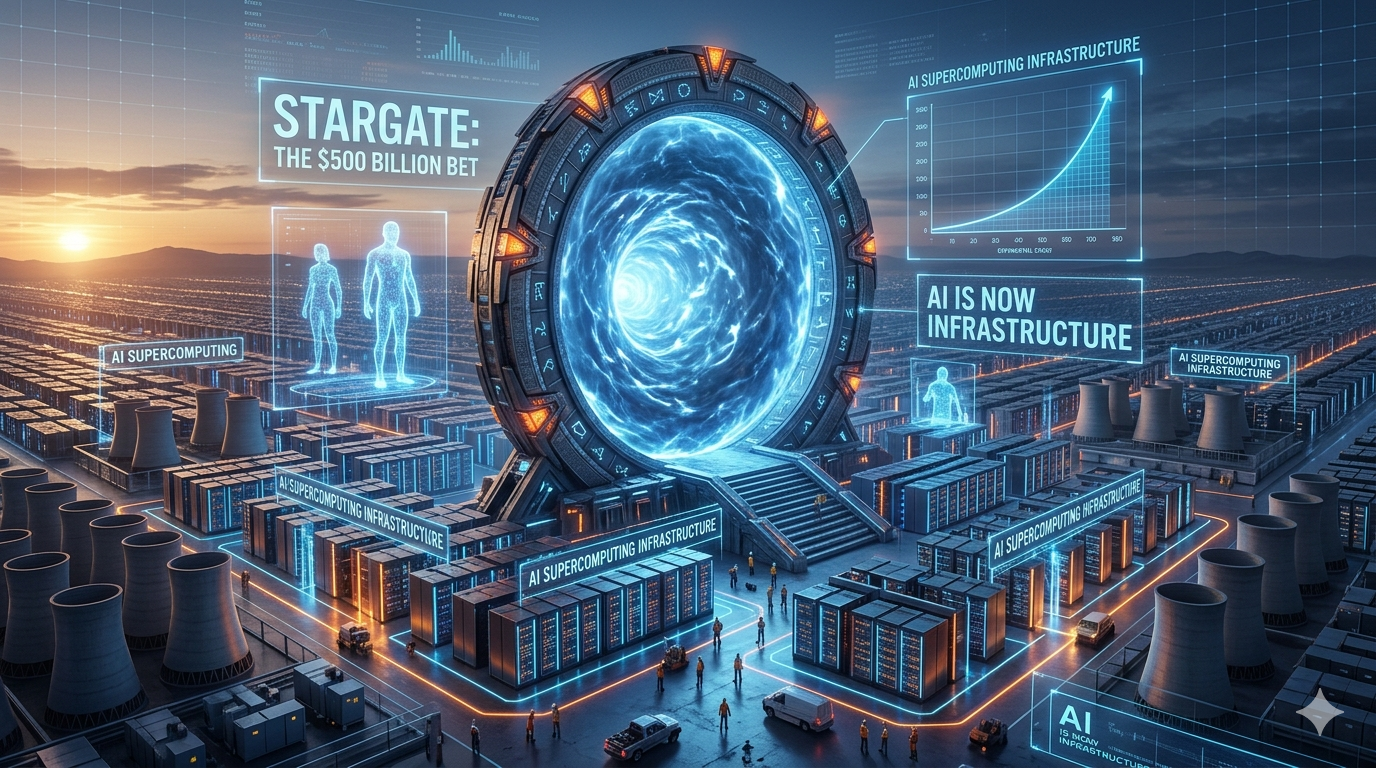
Stargate just turned AI infrastructure from a back-office line item into a White House headline. On January 21, President Trump stood in the Roosevelt Room alongside OpenAI’s Sam Altman, SoftBank’s Masayoshi Son, and Oracle’s Larry Ellison to announce Stargate, a new joint venture that plans to invest up to 500 billion dollars over four years, building AI data centers in the United States, with 100 billion to be deployed immediately. Trump called it the largest AI infrastructure project in history. Whatever you think of the politics or the showmanship, the number alone reframes what we mean by AI.
What was actually announced
Stargate is structured as a new company. The initial equity funders are SoftBank, OpenAI, Oracle, and Abu Dhabi’s MGX, with SoftBank’s Son as chairman, taking on the financial responsibility and OpenAI handling operations. Microsoft, Nvidia, Arm, and Oracle are the key technology partners. The plan: 500 billion dollars over four years, 100 billion of it immediately, to build what Ellison described as roughly 20 data centers, each around half a million square feet, the first of which is already under construction in Texas. Trump put a jobs number on it, over 100,000 American jobs almost immediately, and Altman went further with hundreds of thousands.
There is a nice bit of backstory in the staging, too. Son had already floated a $ 100 billion US investment back in December at Mar-a-Lago, where Trump reportedly pushed him to double it to $ 200 billion. Son’s line at the White House: Now I came back with 500. Whether that is real commitment or a man getting carried away at a podium is exactly the question worth sitting with.
Why this is a turning point
For the last couple of years, the AI story has been about models. GPT this, Claude that, who has the smartest chatbot? Stargate is the moment the conversation visibly shifted from software to physical infrastructure. You cannot run Frontier AI on good intentions; you need buildings, chips, and above all, power. AI leaders have been warning for months that data centers, chips, electricity, and even the water to cool them all would be the real bottleneck. Stargate is the first time that a warning was turned into a half-trillion-dollar plan with a podium and a flag behind it.
And notice the framing. OpenAI said the project would support the re-industrialization of the United States and provide a strategic capability to protect national security. That is not how anyone described a software product two years ago. AI is being talked about the way people once talked about electricity, oil, or the interstate highway system: as national infrastructure, tied to industrial policy and the race against China. Perso, that framing is the real news here, bigger than any single dollar figure. When a technology gets nationalized in the rhetoric, the money and the politics tend to follow.
The healthy skepticism
Now the part I cannot ignore. Five hundred billion dollars is a staggering number, and announcing it is not the same as spending it. A 500 billion commitment over four years, with only 100 billion described as immediate, leaves a lot of room between the press conference and the poured concrete. It was not even immediately clear whether this was a genuinely new venture or a rebrand of plans that had been floating around since 2024, when OpenAI and Microsoft were reportedly already kicking around a 100 billion dollar supercomputer also called Stargate. Big announcements are cheap. Gigawatts are expensive. I would hold the applause until we see how much of this actually gets built, and how fast.
Still, even discounting for the theater, the direction is set. The AI race is now an infrastructure race, and infrastructure is slow, physical, capital-hungry, and political in a way that software never was. C’est a different game from here on. I will be tracking this one closely, because how Stargate actually unfolds, fast, slow, or stalled, is going to tell us whether this whole era is a genuine industrial buildout or the most expensive press release in tech history. The first real answer came in September, when the Abilene flagship went live and five new sites landed.