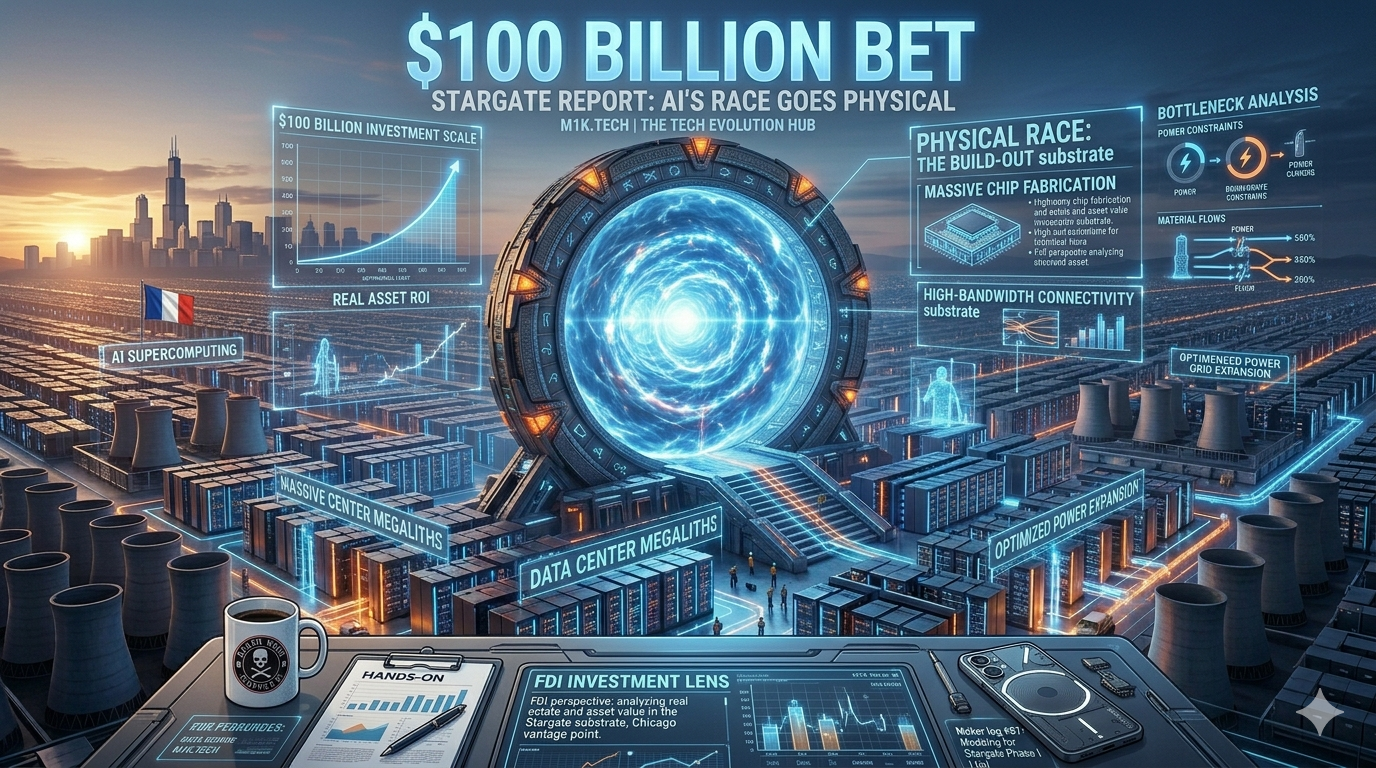
Every so often, a number lands that resets your sense of scale. This week it was 100 billion dollars. According to a report from The Information on March 29, Microsoft and OpenAI are drawing up plans for a data center project that could cost as much as 100 billion dollars, centered on a Stargate supercomputer they have reportedly codenamed exactly that, with a target launch as soon as 2028. To be clear about what this is: a report about an early-stage plan, not an announced product. But the ambition behind it tells you exactly where AI is heading, and it is not toward smarter software. It is toward an enormous physical infrastructure.
What the report actually says
The details, all attributed to people involved in private conversations, are staggering. Microsoft would likely finance the project, which is said to be around 100 times as costly as some of the largest current data centers. The supercomputer would house millions of specialized server chips and could span several hundred acres, drawing up to 5 gigawatts of power. Stargate is described as the fifth and final phase of a five-phase plan to build a series of supercomputers across the US over roughly six years. Microsoft and OpenAI are reportedly in the middle of phase three now, with a smaller phase-four machine targeted for around 2026.
The name, for what it is worth, comes from the 1994 sci-fi film, The Key to the Past, the Door to the Future. A bit grandiose, sure. But 5 gigawatts and 100 billion dollars are the kind of numbers that earn a grandiose codename.
Why this matters more than the price tag
Here is what I want to flag, because I think it is the real story buried under the eye-watering figure. Up to now, the AI race has looked like a software race: better models, smarter chatbots, who has the cleverest assistant? This report is the clearest signal yet that the real competition is shifting to physical capacity. You cannot train and run frontier models without somewhere to put millions of chips, and somewhere to get the gigawatts to feed them. The constraint is becoming concrete, steel, silicon, and above all, electricity.
And notice the detail that should not be glossed over: because of the power needs, the companies have reportedly discussed alternative power sources, including nuclear energy. Sit with that. A software project is now big enough that its planners are thinking about where the electricity comes from, at the level of power plants. That single detail is the tell. When a tech company’s data center plan starts to look like an energy strategy, you are watching a category shift, from AI as an app to AI as infrastructure.
The skeptic’s footnote
Now, the cold water, because this is a report about a plan, and plans are cheap. A $ 100 billion figure attributed to anonymous sources for a facility that would not launch until 2028 is about as speculative as tech news gets. A lot can change in four years; phases can slip, costs can balloon, and partnerships can shift. I would not bet the farm on the specifics. But I would not dismiss the direction either. Even if the number is off and the timeline moves, the underlying logic, that AI now needs a gigawatt-scale, multi-billion-dollar physical buildout, is almost certainly right.
So I am filing this one as a marker. Stargate, today, is a rumor with a great codename. But I suspect we will look back on this report as the moment when the AI infrastructure era stopped being a niche concern for data center engineers and became the main event. C’est the kind of story that sounds outlandish now and obvious in hindsight. And it turned out to be exactly that: less than a year later, Stargate would be reborn as a 500 billion dollar venture announced from the White House. Remember where it started.