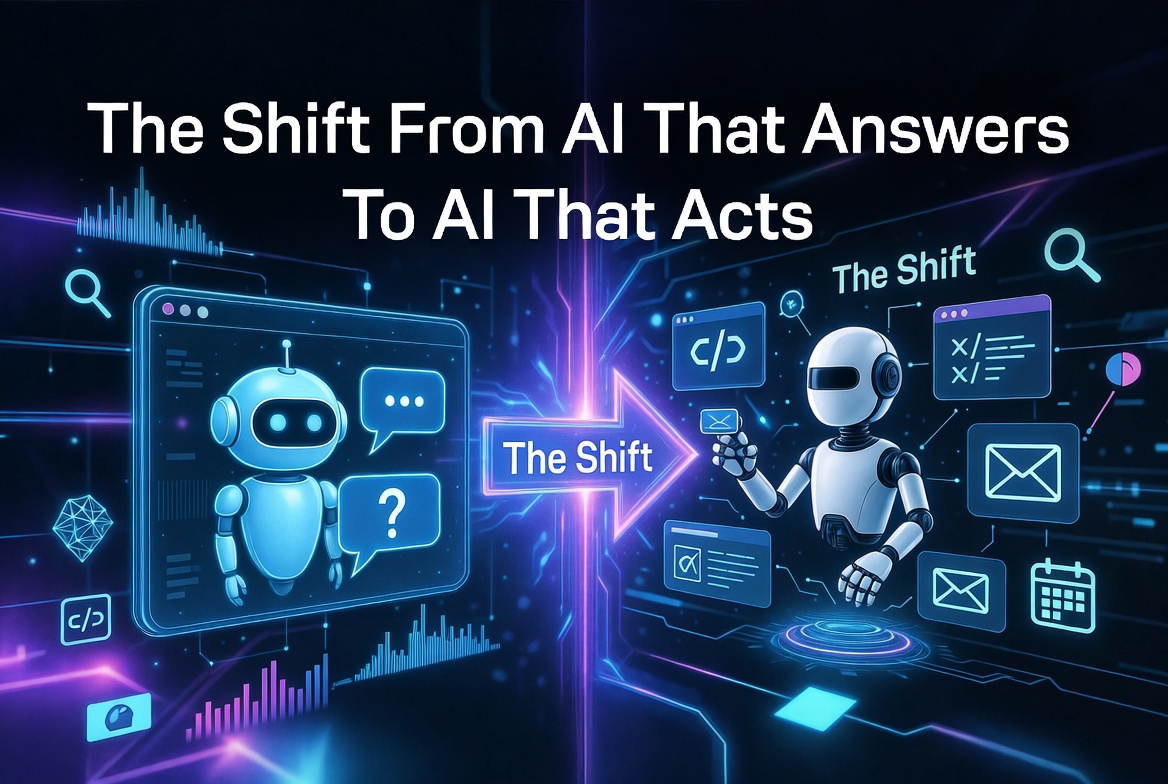
The conversation in AI is shifting from a model that answers your questions to a system that does your work. The buzzword is “agents,” or “agentic AI,” and it represents the next stage in the technology’s evolution. Where ChatGPT and GPT-4 are brilliant responders, waiting for you to ask and then replying, AI agents are designed to take a goal and pursue it across many steps on their own: planning, using tools, checking their results, and iterating until the task is done. This shift from answering to acting is reshaping what enterprises want from AI and, therefore, what data platforms have to provide. Understanding agents explains the entire competitive frame of the current moment.
From Answering to Acting
The difference between a chatbot and an agent is the same as the difference between an advisor and an employee. An advisor answers the question you ask and stops. You ask how to fix something, they tell you, and the doing is left to you. An employee takes the goal and carries it out: they break it into steps, gather what they need, do the work, check whether it worked, and correct course if it did not, coming back to you when the job is finished or when they genuinely need a decision.
An AI agent works like that second model. Give it a goal, say, research our top three competitors and produce a summary. Rather than returning a single response, it plans the work, then executes a sequence of actions: searching for information, reading documents, calling other software tools, writing and revising, evaluating its own output against the goal, and looping until the task is complete. The language model serves as the reasoning engine at the center, deciding what to do next at each step, while the agent framework enables it to actually take those actions in the world.
The Crucial Ingredient: Tool Use
What makes agents genuinely powerful, as opposed to just chatty, is tool use, the ability to call external software to do things the model cannot do on its own. A language model by itself can only produce text. But connect it to tools, a web search, a database query, a calculator, a code runner, an email sender, a calendar, and it can reach out into the world, gather real information, and take real actions. The model becomes the brain deciding which tools to use and when, and the tools become its hands.
Picture a capable assistant sitting at a desk with a phone, a computer, and a filing cabinet. The assistant’s intelligence is necessary but not sufficient; what makes them useful is their ability to pick up the phone, look things up, file paperwork, and send messages. Tool use is what gives an AI agent its phone and filing cabinet. For enterprises, the most valuable tools an agent can use are those connected to their own systems and data, which is exactly where data platforms come into the picture.
Why Agents Raise the Stakes for Reliability
Agents also raise the stakes dramatically, because an agent that takes actions can cause real consequences, not just give a wrong answer. A chatbot that hallucinates wastes your time; an agent that hallucinates might send the wrong email, delete the wrong record, or make a bad purchase. This makes the reliability techniques that ground a model in trustworthy data through retrieval, careful oversight, and guardrails even more essential. It also makes the quality and governance of the underlying data more important than ever, because an agent acting on bad or ungoverned data can do real damage at machine speed.
This is why so much of the current agentic AI effort focuses not just on making agents capable, but on making them safe to deploy: sandboxed environments where their actions are contained, permission systems limiting what they can touch, audit logs recording what they did, and human approval gates for consequential steps. The capability is exciting; the governance is what makes it deployable in a real business.
What It Means for the Market
The agentic shift is redefining the competitive battleground for the data platforms. If AI is moving from answering questions to performing multi-step work using tools and data, then the platform that holds a company’s data and connects it to those agents sits in the most valuable position of all. Both Databricks and Snowflake are moving to position themselves as the foundation for enterprise agents, the trusted, governed environment where a company’s data lives and where agents can safely access it and act on it. The pitch is evolving from be the home of your data and your AI models to be the home of your data, your models, and the agents that act on them.
This is also intensifying convergence with the largest technology companies, because agents require not just data but also reasoning models, tool integrations, and governance, drawing data platforms deeper into competition and partnerships with the cloud giants and AI model builders. The benefit to enterprises is the prospect of AI that not only informs work but also performs it, automating complex, multi-step processes that previously required human labor at every stage. The risks scale up accordingly: an agent acting autonomously on company systems demands far more trust, oversight, and robust data governance than a chatbot ever did, and the consequences of failure are tangible rather than merely informational. The agentic shift makes one thing clearer than ever: in a world where AI acts on data, controlling the data and the governance around it is the most valuable position in the entire stack.