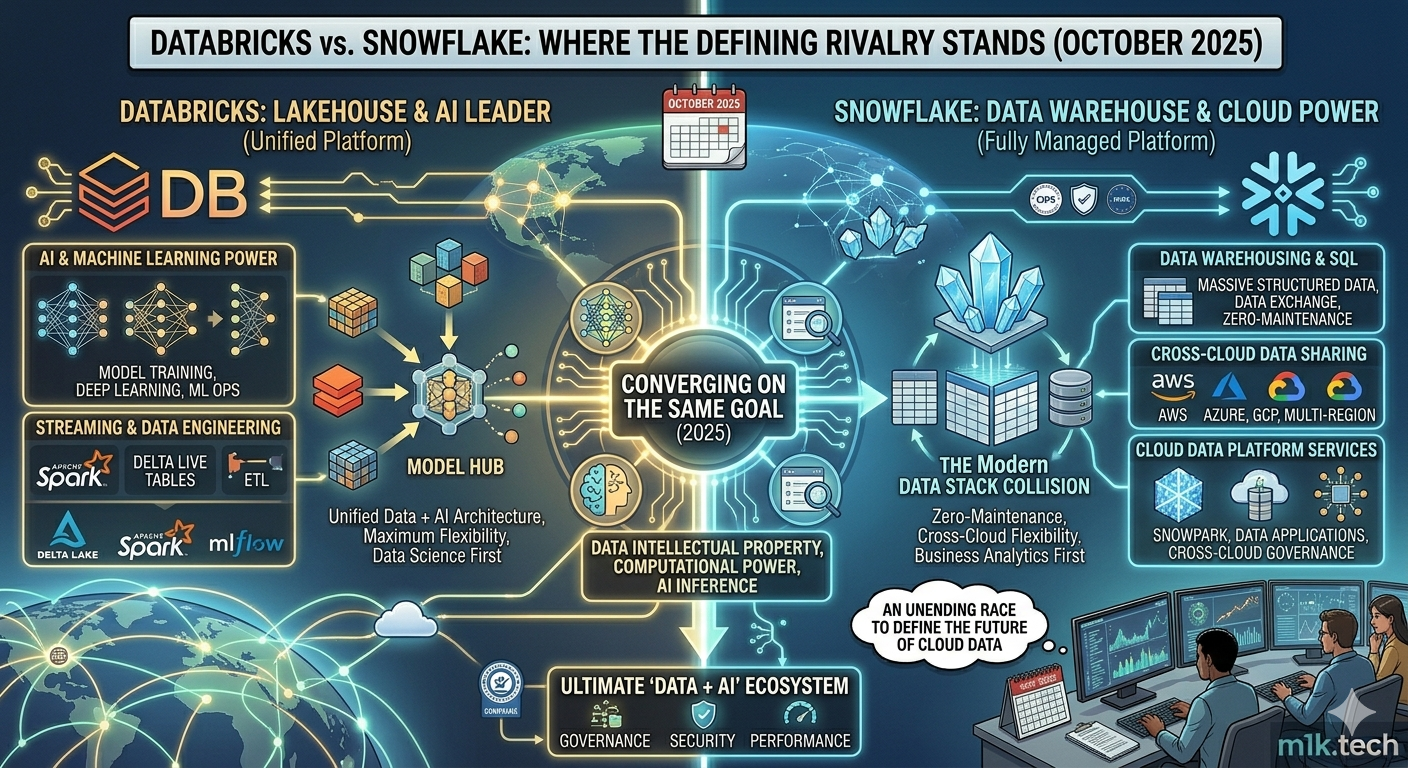
The rivalry that defines the modern data industry, Databricks versus Snowflake, has reached a fascinating and revealing state. The two companies started from opposite ends of the data world: Databricks from data science and machine learning, Snowflake from the structured data warehouse, and they have spent more than a decade converging, each expanding into the other’s territory until they now compete head-on across nearly the whole landscape of enterprise data and AI. It is worth taking stock of where that rivalry stands, because the shape of the competition between these two giants is, in many ways, the shape of the entire modern data industry.
How the Two Converged
The convergence is the heart of the story. Databricks began as the company behind Apache Spark, built for processing messy, large-scale data and training machine-learning models, the natural home of data scientists. Snowflake began as a cloud data warehouse, built for clean, structured, reliable business analytics, the natural home of business analysts. In the early years, they barely competed because they served different people doing different work.
Then each began reaching toward the other. Databricks introduced its lakehouse concept, adding the reliable, structured, warehouse-style analytics that is Snowflake’s stronghold, arguing that a single platform can do both the messy data-science work and the clean business analytics on one copy of the data. Snowflake, on its side, added data science and machine learning capabilities and, after its recent AI pivot, is pushing hard into generative AI, reaching toward the model-building work that is Databricks’ stronghold. Both companies now broadly offer the same promise: a single platform for all of an enterprise’s data and AI needs. They have converged on the same destination from opposite starting points.
Where Each Still Holds an Edge
Despite the convergence, each retains something of its original character, and this shapes how customers choose between them. Databricks, with its deep roots in data science, machine learning, and the open-source AI ecosystem, carries natural credibility in the AI-building conversation, and its early, aggressive moves into generative AI, the MosaicML acquisition, and beyond, reinforce that position. For organizations whose center of gravity is building and customizing AI models on large and varied data, Databricks often feels like the native choice.
Snowflake, with its roots in ease of use and clean, structured analytics, retains a reputation for simplicity and approachability for business analysts rather than only specialized engineers, along with its powerful data-sharing network and marketplace. For organizations whose center of gravity is business intelligence, reporting, and straightforward analytics, with AI added on top, Snowflake often feels like the more natural fit. The two have converged, but they have not become identical, and their different origins still show in their strengths and their cultures.
The Public-Versus-Private Divergence
One of the most striking contrasts is their relationship with the public markets. Snowflake went public in its record-breaking 2020 IPO and lives as a public company, subject to quarterly earnings scrutiny, with a stock price that rises and falls on the market’s mood. Databricks, by contrast, has deliberately stayed private year after year, raising enormous private rounds and reaching a 134 billion dollar valuation, precisely so it can avoid the short-term pressures of public markets while it keeps investing for growth. Two leaders in the same market have made opposite choices about how to finance themselves and whom to answer to. That divergence is one of the most interesting strategic differences between them.
What It Means for the Market
The state of the Databricks-Snowflake rivalry tells the broader story of the data industry’s maturation. The market has consolidated around a small number of dominant platforms, with these two as the independent giants competing alongside the cloud providers’ own offerings. The competition between them has pushed both to build remarkably comprehensive platforms spanning data storage, processing, analytics, machine learning, and generative AI, far beyond what either originally offered. This is the classic benefit of a strong rivalry: each company, pushed relentlessly by the other, builds more and charges more competitively than it would in comfortable isolation.
For competitors, the dominance of these two independent platforms, alongside the cloud giants, makes it hard for smaller players to compete across the full breadth of data and AI, which is why so much innovation happens in narrow specialties that the big platforms then often absorb. For enterprises, the benefit is the existence of two superbly capable, fiercely competing platforms to choose between, each pushing the other to improve, with the cloud giants providing further alternatives. The choice between Databricks and Snowflake is one of the defining infrastructure decisions a data-driven company makes, and the fact that it is a genuine choice between excellent options, rather than a single dominant monopoly, is itself a benefit born of their rivalry. As both companies turn their full attention to the agentic AI era, the contest enters its next phase, with the same fundamental question underneath it that has driven it from the start: who will be the single platform where an enterprise’s data, and now its AI, truly lives. After more than a decade, that question still has no final answer, and the competition to answer it continues to shape the entire industry.