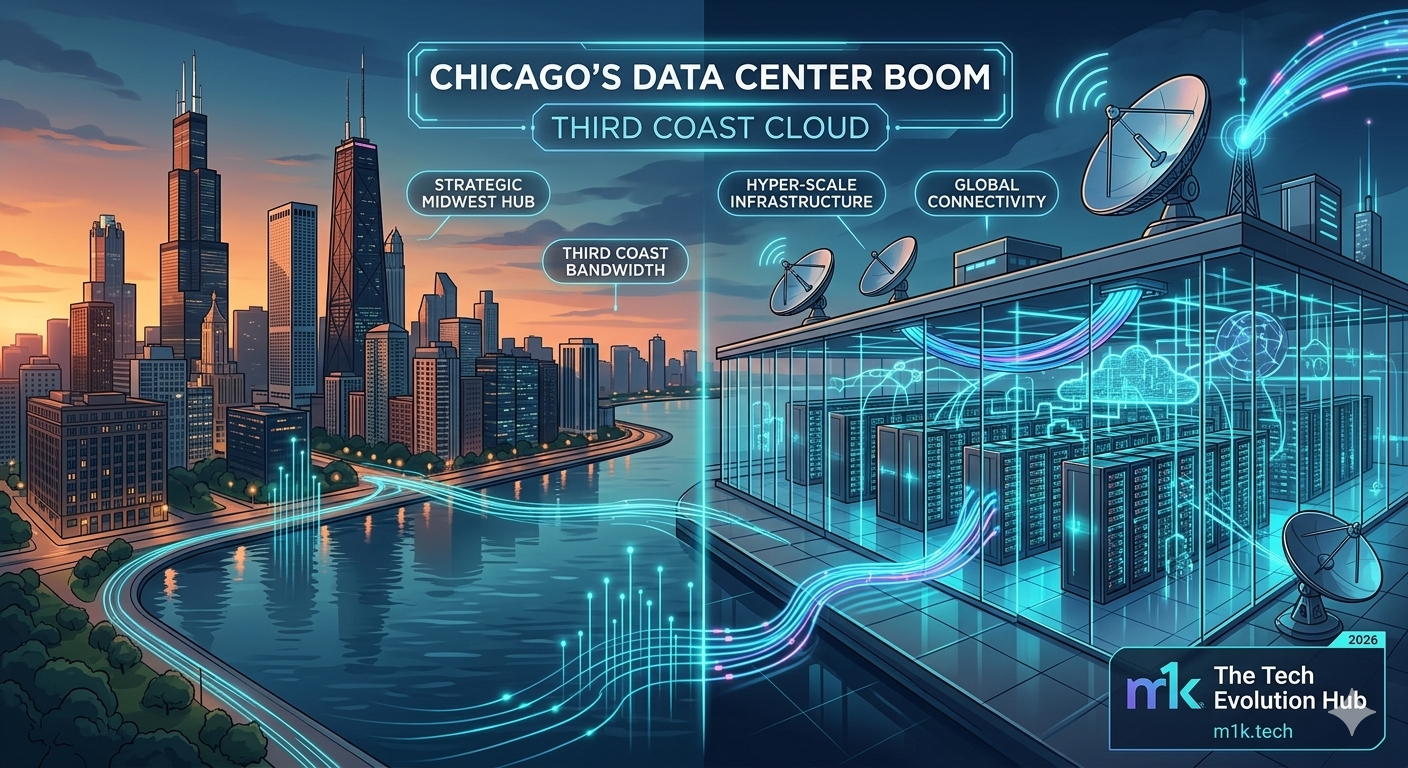
Chicago just became the cloud’s third coast, and almost nobody outside the infrastructure world noticed. The numbers: vacancy in the Chicago data center market hit a record low of 1.9% in 2025, underscoring intense demand for digital services and storage. Rental rates climbed 33% year over year, reflecting the growing competition among businesses eager to establish their presence in this tech hub. More than $11 billion in new-build commitments have landed in Illinois since 2019, underscoring robust investment in infrastructure that positions the state as a leader in technology. As the city’s strategic location and skilled workforce attract numerous tech firms, ComEd is planning for data center load on its grid to jump from roughly 400 megawatts today to nearly 5 gigawatts, the equivalent of five nuclear power plants.
Why Chicago, why now
Two forces collided, creating a significant shift in the data center landscape. First, Northern Virginia, recognized as the world’s largest data center market, has reached its power ceiling, leaving no room for further expansion. Hyperscalers now urgently need alternative locations to build their infrastructure. Chicago emerges as a compelling option due to its abundant grid capacity, extensive fiber backbone, and vast expanses of available land. Additionally, the state offers a valuable sales tax exemption on qualified data center equipment, enhancing the economic feasibility of establishing operations in the area. Second, the unprecedented demand for AI training and inference necessitates enormous computational power. The industry giants involved in this compute revolution, including Microsoft, Google, Meta, and Amazon, require sites capable of providing hundreds of megawatts of energy per campus to support their vast operations. Recognizing this demand, companies like T5, Equinix, NTT, and Edged are rapidly developing facilities that are set to come online in the Chicago suburbs.
The connection to Chicago’s AI story
This is not an isolated infrastructure play. The Aurora exascale supercomputer at Argonne, the Illinois Quantum and Microelectronics Park on the South Side, and the UChicago AI Research Commons all sit inside the same regional compute ecosystem. When a hyperscaler builds a 130-megawatt campus in the Chicago suburbs, it is not just storing data. It is training models and running inference workloads that feed directly into the AI infrastructure the region is building.
Data centers are not glamorous. They do not make good demo videos. But they are the essential physical layer underneath every AI model, every cloud service, and every streaming platform. Chicago is now one of the three most important places in the country for that layer. The tax incentives, reliable power, and fiber network have collectively attracted hyperscalers. Whether the city can convert that infrastructure into a visible AI advantage rather than just becoming a passive host for racks and servers operated by companies headquartered elsewhere is the question that matters next.