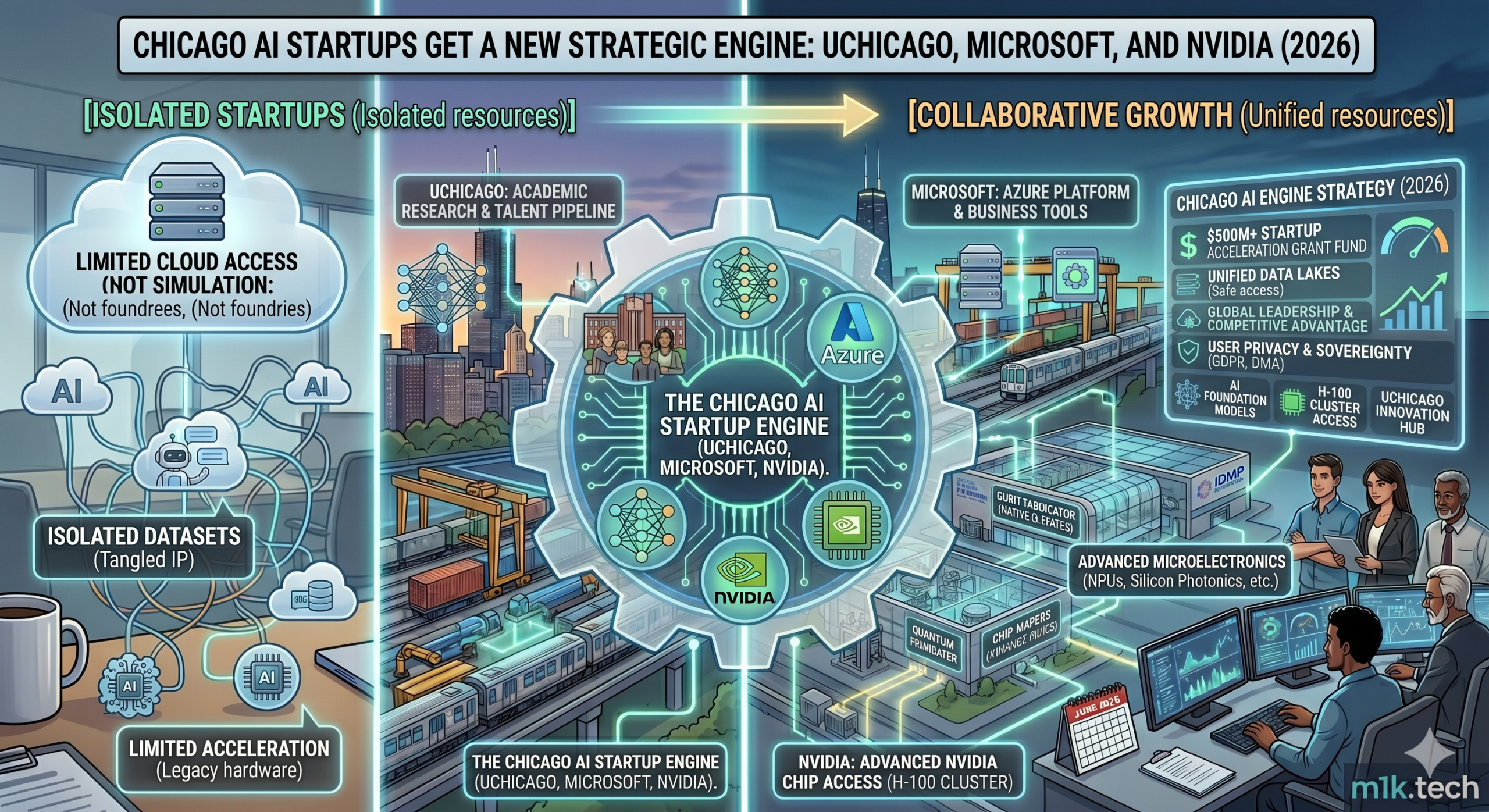
Chicago AI startups just got a serious new launchpad, and it is coming straight out of the universities. For a city that has always been better at producing AI research than at turning it into companies, that is exactly the gap that matters, and it looks like someone finally decided to close it.
What was announced
According to the Polsky Center for Entrepreneurship and Innovation at the University of Chicago, the University has launched the AI Research Commons Midwest Fellows Program, built in partnership with Microsoft and Nvidia, and named its inaugural cohort in May 2026. The pitch is simple and overdue: take AI research coming out of Midwest universities and give the founders the compute, technical guidance, and go-to-market support they need to turn it into a real business. According to Microsoft, its Microsoft for Startups arm is supplying the technology and commercial support, which in plain terms means cloud credits, engineering help, and a sales motion, the three things university spinouts rarely have on day one.
It is not a one-off
This sits atop machinery that UChicago has been quietly assembling. The Polsky Center and the university’s Data Science Institute also launched Transform, an accelerator specifically for early-stage data science and emerging AI startups, housed in a new deep-tech space. Add the long-running New Venture Challenge and the research pouring out of Argonne National Laboratory, and you start to see an actual pipeline rather than a one-time announcement. Research goes in one end, and companies come out the other.
Why this is the piece Chicago was missing
Chicago has never had a research problem. It has had a commercialization problem. The talent and the papers were always here, but too often the company that emerged from the work ended up incorporated in Delaware and staffed in San Francisco. What Microsoft and Nvidia bring to this is the unglamorous part that decides whether a startup survives its first year: compute you can afford, infrastructure that scales, and someone who has actually sold software before telling you how. That is the difference between a promising demo and a company.
The bigger Chicago picture
I have made the AI hub argument before, and this is the part that makes it real. It also rhymes with the quantum park rising on the South Side, which has its own research and workforce facilities baked in. The same playbook keeps showing up across Chicago’s deep enterprise tech base: start with a real research advantage, then build the commercial scaffolding around it to keep the value local.
From where I sit, looking at how regions attract and keep investment, this is the right instinct. The hard part is not announcing a fellowship; it is retention. The real scoreboard, three years from now, is simple: how many of these companies are still headquartered in Chicago, hiring in Chicago, and paying taxes in Chicago. Give founders compute, a customer pipeline, and a reason to stay, and some of them will. That is how a hub is actually built: one company at a time.