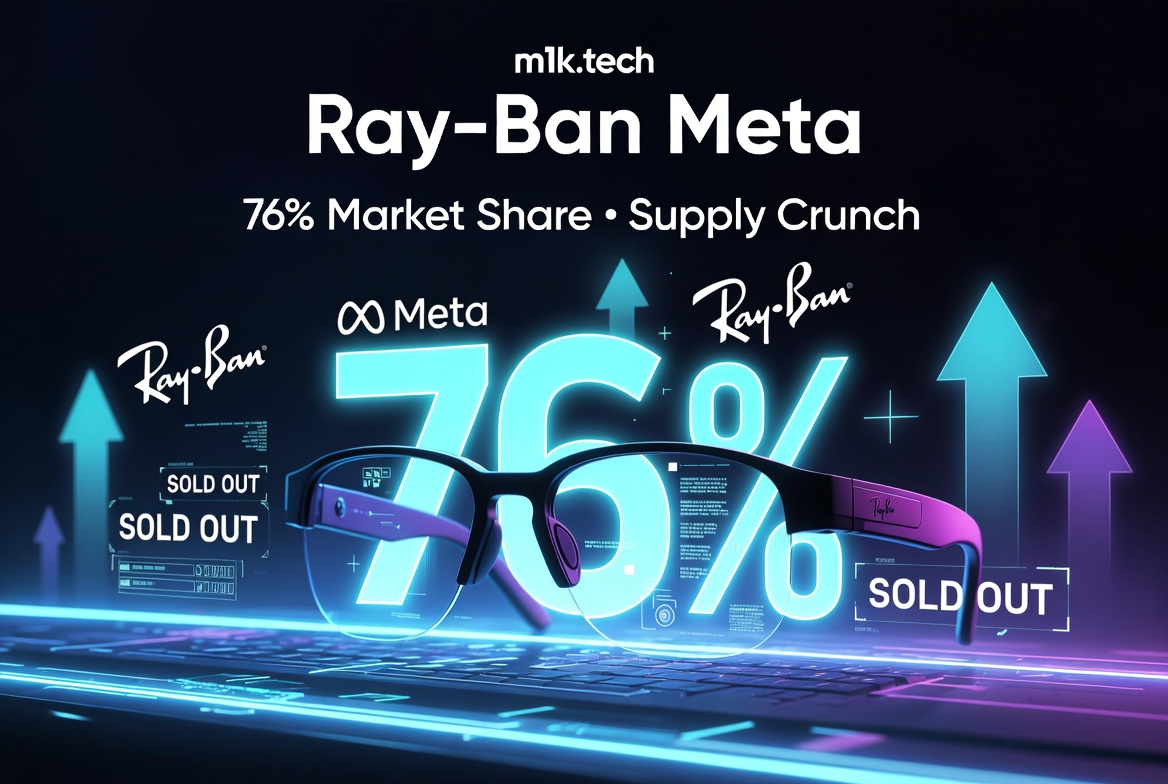
Ray-Ban Meta smart glasses hold 82% of the global smart glasses market as of H2 2025, with 7 million units sold that year and roughly 9 million cumulative since launch. Demand has outpaced supply, delaying the international rollout to prioritize US orders.
Competitors including Google, Snap, and Samsung are entering the market with their own platforms. FCC filings point to new Ray-Ban Meta hardware, likely powered by Qualcomm’s AR1+ Gen 1 chip, while Meta’s partnership with EssilorLuxottica and its fashion-first approach remain significant structural advantages.
Meta has a problem nobody in XR has ever had before: too much demand. The Ray-Ban Display launched in the US last fall, and the waitlists have stretched well into 2026. Meta is delaying its planned international rollout to the UK, France, Italy, and Canada to prioritize fulfilling domestic orders. The company that spent years trying to convince people to put a screen on their face now cannot make them fast enough.
82% market share and a supply ceiling
The numbers tell the story. Counterpoint Research put Meta’s share of the global smart glasses market at 82% in H2 2025, with EssilorLuxottica confirming 7 million units sold in 2025 alone and roughly 9 million cumulative since the October 2023 launch. EssilorLuxottica is ramping manufacturing capacity. Meanwhile the product keeps evolving through software: CES 2026 brought a teleprompter mode, gesture-based writing, and expanded pedestrian navigation to more US cities. Software is moving faster than hardware can refresh.
The competitive landscape tightens
Google is building AR glasses on Android XR. Snap has announced Specs for commercial availability. Samsung’s Galaxy XR headset is already on the market. FCC filings have surfaced for two new Ray-Ban Meta models codenamed Scriber and Blazer, moving from the RW40xx series to RW7000, which suggests a meaningful hardware refresh rather than an incremental update. Qualcomm’s AR1+ Gen 1, announced at AWE 2025 with 26% smaller packaging and on-device small language model support, is the likely engine for whatever comes next.
The trend for the year ahead
Meta has turned smart glasses from a curiosity into a supply-constrained consumer product. The question is no longer whether people want AI on their face. It is whether Meta can manufacture fast enough while Google, Samsung, and Snap line up with their own platforms and distribution.
From the partnership announcement to the deliberately modest first generation to the AR1-powered second generation to a display tier and now a supply-constrained global product: the patient, fashion-first strategy worked. The next test is whether the AR1+ and Gen 3 can maintain the lead when real competitors arrive with their own silicon. The EssilorLuxottica moat is deeper than most appreciate, because making glasses people genuinely want to wear is hard, and Meta has a five-year head start on that problem.
Part of Two Decades of XR, my running diary of virtual, augmented, and mixed reality.